ARTICLE
SFDR 2.0: Why data becomes the new competitive edge

Bloomberg Professional Services
- The new rules will take time, with amendments likely as the European Parliament and EU Member States negotiate the final text before SFDR 2.0 takes effect.
- The SFDR overhaul aims to restore trust by ensuring that sustainable fund labels are accurate and meaningful. Overall, data quality expectations are rising as investment managers must demonstrate their investment approach, validate exclusions, and justify selected product-level PAI indicators.
This article was written by Murat Bozdemir, Product Manager for Regulatory and Sustainable Finance Data Solutions and Maria Elena Sandalli, Manager for Regulatory Affairs at Bloomberg.
The EU’s new Sustainable Finance Disclosure Regulation (SFDR) 2.0 fund labels are set to reshape the European sustainable fund landscape, with capital expected to shift toward sustainability strategies backed by transparent, easy-to understand labels. At the same time, the new rules are raising the bar for data quality expectation, an evolution investment firms should pay close attention to.
A new sustainable fund landscape
Our analysis of the impact of the new rules shows a subtle but important shift ahead. Under SFDR 2.0, the number of funds under the new Article 8-equivalent category will likely drop compared with SFDR 1.0. In contrast, sustainable (Article 9-like) funds are expected to grow, and a brand-new category focused on transition strategies is entering the market with momentum, with more than 200+ funds already fitting the criteria.
Provisions like grandfathering closed-end funds and ‘short-cut’ rules for Taxonomy-aligned portfolios will also have some impact. Today, by Bloomberg’s own calculations, only a small portion of Article 9 funds meet the 15% EU Taxonomy alignment threshold, which can be used to qualify for the proposed Sustainable and Transition product categories under SFDR 2.0. But with the Corporate Sustainability Reporting Directive (CSRD) and European Sustainability Reporting Standards (ESRS) continuing to make EU Taxonomy reporting mandatory, adoption is likely to accelerate in the future.
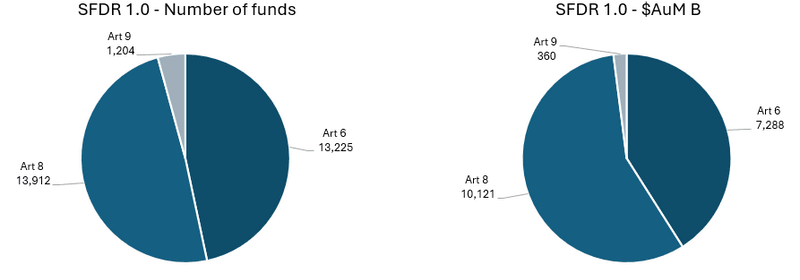
SFDR 1.0: Number of funds and AuM. Source: Bloomberg data
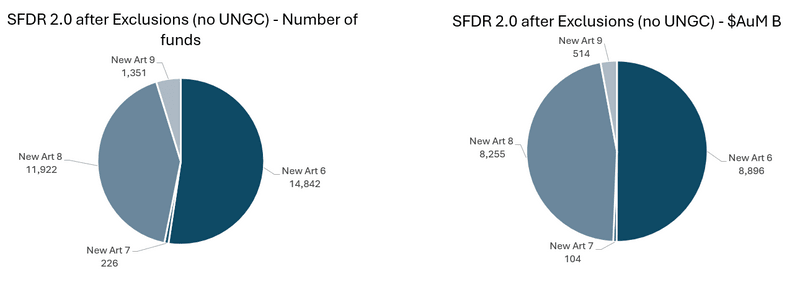
SFDR 2.0: Number of funds and AuM. Source: Bloomberg data
To perform this analysis, we mapped the transition from SFDR 1.0 to SFDR 2.0 by reclassifying existing Article 6, 8, and 9 funds into the new Article 6, 7, 8, and 9 categories based on naming, isolating ‘transition’, ‘sustainable’ and ‘impact’ strategies. We then applied SFDR 2.0 aligned Paris Aligned Benchmark exclusions using fund look-through to test which funds would qualify, excluding UN Global Compact and OECD violations where no regulatory threshold has been defined.
Why the EU reopened SFDR
SFDR 1.0 fundamentally reshaped the market, helping drive sustainable European assets to $17.7 trillion in 2025 according to Bloomberg data. The rules sparked innovation, with investors re-engineering sustainability strategies, rebranding products, and adapting to new regulatory realities. Despite its shortcomings, the framework was catalytic.
However, while so-called “light-green” Article 8 funds kept expanding, so-called “dark-green” Article 9 funds continued to struggle. The market also faced challenges with insufficiently clear concepts, as well as dense, complex and hard-to-compare disclosures, which the market treated as labels; this created confusion, inconsistent application, and heightened greenwashing risks.
What is changing for investors
On November 20, 2025, the European Commission proposed a major overhaul of the SFDR, as part of the EU’s wider effort to simplify and align its sustainable finance regime to create clearer, more usable regulation for investors.
One of the biggest changes is the removal of Articles 8 and 9, which are replaced with three formal product categories: Transition, ESG Basics, and Sustainable. In addition to these labels, the regime introduces new criteria, minimum investment thresholds and strict exclusions (see table below.)
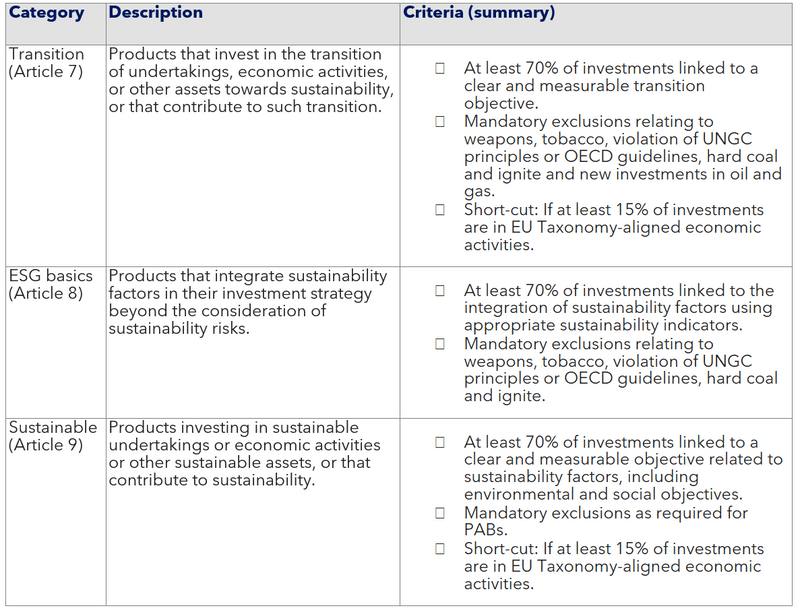
The definition of “Sustainable Investments” and the embedded “Do No Significant Harm” principle have been removed and replaced by a new system relying on quantifiable thresholds and exclusions. Across all new labels, at least 70% of assets must align with the stated strategy.
Another innovation concerns fund-of-fund investments, as SFDR 2.0 explicitly states they can apply one of the new categories if they meet the relevant 70% threshold, by investing in categorized products or in other investments that themselves meet the requirements.
SFDR 2.0 also introduces a formal concept of ‘sustainability-related financial product with impact’. This may be used by new Article 7 or Article 9 products whose objective is the generation of a pre-defined and measurable social or environmental impact.
Why data becomes the new competitive edge
While the removal of firm-level Principal Adverse Impact (PAI) disclosures reduces the reporting requirements for firms, it heightens the focus on product-level transparency. This means the bar is rising for data quality and disclosures, particularly for Transition and Sustainable funds, where product-level specific PAI indicators and certain exclusions are mandatory.
Recognizing that data gaps are unavoidable, SFDR 2.0 mandates greater transparency on the use of estimates and third-party data. Investors must document their methodologies and arrangements with data providers, boosting reliability and auditability.
To proactively manage these new requirements, investors may wish to review their existing data sourcing processes and assess data providers with a focus on consistent data feeds, established governance and data quality controls supported by transparent methodologies.
Explore our solutions here or request a demo.