ARTICLE
Trump’s Iran nuclear deadline has energy market on edge

Functions for the Market
- Brent crude surged as much as 13% after US and Israeli strikes on Iran all but halted tanker traffic through the Strait of Hormuz, with Citigroup projecting oil will trade in the $80-to-$90-a-barrel range over the coming week.
- Iran retaliated with strikes on US bases, Gulf neighbors and oil tankers, while Saudi Aramco shut its largest refinery and Qatar halted the world’s biggest LNG export facility, sending European gas prices up more than 50%.
- JPMorgan estimates a 25-day halt to Hormuz traffic would fill producer nations’ storage, forcing production cuts, while Wood Mackenzie warns oil could top $100 a barrel if tanker flows are not restored quickly.
Background
The US and Israel launched a coordinated military offensive against Iran on February 28, days after President Donald Trump warned in his State of the Union address that Tehran was pursuing “sinister” nuclear ambitions. The operation, dubbed Epic Fury by the Pentagon, is the largest concentration of American military firepower in the Middle East since the 2003 invasion of Iraq.
PRODUCT MENTIONS
Tanker traffic through the Strait of Hormuz, which handles roughly a fifth of the world’s oil and liquefied natural gas, has largely come to a halt. Iran attacked three oil tankers over the weekend and issued radio broadcasts suggesting the waterway was closed, though Foreign Minister Abbas Araghchi later said his country has no intention to shut the strait. Trump said US forces sank nine Iranian naval ships and that combat operations would continue until all objectives were completed.
The issue
Oil surged the most in four years as markets reopened following the weekend strikes. Brent futures topped $80 a barrel and traded about 9% higher, while diesel futures jumped more than a fifth. Crude has climbed roughly 30% this year, defying earlier expectations for market weakness.
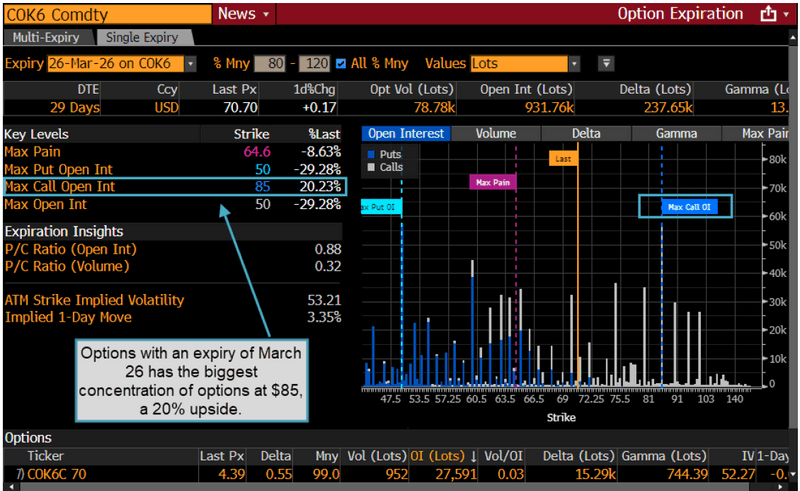
Before the strikes, prediction markets showed 60% odds that the US would hit Iran by the end of March, up from 30% just 10 days earlier. Brent options had been pricing significant upside, with the $85 strike showing the largest open interest for March expiry. Bloomberg’s WSL Predict tool tracks these betting market probabilities alongside crude prices in real time.
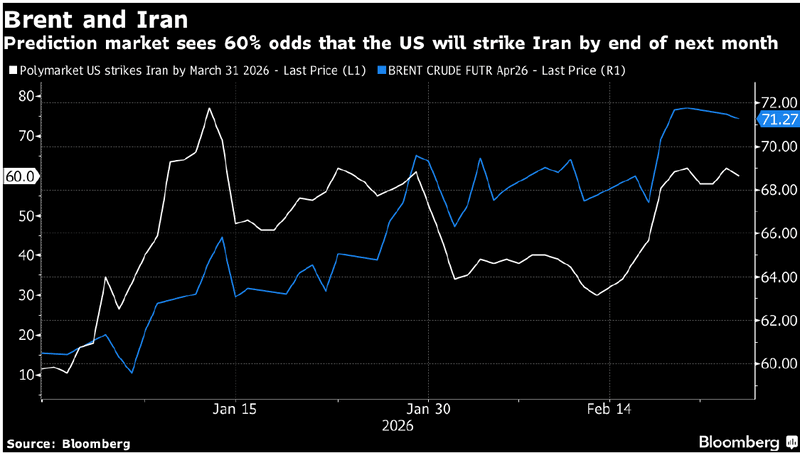
The physical fallout has been swift. Saudi Aramco halted operations at its Ras Tanura refinery after a drone strike, adding to a spike in fuel prices. Qatar shut down the world’s largest LNG export facility after it was targeted in an Iranian drone attack, sending European gas prices surging more than 50%. A US-flagged oil tanker operating as part of a military fuel supply program was hit, and naval forces described the threat in the region as “critical.”
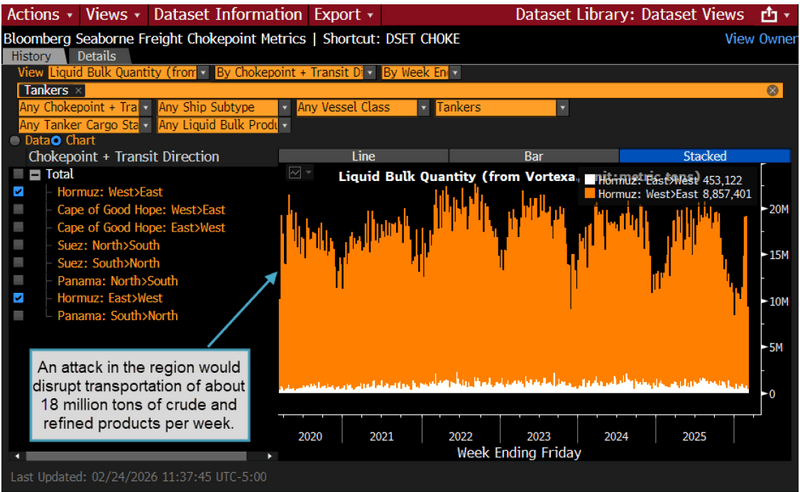
The near-halt in Hormuz traffic is threatening the transit of roughly 18 million tons of crude and refined products that flow through the strait each week. Bloomberg’s DSET chokepoint tracker shows the scale of Hormuz shipping flows that are now at risk. JPMorgan Chase & Co. estimates a halt lasting 25 days would fill producer nations’ storage tanks, forcing them to cut production. Insurance markets are scrambling to price the risk, with major clubs planning to end war-risk coverage in the Persian Gulf.
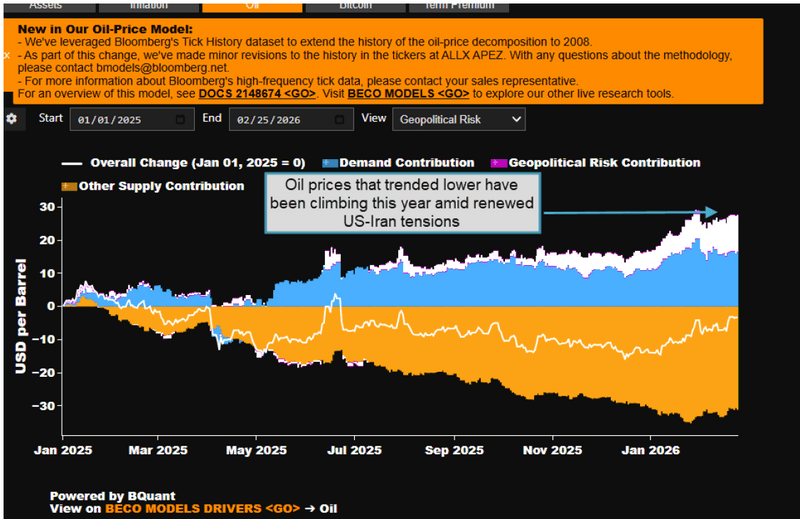
Bloomberg Economics’ oil price model shows geopolitical risk has been the dominant upward driver of crude prices since the start of the year, reversing the supply-glut fears that weighed on oil through much of 2025. Bloomberg Intelligence analyst Salih Yilmaz wrote before the strikes that Brent near $72 was embedding an $8-to-$10-a-barrel war premium, and that a physical-flow disruption such as Hormuz impairment could lift prices $20 to $50.
“We see Brent oil trading in the $80-to-$90-a-barrel range in our base case over at least the coming week,” Citigroup Inc. analysts including Max Layton said. Morgan Stanley raised its second-quarter Brent forecast to $80 from $62.50. Wood Mackenzie warned that if tanker flows are not restored quickly, oil could exceed $100 a barrel, noting that even with OPEC raising output, additional volumes will be inaccessible if Hormuz remains closed.
In reaction to the conflict, OPEC+ agreed to raise quotas by 206,000 barrels a day for April. But the path ahead is far from certain. “Iran has retaliated in a far more aggressive and expansive manner than in prior exchanges,” said Jorge Leon, head of geopolitical analysis at Rystad Energy. “Unless de-escalation signals emerge swiftly, we expect a significant upward repricing of oil.” Gulf allies are already pushing for an end to the fighting. The UAE and Qatar are privately lobbying allies to help Trump find an off-ramp, warning that prolonged disruption to shipping lanes would trigger an even sharper energy price shock.
Tracking
Track Brent options positioning with the OPX function:
- Type “brent” in the command line and select CO1 Comdty – Generic 1st Crude Oil, Brent (ICE).
- Type “option expiration” and select OPX. The shortcut is CO1 Comdty OPX.
- Select Single Expiry tab.
- Select 26-Mar-26 on COK6” in the Expiry dropdown if not already selected.
- Tick the box next to All % Mny.
For more information on this or other functionality, click here to request a demo with a Bloomberg sales representative. Existing clients can press <HELP HELP> on their Bloomberg keyboard.