ARTICLE
Drone defense, US in NATO: Lessons from ret. Air Force general

Bloomberg Intelligence
This article was written by Bloomberg Intelligence Senior Industry Analyst George Ferguson and Senior Associate Analyst Melissa Balzano. It appeared first on the Bloomberg Terminal.
Drone attacks in the Iran war underscore the need for scalable, lower-cost interceptors, retired General Tim Ray, former commander of US Air Force Global Strike Command, said on a BI webinar. Potential beneficiaries include BAE/L3Harris and Rheinmetall, given exposure to cost-effective counter-drone solutions, our analysis shows. Despite a tense relationship between the US and Europe, Ray believes the US will remain in NATO.
Industry is responding to US gap in counter-drone
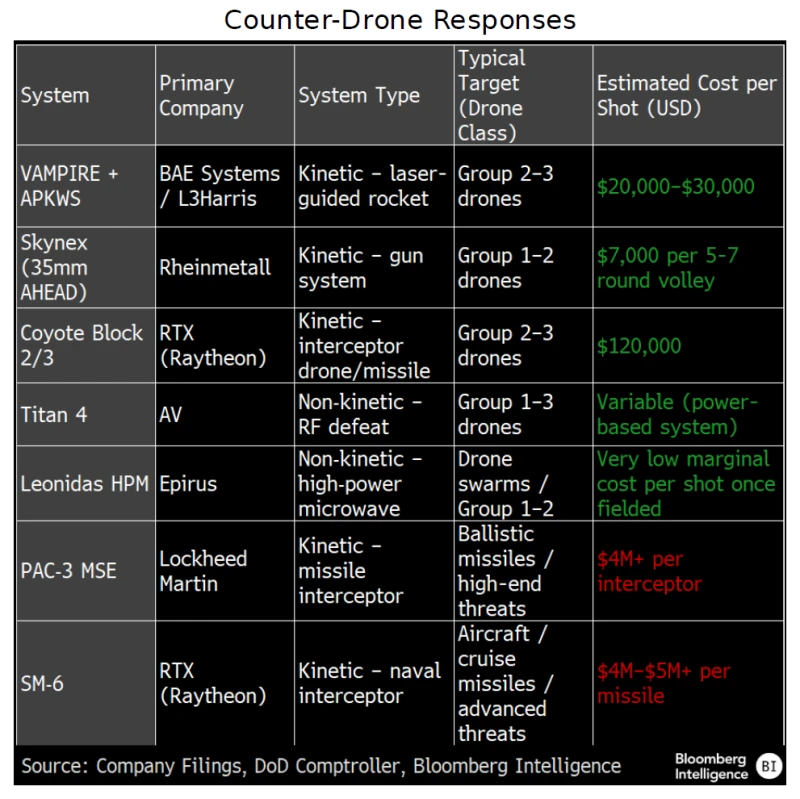
General (Ret.) Tim Ray, former commander of US Air Force Global Strike Command, flagged a key gap: US bases and critical infrastructure still lack scalable, low-cost counter-drone “magazine depth.” This vulnerability was underscored by Iranian drone attacks that killed US soldiers and hit AWS facilities. Near-term fixes favor affordable layers: BAE/L3Harris’ VAMPIRE-fi ring APKWS, Rheinmetall’s Skynex 35mm AHEAD and RTX’s Coyote are far cheaper per shot than Lockheed Martin’s PAC-3s and RTX’s SM-6s.
DOD is also pushing non-kinetic options to bend the cost curve, like AeroVironment’s Titan 4 and Epirus’ Leonidas (IFPC-HPM deliveries/GEN II contract), though maturation and scale remain gating factors. Allies are converging on layered systems; Poland’s €2 billion “anti-drone” effort highlights the demand signal.
US, Europe divorce overplayed: retired Air Force General
The conversation with retired Air Force General Tim Ray reinforced our view that a permanent split between the US and Europe isn’t at hand. Ray indicated that despite political turmoil, there are strong connections in other strata that make up a relationship, such as military, scientific and business ties. He said that he doesn’t see the US leaving NATO, though Europe could improve its defense abilities.
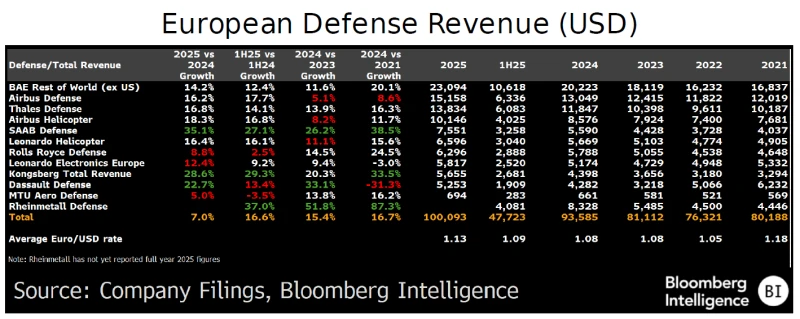
Bloomberg Intelligence’s view is similar, as we expect the US-Europe relationship to persist, though US budget realities and competition with China will require more European spending. Europe should have the capability to pursue its own foreign policy, but that would require spending over $1 trillion and stronger coordination within the bloc.
Middle East peace could be closer but military buys to continue
Retired Air Force General Ray said the opportunity for lasting Middle East peace could be stronger than ever. He said that pushing back Hezbollah from Southern Lebanon and depleting Iranian resources that can’t be resupplied by Russia in the midst of the Ukrainian conflict sets the stage for a diminished Iran and the potential for real progress in the region. At the same time, relationships between Israel and its Gulf neighbors might be as good as they have ever been.
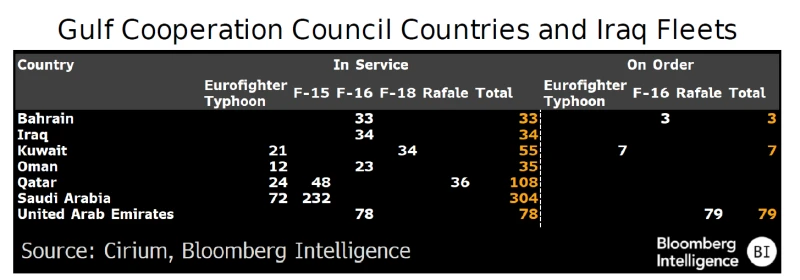
Gulf Cooperation Council countries are large buyers of military equipment from the US and Europe, with international sales typically more profitable than domestic. We don’t see a significant near-term decline in demand. Even if peace were to prevail, it will take many years and memories will fade slowly.
Exquisite vs. scalable mass calculus
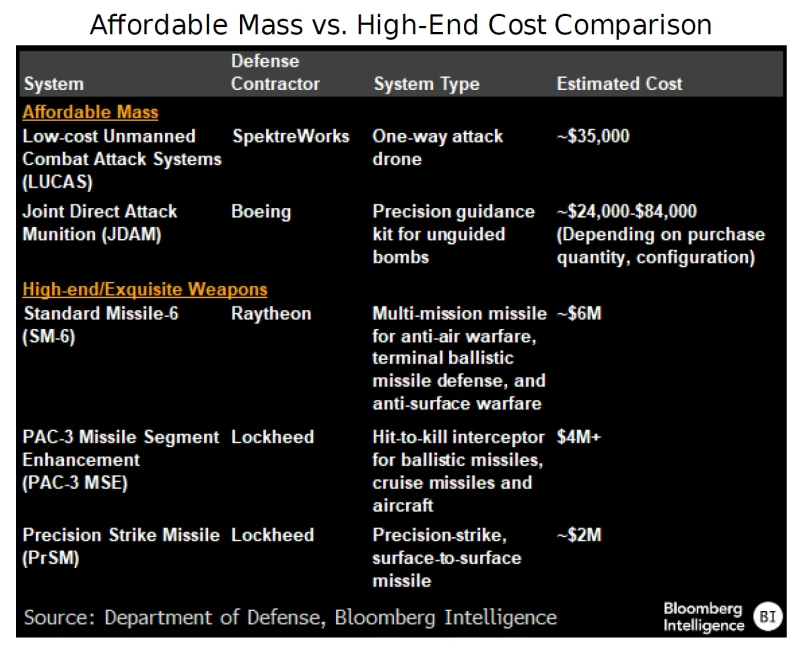
Retired Air Force General Ray emphasized the need for the US to balance resources and preserve magazine depth, which is critical given fiscal constraints and limited production capacity. As the US and Israel exert air dominance in Iran, the need for exquisite, standoff weapons costing multiple million dollars declines, allowing the US to shift to lower-cost options like Boeing’s JDAM guidance kits on gravity bombs or SpektreWorks’ Low-cost Unmanned Combat Attack System (LUCAS), which was reverse engineered from Iran’s Shahed-136.
This balanced approach applies to offensive and defensive capabilities, especially given the proliferation of affordable drones, which is driving US and allied investments in low-cost kinetic and non-kinetic counter-drone systems.
The data included in these materials are for illustrative purposes only. The BLOOMBERG TERMINAL service and Bloomberg data products (the “Services”) are owned and distributed by Bloomberg Finance L.P. (“BFLP”) except (i) in Argentina, Australia and certain jurisdictions in the Pacific Islands, Bermuda, China, India, Japan, Korea and New Zealand, where Bloomberg L.P. and its subsidiaries (“BLP”) distribute these products, and (ii) in Singapore and the jurisdictions serviced by Bloomberg’s Singapore office, where a subsidiary of BFLP distributes these products. BLP provides BFLP and its subsidiaries with global marketing and operational support and service. Certain features, functions, products and services are available only to sophisticated investors and only where permitted. BFLP, BLP and their affiliates do not guarantee the accuracy of prices or other information in the Services. Nothing in the Services shall constitute or be construed as an offering of financial instruments by BFLP, BLP or their affiliates, or as investment advice or recommendations by BFLP, BLP or their affiliates of an investment strategy or whether or not to “buy”, “sell” or “hold” an investment. Information available via the Services should not be considered as information sufficient upon which to base an investment decision. The following are trademarks and service marks of BFLP, a Delaware limited partnership, or its subsidiaries: BLOOMBERG, BLOOMBERG ANYWHERE, BLOOMBERG MARKETS, BLOOMBERG NEWS, BLOOMBERG PROFESSIONAL, BLOOMBERG TERMINAL and BLOOMBERG.COM. Absence of any trademark or service mark from this list does not waive Bloomberg’s intellectual property rights in that name, mark or logo.
All rights reserved. © 2025 Bloomberg.