Bloomberg Economics
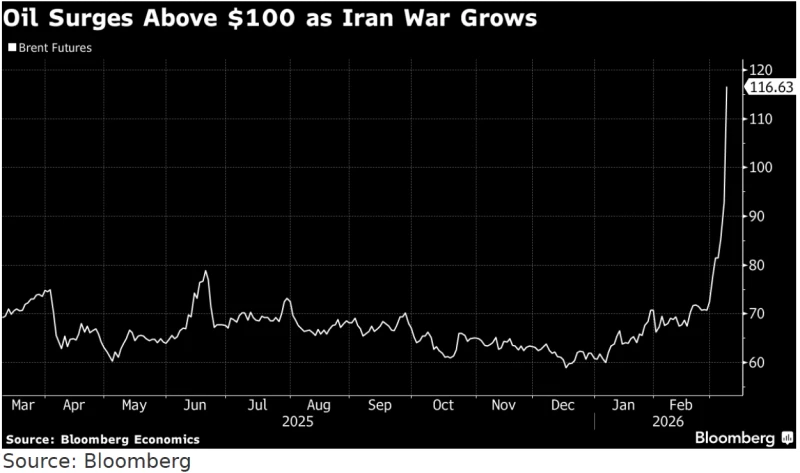
- Oil surged above $100 a barrel as war in the Middle East extended into its second week, with traffic in the Strait of Hormuz remaining paralyzed and several countries cutting crude output.
- The conflict has left Gulf Arab states exposed, with their air defenses being overtaxed and their limited stockpiles of interceptors being drained by Iranian missile and drone attacks.
- The US has announced plans to provide naval escorts and insurance guarantees for tankers transiting the Strait, but keeping it open may prove to be a challenge due to potential Iranian disruptions.
This article was written by Bloomberg Economics Middle East Geoeconomics Lead Dina Esfandiary, Chief Emerging Markets Economist Ziad Daoud, Defense Lead Becca Wasser, and Chief Geoeconomics Analyst Jennifer Welch. It appeared first on the Bloomberg Terminal.
Oil surged above $100 a barrel on Monday, as war in the Middle East extended into its second week. Traffic in the Strait of Hormuz remains paralyzed. Saudi Arabia’s largest oil refinery is offline. Qatar has shut off the world’s biggest liquefied natural gas facility. Iraq, Kuwait, and the UAE are all cutting crude output.
Going forward, a central question is how far oil markets will go in pricing in the risk that disruptions won’t be temporary. Answering that question hinges on five variables: Iranian firepower, Gulf defenses, US resolve, Hormuz reopening and supply rerouting.
1. How long can Iran keep fighting?
There are two dimensions to this question: Iran’s political resilience and its military capacity.
- Politically, while former Supreme Leader Ayatollah Ali Khamenei and many senior officials have been killed by joint US-Israeli strikes, the Islamic Republic remains in place and a collapse is unlikely, at least in the near term. Iran named Mojtaba Khamenei, the son of the late ayatollah, the new supreme leader, signaling continuity and likely a continuation of the war.
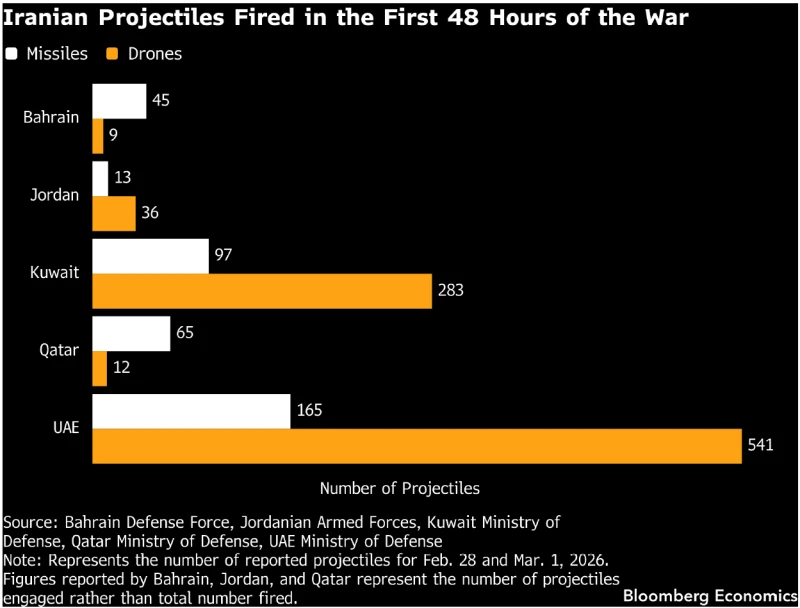
- Militarily, there’s no way of knowing exactly how many missiles or drones are left in Iran’s stockpile. We estimate Iran fired more than 1,200 projectiles in the first 48 hours of the war and that US-Israeli strikes have hit a number of its missile production facilities and launchers, and missile and drone launch sites.
- That math suggests Iran’s current intensity of attacks may not be sustainable. Iranian missile attacksare slowing, but drone attacks continue apace.
- Even a small number of projectiles could continue to disrupt traffic in the Strait, damage regional energy facilities and impact civilian populations — especially if air defenses are stretched.
2. How long can the Gulf keep defending?
The conflict has left Gulf Arab states exposed and their economic visions under siege.
- After retaliating against Israel and US bases in the region, Iran hit the Gulf states, unleashing waves of missiles and drones. While most attacks were intercepted, some were not — undercutting the Gulf states’ carefully curated image as havens of stability and prosperity and dependable energy suppliers.
- Those attacks are also overtaxing Gulf states’ air defenses and draining their limited stockpiles of interceptors — which can’t be easily, quickly or cheaply replenished. The mixed barrages of drones and missiles mean the Gulf states have been countering Iranian one-way attack drones that cost anywhere from $20,000 to $50,000 with air defense interceptors costing $4.19 million apiece.
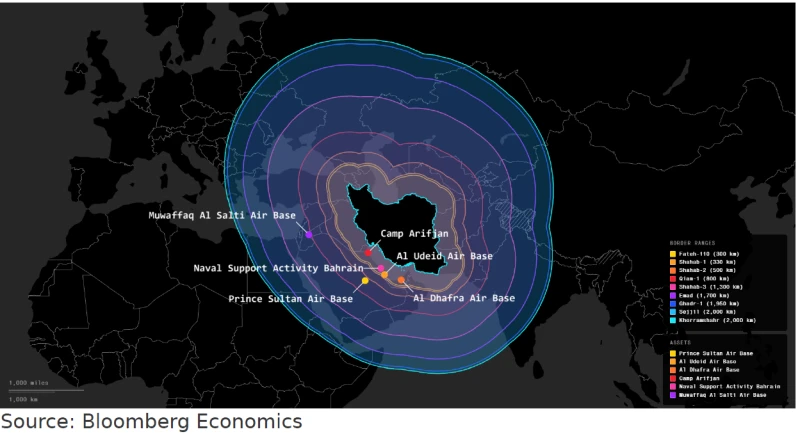
Iranian missiles have range
3. Will Washington stay the course?
More than a week into the conflict, questions remain about the Trump administration’s motives, strategy and desired end state — and political risks loom large.
- On Feb. 28, President Donald Trump said the goal was “eliminating imminent threats.” On March 2, he put forth the more detailed goals of destroying Iran’s missile capabilities and navy, and ensuring Tehran couldn’t obtain a nuclear weapon or support external terrorist organizations. Those are ambitious objectives. Meeting them would require time, resources and staying power. Some may not be met by military force alone.
- On March 6, Trump said there would be no deal with Iran except
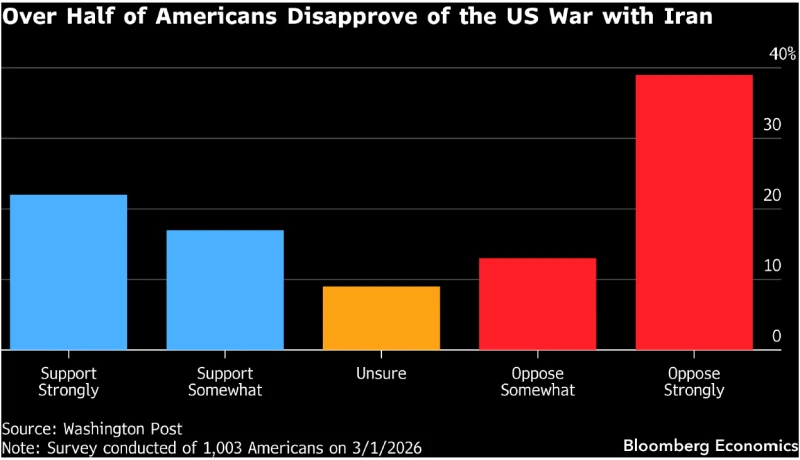
unconditional surrender, yet the political incentives to find an off ramp may be growing. Significant portions of the US public — in some polls as high as 60% of respondents — disapprove of the conflict. Those numbers will likely rise if oil and gas prices keep climbing, and if there are additional US casualties. To date, the US says seven service members have been killed in the war.
4. Can the US reopen Hormuz?
Trump says the US will provide naval escorts and insurance guarantees for tankers transiting the Strait, following Iranian threats and attacks that have all but halted traffic. Keeping the Strait open may prove to be a challenge, however.
- The Hormuz blockage is already straining oil production across the Middle East and, combined with attacks on regional energy infrastructure, pushing oil prices above $100 a barrel. If Hormuz remains shut and disruptions persist, it’s not hard to imagine oil prices hitting a significantly higher number.
- There are multiple ways Iran could continue to disrupt traffic, even after US-Israeli strikes on its navy, missiles and drones facilities.
- Islamic Revolutionary Guard Corps gunboats and drones could swarm and harass commercial ships, conducting risky maneuvers alongside them.
- Drones and missiles launched from shore — or even suicide boats — could attack ships.
- Iran could also mine the Strait, using small vessels and fi shing boats if its navy is incapacitated.
- Iranian proxies like the Houthis could also harass ships with drones.
- US forces could fi re on attacking Iranian ships, shoot down Iranian projectiles and clear mines. But that would come at a cost, put US forces at greater risk and wouldn’t necessarily prevent Iran from attempting to close the Strait again. The instability and uncertainty itself may be enough to disrupt some traffic.
5. Can re-routing away from Hormuz solve the problem?
The short answer is no. The long answer is still no, for these reasons:
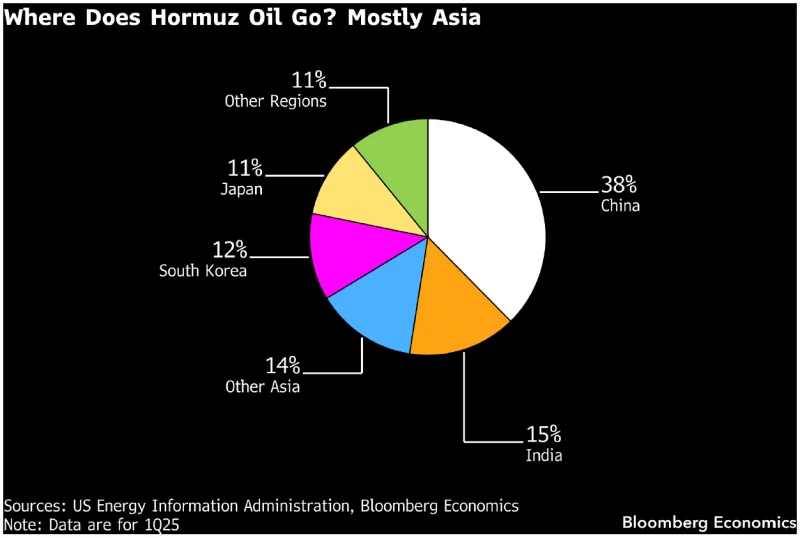
- Alternative routes can absorb only a fraction of the region’s energy exports. Saudi Arabia’s East-West pipeline and the UAE’s Fujairah link bypass the Strait of Hormuz. Yet even combined with other routes, their capacity could handle, at best, about half of normal Hormuz flows, leaving a significant shortfall.
- These pipelines are hardly secure and could themselves become targets of attacks. Tankers loading Saudi crude in the Red Sea may still transit the Bab el-Mandeb Strait. The narrow passage lies within reach of Yemen’s Houthis, exposing vessels to further disruptions.
- Many producers, including Bahrain and Kuwait, lack alternatives to the Strait of Hormuz. Iraq, Kuwait and the UAE are already cutting output as exports stall and storage facilities fill up.
- The alternatives for gas are even more scarce. Qatar — one of the world’s largest liquefied natural gas exporters — relies almost entirely on tankers leaving the Gulf. With no pipelines carrying gas abroad, shipments halt if tankers cannot leave the Gulf.
The data included in these materials are for illustrative purposes only. The BLOOMBERG TERMINAL service and Bloomberg data products (the “Services”) are owned and distributed by Bloomberg Finance L.P. (“BFLP”) except (i) in Argentina, Australia and certain jurisdictions in the Pacific Islands, Bermuda, China, India, Japan, Korea and New Zealand, where Bloomberg L.P. and its subsidiaries (“BLP”) distribute these products, and (ii) in Singapore and the jurisdictions serviced by Bloomberg’s Singapore office, where a subsidiary of BFLP distributes these products. BLP provides BFLP and its subsidiaries with global marketing and operational support and service. Certain features, functions, products and services are available only to sophisticated investors and only where permitted. BFLP, BLP and their affiliates do not guarantee the accuracy of prices or other information in the Services. Nothing in the Services shall constitute or be construed as an offering of financial instruments by BFLP, BLP or their affiliates, or as investment advice or recommendations by BFLP, BLP or their affiliates of an investment strategy or whether or not to “buy”, “sell” or “hold” an investment. Information available via the Services should not be considered as information sufficient upon which to base an investment decision. The following are trademarks and service marks of BFLP, a Delaware limited partnership, or its subsidiaries: BLOOMBERG, BLOOMBERG ANYWHERE, BLOOMBERG MARKETS, BLOOMBERG NEWS, BLOOMBERG PROFESSIONAL, BLOOMBERG TERMINAL and BLOOMBERG.COM. Absence of any trademark or service mark from this list does not waive Bloomberg’s intellectual property rights in that name, mark or logo.
All rights reserved. © 2025 Bloomberg.