
Bloomberg Professional Services
- U.S. equity market concentration has increased sharply over the past decade as mega-cap companies have grown faster than the broader large cap universe.
- Measures such as the effective number of stocks and sectors show that market breadth has narrowed significantly despite thousands of listed constituents.
- Recent sector rotations and reassessment of AI-related valuations raise the question of whether current concentration levels could begin to normalize.
This article was written by Yingjin Gan, Head of Index Research, Antonios Lazanas, Head of Quantitative Investment Research, and Rui Dong, Quant Researcher at Bloomberg.
Recent years have witnessed a rapid increase in equity market concentration, particularly in the U.S. The sustained rise of mega-cap companies has reshaped index structures in a way that is historically significant.
PRODUCT MENTIONS
This shift can be illustrated by examining the Bloomberg B500 Index. At year-end 2015, the top five constituents had a combined market capitalization of approximately $1.9 trillion. By the end of 2025, that figure had risen to $15.9 trillion—a cumulative increase of 746%. Over the same period, the total market capitalization of the index increased from $17.8 trillion to $58.4 trillion, a cumulative increase of 229%. In other words, the largest companies have grown at a rate dramatically exceeding that of the broader large cap market.
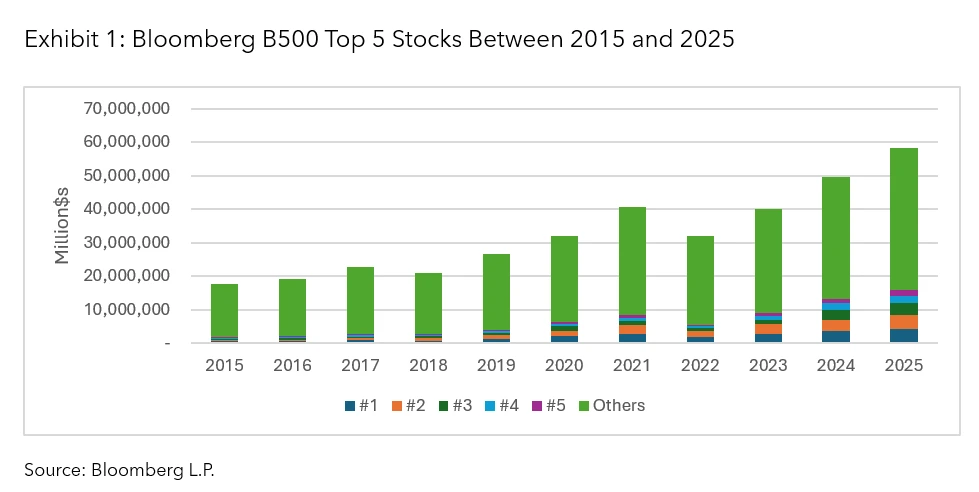
How has equity market concentration increased over the past decade?
Sector concentration has followed a similar trajectory. As shown in Exhibit 1, the top three sectors were relatively balanced, each with a market capitalization between $2.5 and $2.8 trillion in 2015. Today, the largest sector, Technology at $19.7 trillion – is more than double the second and third largest sector (Financials at $7.8 trillion and Communications at $7.03 trillion). The dispersion across sectors is now materially wider than a decade ago.
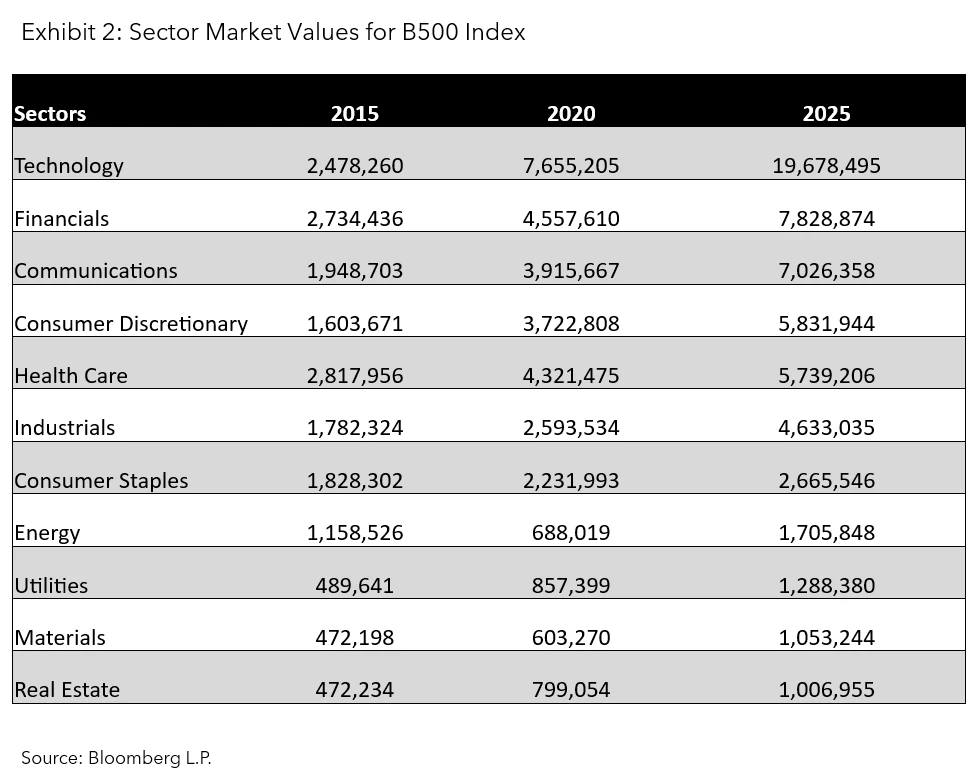
What the effective number of stocks reveals about market breadth
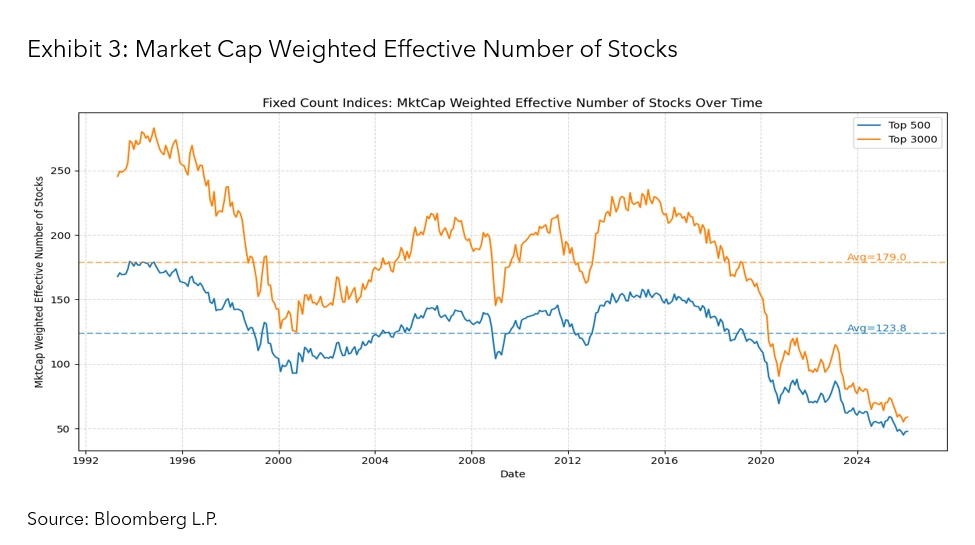
While top-N weights (e.g. top 5 or top 10) are commonly used to assess concentration, they focus only on the largest constituents. A more comprehensive concentration measure is the effective number of stocks/sectors. It is calculated as the inverse of the sum of squared constituent weights. In the extreme case of a single-stock market, the effective number is 1. In a perfectly equal-weighted market of N stocks, the effective number equals N. This metric captures the full weight distribution, not just the top tier.
Using this framework, we examine the effective number of stocks for the Bloomberg B3000 and B500 over the past three decades. The B3000 has historically exhibited an average effective number of 177. However, since its peak in 2015, effective number has declined materially, indicating a structurally narrow market despite a large nominal number of constituents.
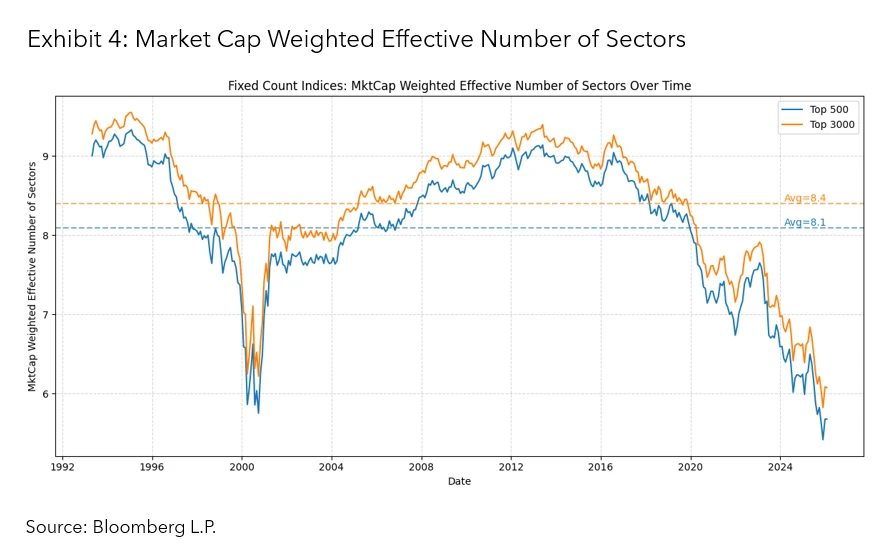
A similar analysis at the sector level (using Bloomberg BICS Level 1) reveals similar dynamics. With 11 sectors in total, the long-term average effective number of sectors has been approximately 8.4. Over the past decade, this measure has also trended downward, confirming that concentration is not merely stock-specific but extends across industry structure.
Could sector rotation signal a turning point in market concentration?
Interestingly, the behavior of these two metrics differs across historical episodes. During the dot-com bubble, both stock-level and sector-level effective breadth declined sharply and then recovered. During the Global Financial Crisis, however, the decline and subsequent rebound were far more pronounced at the stock level than at the sector level, highlighting the distinct structural nature of each crisis.
As for the current period of elevated concentration, we do not claim foresight. The rise in concentration may reflect overvaluation similar to the late 1990s, albeit stretched over a longer horizon. Alternatively, it may represent a structural transformation driven by technological change and scale advantages that are more persistent. The truth could lie somewhere between these extremes.
For investors who believe that valuation dispersion has played a role in the prolonged rise in concentration, history offers an important reminder: turning points in market breadth can be abrupt. Periods of extreme dominance have often been followed by sustained recoveries in effective breadth. The experience of the dot-com cycle illustrates this clearly — both the effective number of stocks and, even more notably, the effective number of sectors rebounded meaningfully once concentration peaked.
How risk-based sector concentration differs from market-cap concentration
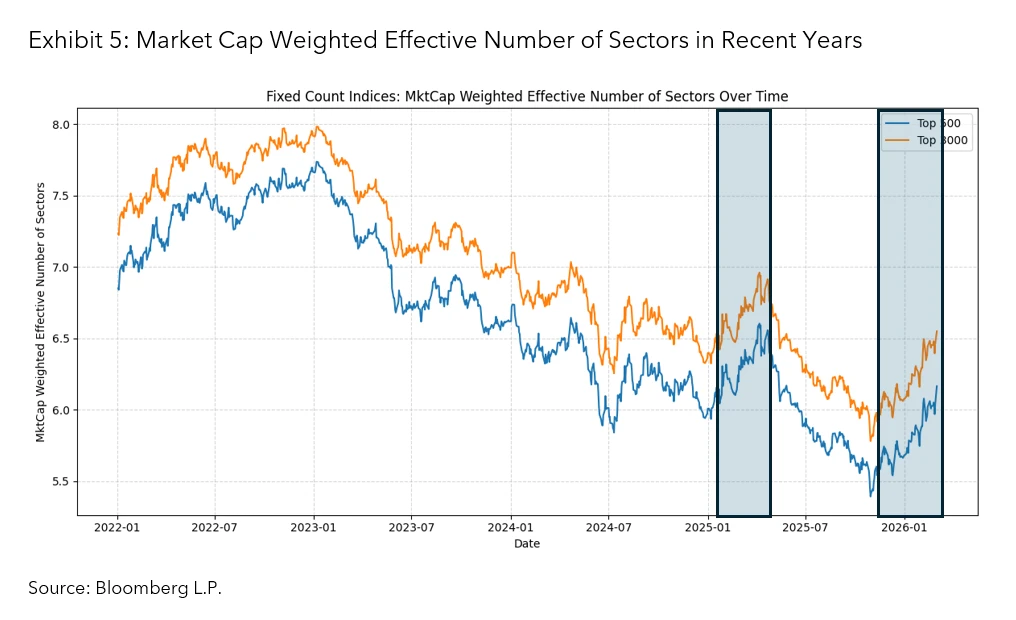
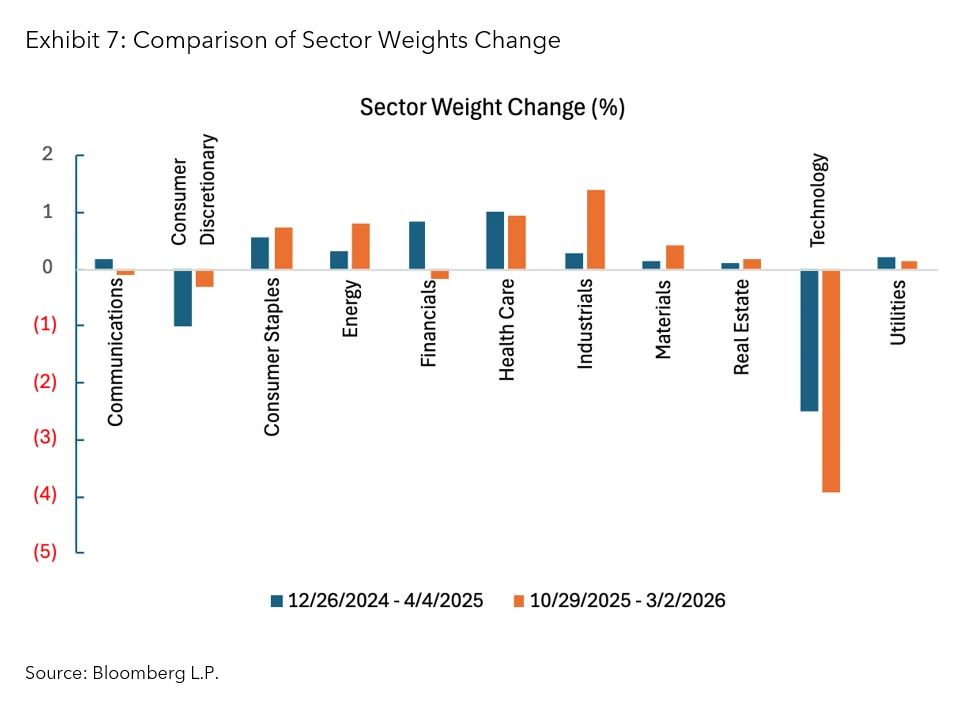
The first half of 2025 also saw a notable — though ultimately temporary — easing in concentration following the sharp market repricing (Exhibit 5). The recent improvement in effective breadth naturally invites comparison. However, a closer look at sector weight changes reveals meaningful structural differences in the underlying rotation.
Technology, the largest sector, was hit hardest in both episodes. In the first half of 2025, consumer discretionary was the second hardest hit, reflecting the tariff-driven nature of the correction, while more tariff-resistant sectors gained relative weight.
In recent months, by contrast, the rotation has looked more like a broad shift away from technology toward more traditional industrial sectors. Financials have been an exception, pressured by concerns surrounding private credit — more a spillover effect than a primary driver. Given the ongoing reassessment of AI and related themes, the current shift could evolve into a more durable rotation, potentially marking the early stages of a more persistent normalization in market structure.
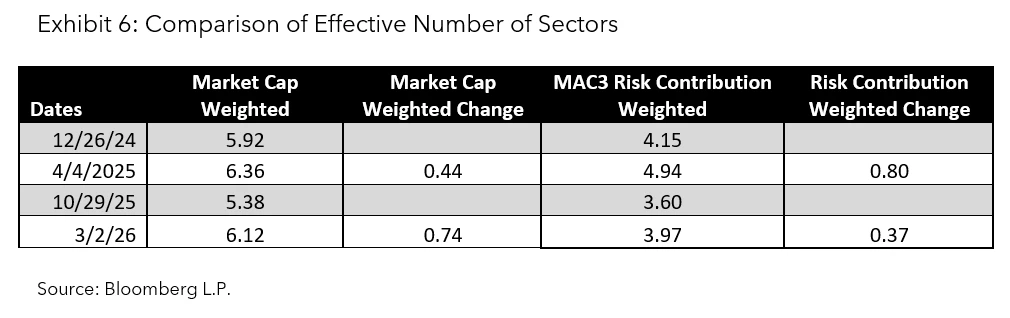
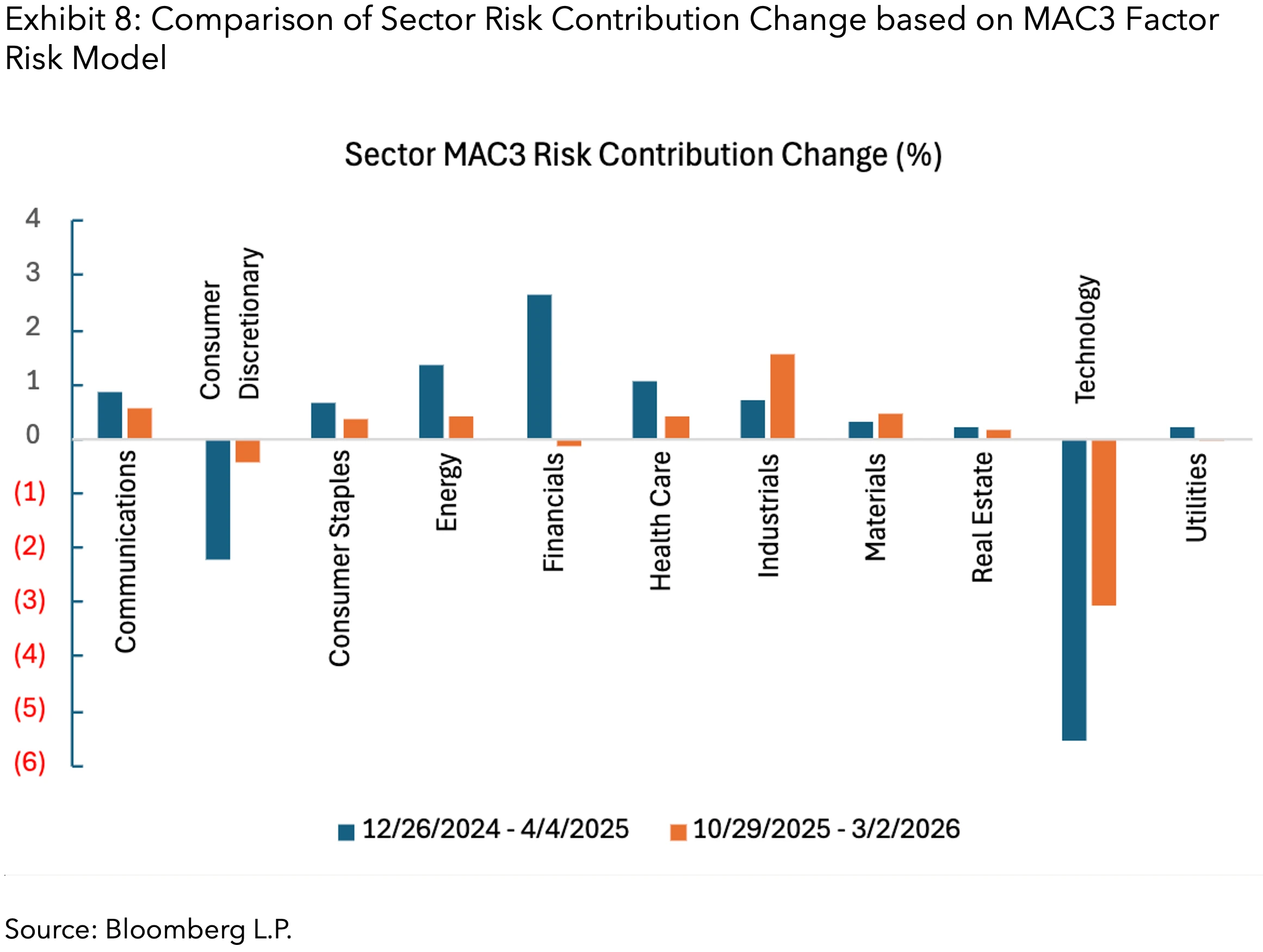
Taking the analysis a step further, we examine sector-level risk contributions and derive an “effective number of sectors” on that basis. This measure is even lower than the one based purely on market-cap weights, suggesting that larger sectors carry disproportionately higher risk and thereby amplify concentration when size and volatility are considered jointly.
Moreover, the recent episode reflects a smaller improvement in risk-based breadth than the one observed in the first half of 2025. In other words, technology’s dominance from a risk perspective is now even more pronounced than it was then.
Taken together, this indicates that the current shift is less a broad-based macro-driven correction and more a concentrated move led by a single sector. The recent easing in market-cap concentration is therefore partially offset by an intensification in risk concentration. While risk concentration tends to be cyclical and mean-reverting, shifts in market-cap concentration are typically more enduring, reflecting deeper changes in market structure.
While the answer will only become clear with time, investors need not hold a definitive view to consider the implications. In environments where concentration risk has been elevated, investors may consider whether traditional market-cap-weighted benchmarks remain the most effective representation of the opportunity set — or whether alternative weighting approaches can offer a more balanced exposure when breadth begins to shift.
Bloomberg does not represent that the quantitative models, analytic tools and/or other information (“Content”) referenced in this publication (including information obtained from third party sources) is accurate, complete or error free, and it should not be relied upon as such, nor does Bloomberg guarantee the timeliness, reliability, performance, continued availability, or currency of any Content. The Content is provided for informational purposes only and is made available “as is.” Because of the possibility of human and mechanical errors as well as other factors, Bloomberg accepts no responsibility or liability for any errors or omissions in the Content (including but not limited to the output of any quantitative model or analytic tool). Any data on past performance, modelling or back-testing contained in the Content is no indication as to future performance. No representation is made as to the reasonableness of the assumptions made within or the accuracy or completeness of any modelling or back-testing.
Bloomberg shall not be liable for any damages, including without limitation, any special, punitive, indirect, incidental or consequential damages, or any lost profits, arising from the use of or reliance on any Content, even if advised of the possibility of such damages.
The Content (including any of the output derived from any analytic tools or models) is not intended to predict actual results, which may differ substantially from those reflected.
Information and publications provided by Bloomberg shall not constitute, nor be construed as, investment advice or investment recommendations (i.e., recommendations as to whether or not to “buy”, “sell”, “hold”, or to enter or not to enter into any other transaction involving any specific interest) or a recommendation as to an investment or other strategy. No aspect of the Bloomberg publications is based on the consideration of a customer’s individual circumstances. Information provided in the publications should not be considered as information sufficient upon which to base an investment decision. You should determine on your own whether you agree with the conclusions made in the publications.
Bloomberg offers its services in compliance with applicable laws and regulations. Services and information provided by Bloomberg should not be construed as tax or accounting advice or as a service designed to facilitate any subscriber’s compliance with its tax, accounting, or other legal obligations. Employees involved in Bloomberg may hold positions in the securities analysed or discussed in Bloomberg publications.
This publication has been distributed by Bloomberg. “Bloomberg” means Bloomberg Finance L.P., Bloomberg L.P., and their affiliates.
© 2026 Bloomberg. All rights reserved.