ARTICLE
AI disruption hits credit: Leveraged loans diverge from high yield bonds

Bloomberg Professional Services
- In early 2026, the U.S. leveraged loan market performed worse than the high-yield bond market, even though these two asset classes usually move together.
- The PORT Hybrid Performance Attribution Model explains the underperformance in terms of interest rates exposure, credit spread changes, different sector exposure profiles, as well as security selection.
- Loan-specific risk modeling is increasingly necessary. The MAC3 USD Leveraged Loan Model captures market dynamics unique to leveraged loans, addressing the limitations of treating loans as proxies for high-yield bonds.
This article was written by Antonios Lazanas, Head of Portfolio, Index and Sustainability Quant Research, and Changxiu “Sue” Li, Product Manager, Fixed Income Portfolio Analytics at Bloomberg.
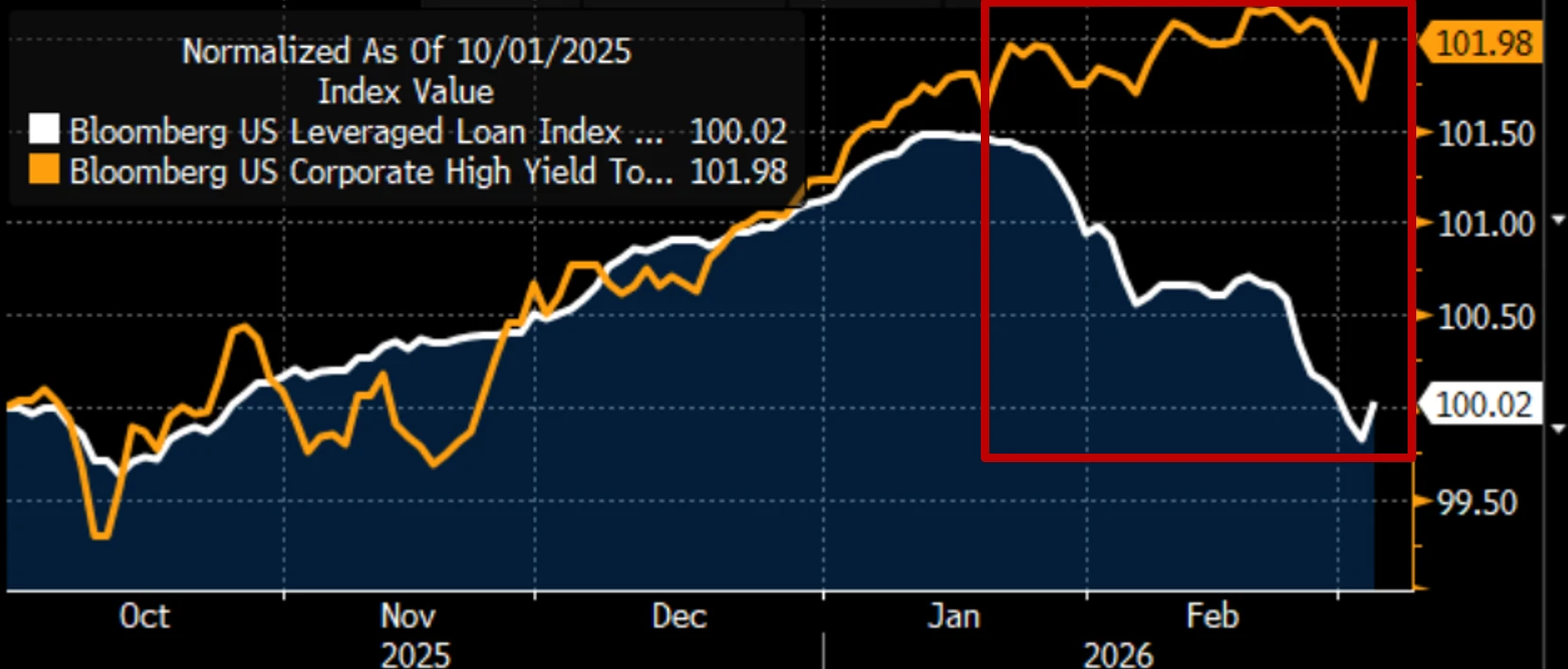
The Bloomberg US Leveraged Loan Index (I39832US Index <GO>), available to Bloomberg Terminal users, posted materially negative returns in early 2026, driven primarily by widening spreads linked to revaluation of AI-related technology companies. By contrast, the Bloomberg US Corporate High Yield (HY) Bond Index (Bloomberg Terminal users can run LF98TRUU Index <GO>), remained resilient until the beginning of March.
Although the performance of the two indices converged by mid-March, the initial divergence underscores structural differences between the two markets, challenging the conventional view that the two asset classes are closely coupled.
PRODUCT MENTIONS
The introduction of the MAC3 USD Leveraged Loan Model addresses this dynamic directly: by calibrating factors on a loan-specific universe, the model is designed to capture the unique market trend of the leveraged loans. Bloomberg Terminal users can find details in the US Leveraged Loan Model paper by running (LPHP PORT:0:1 4349535 <GO>).
The massive sell-off in syndicated loans issued by technology companies, the market’s largest sector, was fueled by fears that rapid advancements in generative AI would upend traditional software business models, transforming what was once considered a stable, high-cash-flow sector into one defined by structural vulnerabilities. This volatility was further amplified by recent strains in the private credit market, including write-downs by BlackRock and redemption suspensions at Blue Owl, which unsettled investor confidence across credit markets.
Figure 1 illustrates the performance divergence between the US Leveraged Loan Index and the US Corporate HY Index from the beginning of 2026 to March 4. The loan index declined by 1.09%, while the HY index has gained 0.74%, resulting in a 1.83% underperformance of loans relative to the HY.
Figure 1: Bloomberg US Leveraged Loan Index vs USD Corporate HY Index
Understanding the drivers of the performance divergence
To analyze the drivers of such performance disparity, we utilize the PORT Hybrid Performance Attribution (MAC HPA) model. Specifically, we use the pure spread return model, which is one of the recommended frameworks for credit portfolios. This model decomposes total outperformance into yield curve, curve volatility, and spread return components. Spread returns are further split into Asset Allocation and Security Selection based on industry classification, following the Brinson methodology: Asset Allocation measures the impact of over- or under-weighting specific industries, while Security Selection captures the return deviation between the portfolio and the benchmark within each industry.
In this framework, we utilize the Duration Times Spread (DTS) contribution to determine portfolio exposure to a particular industry. This approach ensures that sector positioning reflects both the nominal exposure (market value %) and the underlying risk level (DTS). As a result, Security Selection is driven by the deviation of the percentage change of the Option-Adjusted Spread (OAS) between the portfolio and the benchmark within each industry.
Figure 2 presents the performance attribution summary from December 31, 2025, to March 4, 2026, benchmarking the Bloomberg US Leveraged Loan Index against the US Corporate High Yield (HY) Index. Marginal contributions of -0.02% from the yield curve and -0.05% from implied volatility reflect the small year-to-date movement of the US yield curve and the interest rate option-implied volatility surface. Another factor contributing to the underperformance of the loans index is the top-level Duration Times Spread (DTS) exposure. This underperformance is driven by a DTS mismatch between the portfolio and the benchmark, resulting in a -0.28% impact. Indeed, the loans index has significantly higher DTS than the HY index causing it to be more sensitive to credit spread changes in the market.
The primary drivers of relative performance are Asset Allocation and Security Selection, contributing -0.65% and -0.92%, respectively. Spread convexity and residuals account for the 0.11% difference between the reported underperformance of -1.83% and the sum of the contributors listed above.
Figure 2: Summary of the MAC HPA Report
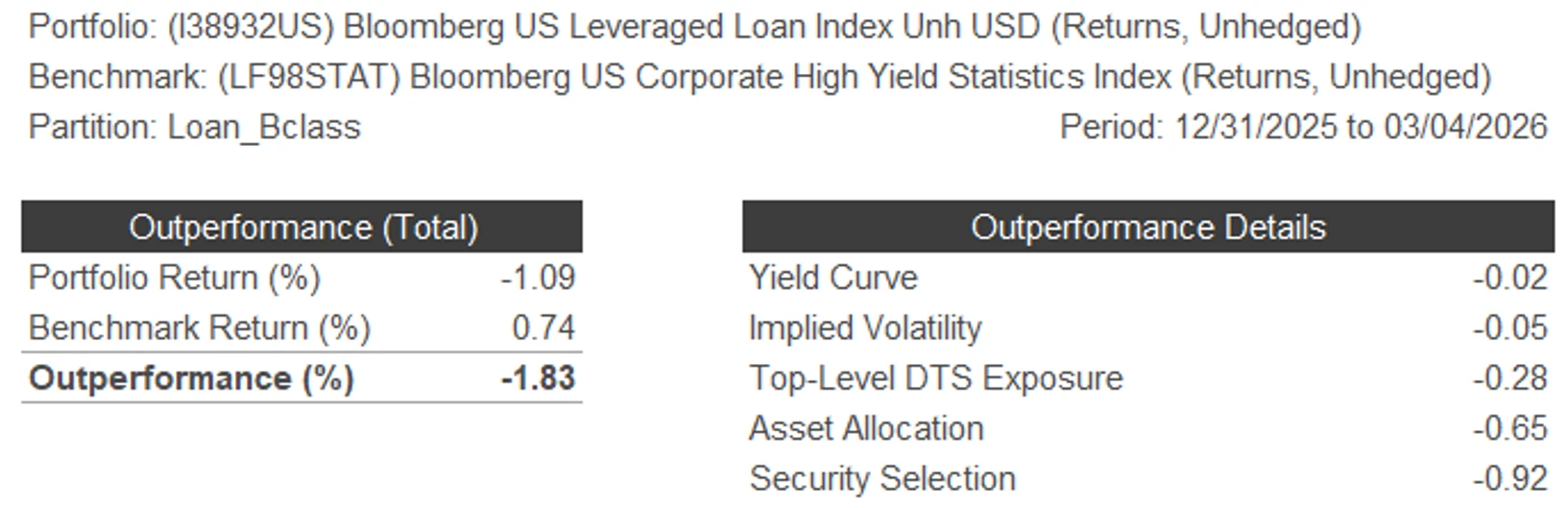
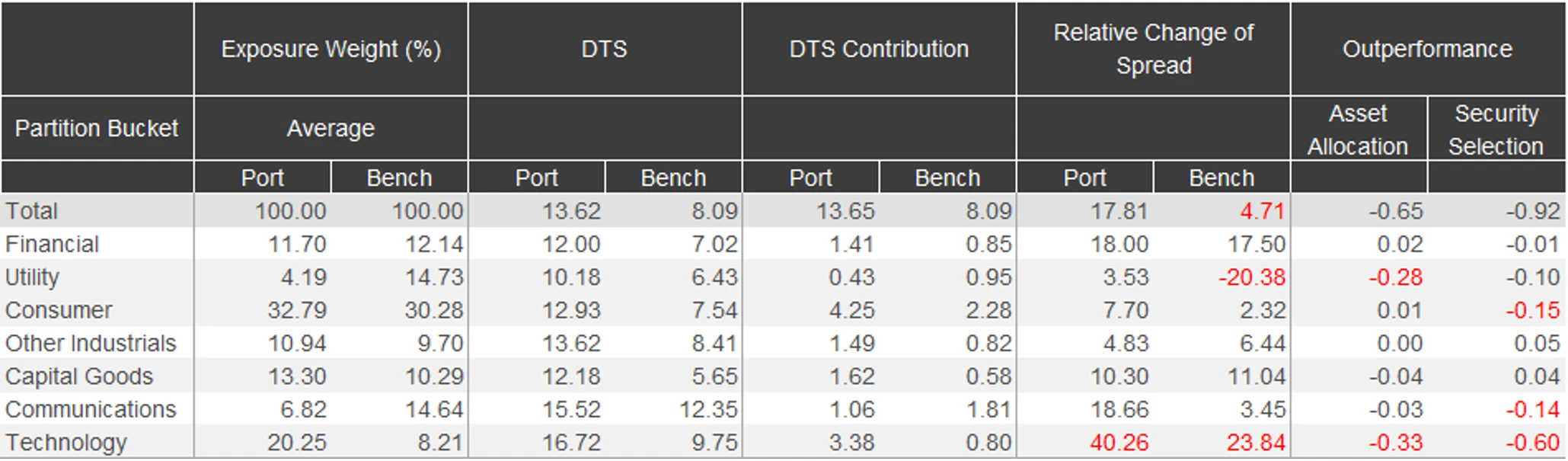
Figure 3 provides a more granular breakdown of the Asset Allocation and Security Selection effects. The Asset Allocation contribution of -0.65% was primarily driven by an underweight in Utilities and an overweight in Technology. Utilities outperformed as its spread tightened by 20.38%, while Technology underperformed, with spreads widening by 23.84%, compared with the overall HY benchmark index, whose spread widened by 4.71%.
Security selection isolates the difference in spread changes between the loan and HY markets, independent of yield curve movements or industry allocations. The resulting contribution of -0.92% reflects the performance divergence between leveraged loans and HY bonds, most notably in Technology, where loan spreads widened by 40.26% compared with 23.84% for HY bonds.
Figure 3: Asset Allocation and Security Selection of MAC HPA Report
The importance of a dedicated Loans Risk Mode
Prior to the release of the MAC3 USD Leveraged Loan Model, the risk forecast for USD loans was represented by a proxy model built on USD High Yield (HY) credit factors, implicitly assuming near-perfect co-movement between leveraged loans and HY bonds. The decoupled performance observed above presents a clear challenge to that assumption.
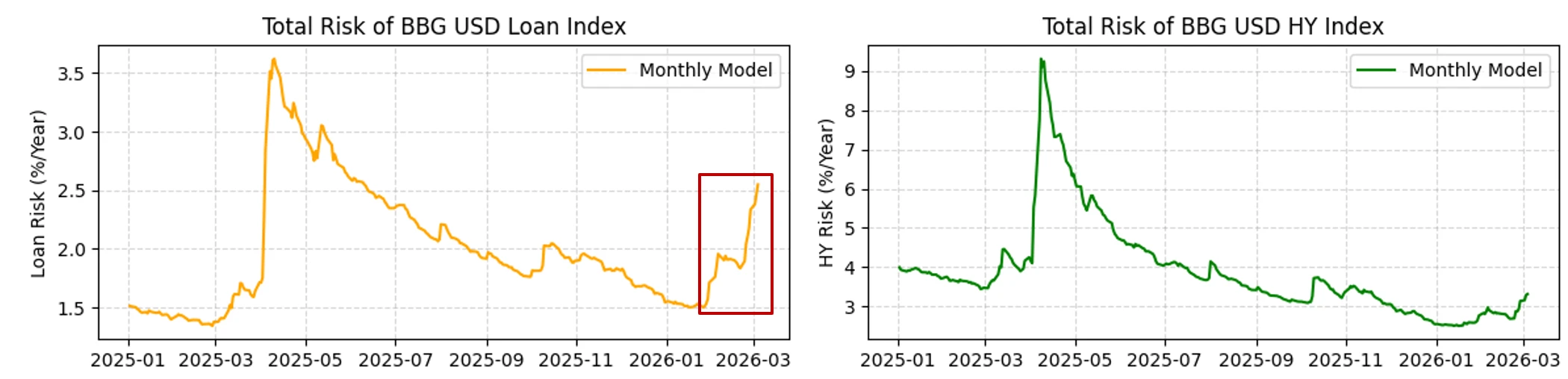
In contrast, the MAC3 Leveraged Loan Model is calibrated directly on instruments from the US Leveraged Loan Index, ensuring that loan-specific market dynamics are explicitly captured. As illustrated in Figure 4, the distinction is evident in the risk evolution: risk levels for the loan index rose materially more than those for the HY index.
Figure 4: Total Risk of US Leveraged Loans Index and US Corporate HY Index
A natural implication of diverging markets is an elevated level of Tracking Error Volatility (TEV) between them. The recently released PORT Risk Change Attribution model decomposes the increase in TEV into six sources: Factor Exposure, Factor Volatility, and Factor Correlation (collectively representing Factor Risk), as well as Active Weights, Idiosyncratic Volatility, and Idiosyncratic Correlation (collectively representing Idiosyncratic Risk).
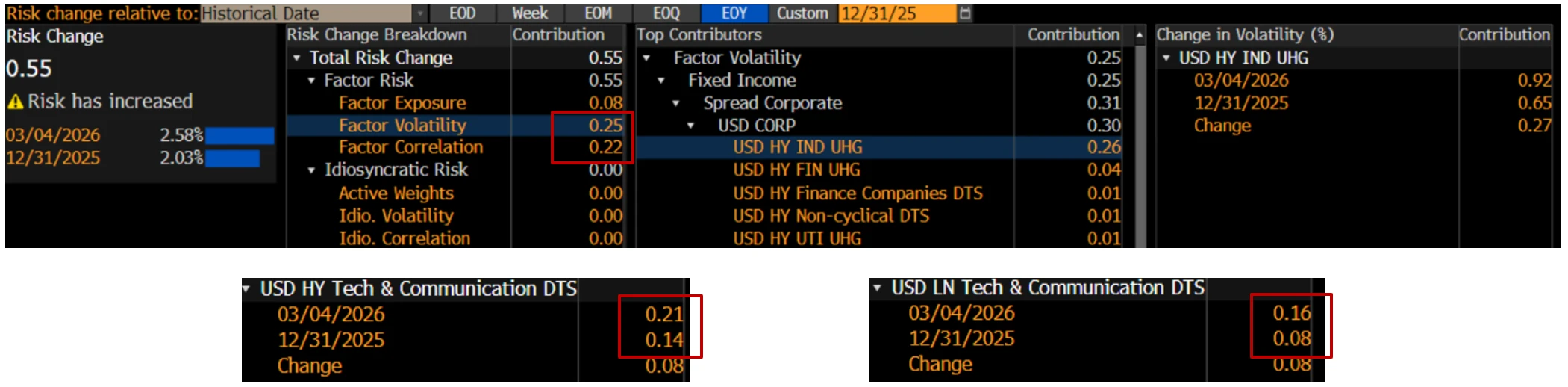
As shown in Figure 5, the MAC3 forecast of the tracking error volatility between the US Leveraged Loan Index and the US Corporate HY Index has increased by 55 bps (annualized) since the end of 2025. While the increasing spreads of loans cause the exposure to the DTS factors to increase, the contribution of factor exposure changes to the TEV increase is small, only 8 bps. The major drivers are changes in factor volatility (25 bps) and factor correlations (22 bps). It is particularly noteworthy that declining factor correlations contribute significantly to the rise in TEV. This would not have been the case with a model where factors are calibrated only to the bond universe.
The risk change attribution tool allows users to inspect the contribution of the volatility change of any individual factor or the correlation change of any pair of factors. In Figure 5 we contrast the HY and Loan DTS factors for the Technology, Media, and Telecommunication industry. The HY DTS factor volatility rose from 14% to 21%, a 50% relative increase, whereas the Loan DTS factor volatility doubled, rising from 8% to 16%, underscoring a more pronounced “risk-off” shift within the leveraged loan market compared to its high-yield counterpart.
Figure 5: Factor Volatility Drilldown or Risk Change Attribution
In Figure 6, we drilldown to the correlation change impact from each factor pair. In the third panel of the snapshot, we observe that the largest impact comes from correlations between the Loan Industrial UHG factor and all other factors, total of 19 bps. The change in the correlation with HY Industrial UHG factor is the second-largest contributor to this effect, accounting for 6 bps. In the fourth panel, we see that this is driven by the decline in the correlation between these two factors from 71% to 65%, indicating a meaningful reduction in co-movement and reinforcing the view of a less synchronized loan and HY market environment.
Figure 6: Factor Correlation Drilldown of Risk Change Attribution

Conclusion
Recent shifts in market dynamics have led to a clear decoupling between the U.S. leveraged loan and U.S. high-yield bond markets. As demonstrated in the analysis using the MAC3 GRM models, these evolving dynamics are appropriately captured for both the loan and HY bond markets. With market volatility remaining elevated, these developments mark an important shift in global financial conditions and underscore the value of analyzing credit markets through the lens of a robust multi-factor framework.
Bloomberg Intelligence is a service provided by Bloomberg Finance L.P. and its affiliates (“Bloomberg”). Bloomberg is not an officially recognized credit rating agency in any jurisdiction, and customers should not use or rely on Bloomberg Intelligence to comply with applicable laws or regulations that prescribe the use of ratings issued by accredited or otherwise recognized credit rating agencies. Bloomberg Intelligence, including Credit and Company research, may not be available in certain jurisdictions.
No aspect of the Bloomberg Intelligence service is based on the consideration of a customer’s individual circumstances. Customers should determine on their own whether they agree with Bloomberg Intelligence. Bloomberg Intelligence should not be construed as tax or accounting advice or as a service designed to facilitate any Bloomberg Intelligence customer’s compliance with its tax, accounting, or other legal obligations. Bloomberg believes that the information it uses in Bloomberg Intelligence comes from reliable sources but does not guarantee the accuracy or completeness of the information contained in Bloomberg Intelligence, which is subject to change without notice, and nothing in this service shall be construed as such a guarantee. Employees involved in Bloomberg Intelligence may hold positions in the securities analyzed or discussed on Bloomberg Intelligence.
Bloomberg makes no claims or representations, or provides any assurances, about the sustainability characteristics, profile or data points of any underlying issuers, products or services, and users should make their own determination on such issues.
The data included in these materials are for illustrative purposes only. The BLOOMBERG TERMINAL service and Bloomberg data products (the “Services”) are owned and distributed by Bloomberg Finance L.P. (“BFLP”) except (i) in Argentina, Australia and certain jurisdictions in the Pacific islands, Bermuda, China, India, Japan, Korea and New Zealand, where Bloomberg L.P. and its subsidiaries (“BLP”) distribute these products, and (ii) in Singapore and the jurisdictions serviced by Bloomberg’s Singapore office, where a subsidiary of BFLP distributes these products. BLP provides BFLP and its subsidiaries with global marketing and operational support and service. Certain features, functions, products and services are available only to sophisticated investors and only where permitted. BFLP, BLP and their affiliates do not guarantee the accuracy of prices or other information in the Services. Nothing in the Services shall constitute or be construed as an offering of financial instruments by BFLP, BLP or their affiliates, or as investment advice or recommendations by BFLP, BLP or their affiliates of an investment strategy or whether or not to “buy,” “sell,” or “hold” an investment. Information available via the Services should not be considered as research analysis or research recommendation or an opinion concerning any financial products or securities or entity or as information sufficient upon which to base an investment decision. The following are trademarks and service marks of BFLP, a Delaware limited partnership, or its subsidiaries: BLOOMBERG, BLOOMBERG ANYWHERE, BLOOMBERG MARKETS, BLOOMBERG NEWS, BLOOMBERG PROFESSIONAL, BLOOMBERG TERMINAL and BLOOMBERG.COM. Absence of any trademark or service mark from this list does not waive Bloomberg’s intellectual property rights in that name, mark or logo. All rights reserved. © 2026 Bloomberg.