Bloomberg Professional Services
- From factors to fundamentals: MAC3 Macro Scenario Analysis moves beyond simple market shocks by linking portfolio performance to structural economic drivers of GDP growth and inflation.
- Precision in times of crisis: Using a Vector Auto Regression (VAR) model, the framework is designed to translate geopolitical uncertainty – such as current Middle East instability – into granular factor shocks across 3,000+ global assets.
- Actionable and adaptive: Investors can scale predefined scenarios or select custom variance—covariance matrices to reflect the elevated correlations typically observed during periods of macro stress.
This article was written by Antonios Lazanas, Head of Quantitative Investment Research, and Changxiu “Sue” Li, Head of Fixed Income Portfolio Analytics at Bloomberg.
The investment landscape of 2026 has been defined by a rapid transition from theoretical risks to realized market shocks. For many investors, instability in the Middle East has moved beyond headline risk and into measurable portfolio impact. In this environment, traditional risk models – often based on simple historical factor shocks – can struggle to capture the multi-dimensional nature of global macro events.
PRODUCT MENTIONS
To address this gap, Bloomberg has introduced Macro Scenario Analysis, extending the scenario analysis capabilities of PORT and MARS. Available to PORT users since April 6th, 2026, the framework links macroeconomic drivers directly to portfolio outcomes, enabling investors to move beyond the question of “What if markets fall?” toward a more detailed understanding of how portfolios respond to shifts in growth, inflation, and geopolitical risk.
The evolution of stress testing: From factors to macro drivers
Historically, factor-based scenario analysis has been a reduced-form exercise. Investors might shock an equity index or a yield curve, but these shocks are often not explicitly tied to the underlying economic forces. The current macro backdrop – characterized by stagflationary pressures and regional instability – requires a more integrated approach.
The MAC3 Macro framework combines the Bloomberg Economics Forecast Model (Bloomberg Terminal users can access via SHOK<GO>) with a factor-based methodology grounded in structural macroeconomic shocks.
While headline GDP growth often shows a limited contemporaneous relationship, on average, with asset returns, its underlying drivers, such as credit risk, policy rates, and economic uncertainty, tend to exhibit more stable and economically intuitive linkages. By constructing scenarios around these drivers, the framework introduces greater specificity into scenario design, resulting in outputs that are both interpretable and aligned with market behaviour.
Case study: Analyzing regional conflict transmission
The value of this approach becomes clearer when applied to recent developments in the Middle East. The impact of regional conflict is not fully captured by isolated shocks to GDP or inflation; rather, it is better represented as a combination of supply disruptions, energy price shocks, and a flight to quality.
Using the Middle East War scenario available in PORT as an example, we illustrate how our model estimates the impact of geopolitical risk on asset returns. In this scenario, the fundamental drivers are rising oil prices, higher inflation expectations, and increased economic uncertainty — three of the twelve economic variables available in SHOK<GO>.
The magnitude of the crisis is determined by the size of the shocks to these drivers. The scenario is calibrated to produce a decline in U.S. GDP growth of approximately 0.16% and an increase in U.S. inflation of 0.75% relative to the corresponding baseline expectations. Users can adjust the magnitude by applying a linear scaling to these shocks.
A Vector Auto Regression (VAR) model is then used to translate macro shocks into PORT core factor shocks, capturing both direct and cross-asset effects. In this scenario, increased uncertainty is associated with a 13.8% rise in equity volatility and a 2.23% decline in the US equity market factor, while the oil shock drives a 13.18% increase in the crude oil factor.
On the fixed income side, the model estimates a 39 bps upward shift in the U.S. yield curve and a 12 bps increase in the U.S. breakeven inflation factor. These core factor shocks are subsequently propagated across all MAC3 factors used to estimate security and portfolio-level returns. By default, PORT uses the latest available covariance matrix for propagation, but users can choose any historical covariance matrix that may be more consistent with the scenario.
Scenario results and market comparison
To assess the framework, we compare model outputs with observed market performance during the Iran related volatility episode (February 27 to March 11, 2026) across major Bloomberg equity and fixed income indices.
The model estimates a -2.33% return for the Bloomberg 500 Index (B500), compared with an observed return of -1.43%. Across fixed income indices, both total returns and their components, curve, spread, and FX, show broadly consistent patterns with realized outcomes.
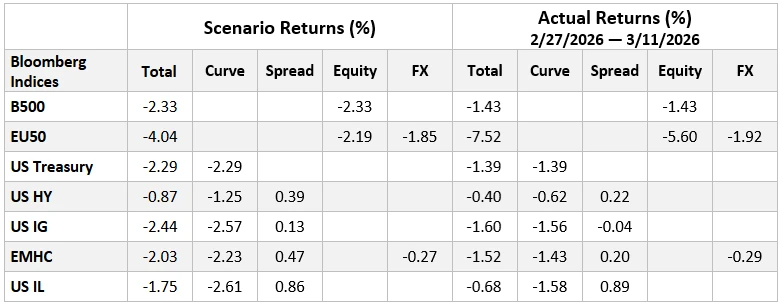
While differences in magnitude remain, the results indicate that the framework captures both the direction and relative scale of market moves, while also providing insight into the underlying drivers of performance.
A suite of scenarios for a global environment
The PORT Scenario Analysis tool includes a library of predefined scenarios covering a range of macroeconomic and geopolitical risks across the U.S. and Europe, including:
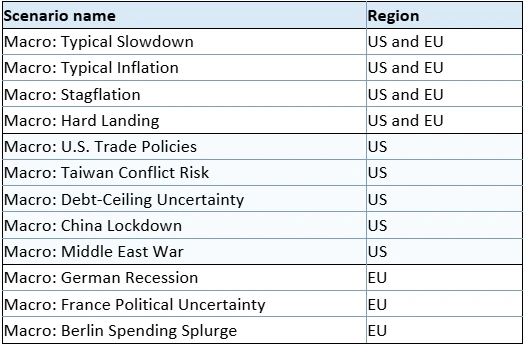
This library enables users to quickly stress test portfolios against relevant “what if” scenarios directly within the PORT interface.
Flexibility for active management
The MAC3 framework is designed to support a range of investment views. A key component is the choice of variance covariance (VCV) matrix used in the propagation of shocks.
During periods of macro stress, correlations across risky assets typically increase. MAC3 allows users to select VCV matrices calibrated to historical stress environments, helping ensure that cross-asset contagion effects are more realistically reflected in scenario results.
Strategic implementation in PORT
Macro Scenario Analysis is integrated directly into the PORT workspace via the Scenario tab and PREP MSR report, providing:
Security Level Granularity: Identify exposures to specific macro drivers such as energy shocks or demand slowdowns.
Detailed Attribution: Decompose returns into FX, equity, curve, and spread components.
Actionable Reporting: Export results for client communication and internal risk discussions.
Turning uncertainty into strategy
Periods of elevated volatility can complicate investment decision making. By decomposing geopolitical events into structural macroeconomic drivers, such as demand, uncertainty, energy, and interest rates, MAC3 Macro Scenario Analysis offers a more structured approach to assessing risk.
The ability to map macroeconomic shocks to portfolio outcomes provides investors with a clearer understanding of both potential impacts and their underlying drivers. As macro uncertainty persists, integrating economic modeling with portfolio analytics is likely to remain an important component of modern investment workflows.
What is MAC3?
Bloomberg MAC3 is a unified, multi-asset class factor risk model that provides a consistent view of risk across equities, fixed income, derivatives, and private assets. Integrated directly into PORT, it uses over 3,000 factors to decompose performance, identify risk drivers, and offer six analysis horizons for investment strategies.
What is PORT?
Bloomberg PORT is a comprehensive portfolio management and risk analytics platform integrated into the Bloomberg Terminal. It provides sophisticated tools for risk forecasting, performance attribution, and portfolio optimization. The platform supports multi-asset strategies across equities, fixed income, derivatives and private assets, offering actionable insights through advanced factor models like MAC3.
For detailed technical instructions and a step by step workflow, please consult the “MAC3 GRM Factor—Based Scenario Analysis — User Guide” on the Bloomberg Terminal. For more information on MAC3, click here.
Notwithstanding anything in the MAC3 GRM Factor Based Macro Scenario Analysis (this “White Paper”) to the contrary, the information included in this White Paper is for informational purposes only. Bloomberg Finance L.P. and/or its affiliates (as applicable, “Bloomberg”) makes no guarantee as to the adequacy, correctness or completeness of, or make any representation or warranty (whether express or implied) with respect to this White Paper. To the maximum extent permitted by law, Bloomberg and its affiliates shall not be responsible for or have any liability for any injuries or damages arising out of or in connection with this White Paper. All the information provided in this White Paper is confidential and proprietary to Bloomberg. Customer may not share, reproduce, publish, distribute or communicate this White Paper or information of any kind relating to these responses to any company, third parties or persons other than within Customer and only to such persons on a need—to—know basis in connection with this review.
The BLOOMBERG TERMINAL service and Bloomberg data products (the “Services”) are owned and distributed by Bloomberg Finance L.P. (“BFLP”) except (i) in Argentina, Australia and certain jurisdictions in the Pacific islands, Bermuda, China, India, Japan, Korea and New Zealand, where Bloomberg L.P. and its subsidiaries (“BLP”) distribute these products, and (ii) in Singapore and the jurisdictions serviced by Bloomberg’s Singapore office, where a subsidiary of BFLP distributes these products. BLP provides BFLP and its subsidiaries with global marketing and operational support and service. Certain features, functions, products and services are available only to sophisticated investors and only where permitted. BFLP, BLP and their affiliates do not guarantee the accuracy of prices or other information in the Services. Nothing in the Services shall constitute or be construed as an offering of financial instruments by Bloomberg Finance L.P., BLP or their affiliates, or as investment advice or recommendations by Bloomberg Finance L.P., BLP or their affiliates of an investment strategy or whether or not to “buy”, “sell” or “hold” an investment. The following are trademarks and service marks of BFLP, a Delaware limited partnership, or its subsidiaries: BLOOMBERG, BLOOMBERG ANYWHERE, BLOOMBERG MARKETS, BLOOMBERG NEWS, BLOOMBERG PROFESSIONAL, BLOOMBERG TERMINAL and BLOOMBERG.COM. Absence of any trademark or service mark from this list does not waive Bloomberg’s intellectual property rights in that name, mark or logo. All rights reserved. © 2026 Bloomberg.