
Bloomberg Economics
This article was written by Bloomberg Economics Geoeconomics Technology Analyst Michael Deng. It appeared first on the Bloomberg Terminal.
Just 44 artificial-intelligence-linked companies now account for roughly 45% of the S&P 500 and 71% of the index’s earnings growth. Microsoft Corp., Alphabet Inc., Amazon.com Inc., Meta Platforms Inc. and Oracle Corp. may spend a combined $3 trillion to $4 trillion on AI-related capex through 2032. Underpinning all of that isn’t just confidence in the new technology, but a belief that politics — local, national and global — won’t get in the way. That may be misplaced. Here are six reasons why:
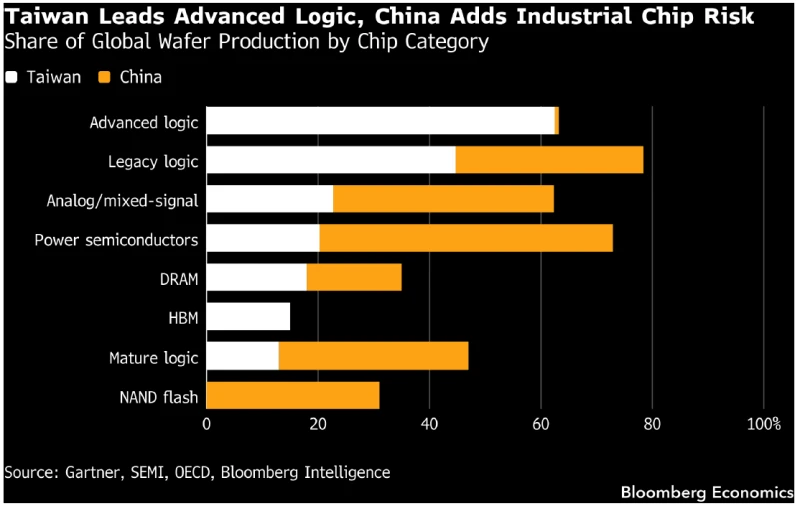
- Taiwan produces more than 60% of the world’s advanced logic chips. Any conflict over the island could disrupt that supply and stall the AI buildout.
- Supply chains for the AI revolution depend on Chinese-controlled rare earths, conflict-vulnerable materials and physical infrastructure that’s increasingly a target.
- Export controls are expanding from hardware to frontier models. Anthropic PBC’s case shows how shifts in Washington can put a frontier AI firm in the crosshairs — especially as powerful models raise national security concerns.
- Tariffs haven’t yet hit the core AI hardware stack, but the US imports an estimated 80% of the inputs needed to build it, and continued uncertainty alone deters investment.
- Local resistance to data centers has delayed or blocked an estimated $64 billion in US projects. Some 71% of Americans oppose construction in their area.
- AI skepticism is bipartisan. 80% of Americans want safety rules even if they slow development, a view shared by 88% of Democrats and 79% of Republicans.
Taiwan disruption risk
Taiwan accounts for more than 60% of the world’s advanced logic chip production, including the processors used in AI servers. A Chinese invasion — unlikely in the near-term but far from implausible — would take that capacity offline, stalling data-center construction and forcing cloud providers to ration existing compute. The AI infrastructure build out would come to an extended halt.
Supply chain vulnerabilities
Taiwan isn’t the only place where geopolitics and the AI supply chain intersect. The buildout depends on a global web of specialized inputs that can be disrupted by wars, shipping shocks, sanctions, export controls or production outages far from the data center itself.
Beijing dominates rare-earth processing, permanent magnet production, battery materials, solar wafers and other manufactured components tied to the energy, cooling, grid and manufacturing systems needed to support data centers. China’s rare-earth magnet controls in June 2025 showed how quickly that dominance can move from signaling to disruption.
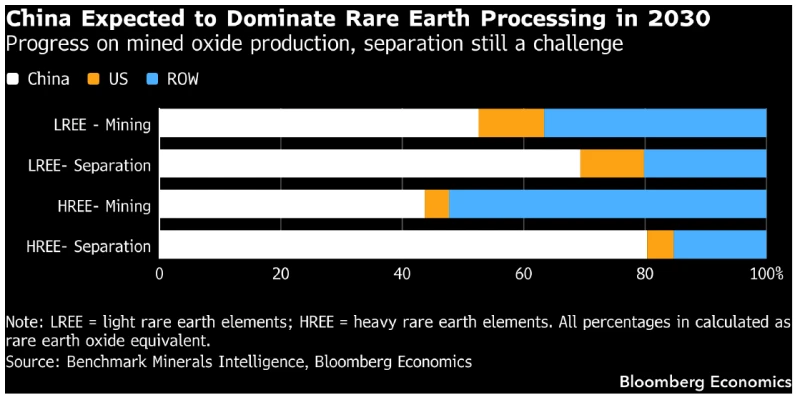
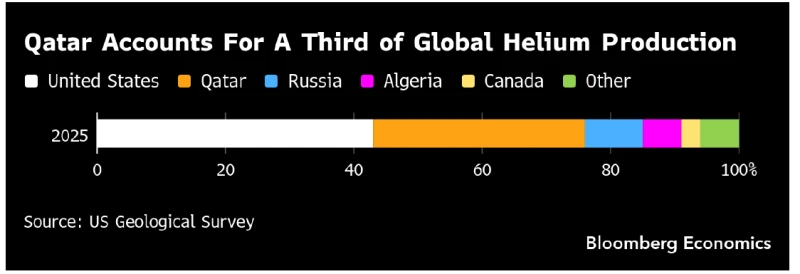
Helium, which is difficult to replace in semiconductor manufacturing, saw production and shipping interrupted by the Iran conflict. Neon became a concern for chip production early in the war in Ukraine. In both cases, a seemingly obscure input suddenly threatened to constrain chip output.
The risk runs wider than GPUs. Specialty materials, chipmaking tools, cooling and power systems, many of them with limited redundancy and long replacement timelines, are all vulnerable to supply chain outages.
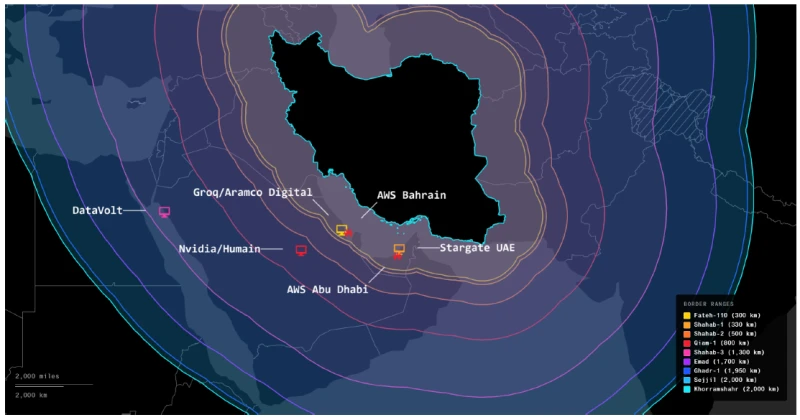
As compute becomes strategic infrastructure, it can also become a target. Attacks and threats against Gulf cloud and data-center infrastructure during the Iran war showed that physical security is now part of the cost and geography of frontier compute.
Gulf AI infrastructure within Iranian missile range
Frontier model controls
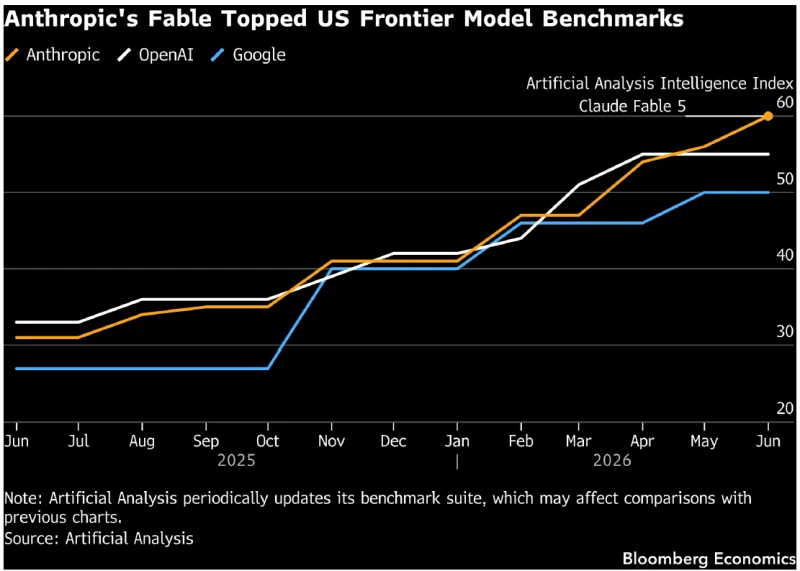
The US Commerce Department’s restriction on Anthropic shows that US export controls can limit access to alive frontier model, extending AI controls from the supply chain to the product itself. The full technical basis hasn’t been made public. But the administration’s request that OpenAI limit initial access to its latest model suggests the concern is broader than Anthropic. Together, these moves signal that governments are becoming less comfortable with the global spread of increasingly powerful AI systems, especially models with cyber or military applications.
Frontier models are increasingly likely to be treated as strategic assets, subject to the kinds of access limits and release restrictions that have historically applied to hardware.
Tariff uncertainty
Building a data center in the US requires servers, GPUs, networking gear, cooling systems and power equipment. An estimated 80% of the compute stack is imported. Taiwan supplied about $86 billion in server and related equipment in 2025, and effectively all US-brand AI servers are sourced from Taiwanese manufacturers.
The direct tariff hit to AI hardware remains limited for now, with many core
semiconductor and data-center uses still carved out, and the administration has shown flexibility in avoiding hitting priority sectors. But chip tariff s remain on the table. The White House has said broader duties may follow negotiations, and administration officials have framed the issue as one of timing and scale rather than whether semiconductor protection is needed.
The numbers add up quickly when the US is on track to spend trillions
on data-center infrastructure by 2030. One industry estimate put the cost of a 25% tariff on semiconductors used in data centers at roughly $90 billion a year, enough to relocate, cancel or delay about 20% of planned US buildouts through 2030. But the bigger constraint might be the uncertainty itself. Companies have less reason to commit to US fabs or datacenters if they can’t tell what the tariff regime will look like.
Local resistance
In Matthews, North Carolina, developers withdrew a proposed data center after residents packed public meetings, organized a 2,700-signature petition and flooded local officials with opposition. The mayor said roughly 99 of every 100 emails he received were against the plan.
Matthews isn’t unusual. Gallup found in May that 71% of Americans oppose construction of an AI data center in their local area, making them more unpopular than nuclear plants, which drew 53% opposition. Virginia’s legislative watchdog estimated that data-center-driven generation and transmission costs could add $14 to $37 a month to a typical Dominion Energy Inc. residential bill by 2040.
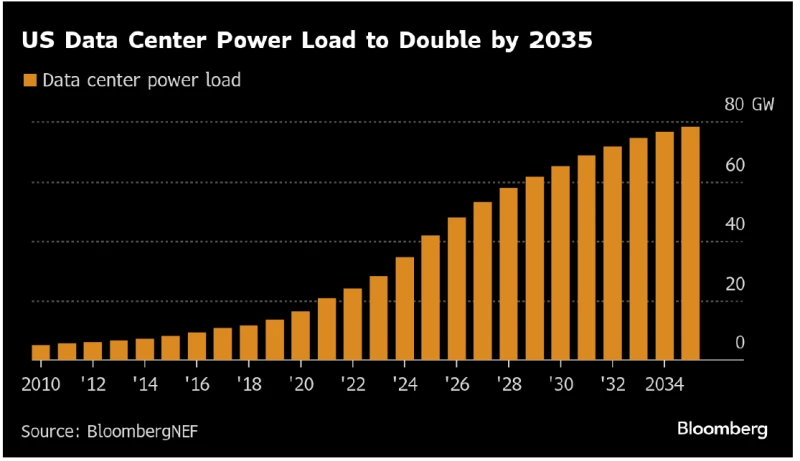
Most countries’ grids weren’t built for the speed or scale of the current data-center rush, and the US regulatory system wasn’t designed to move this fast. On June 18, FERC told regional grid operators to explain whether their rules can handle a wave of new data-center power demand, or change them if they can’t. AI infrastructure can move only as fast as regulators can reconcile hyperscaler demand with reliability, customer bills and local resistance.
Public backlash to AI
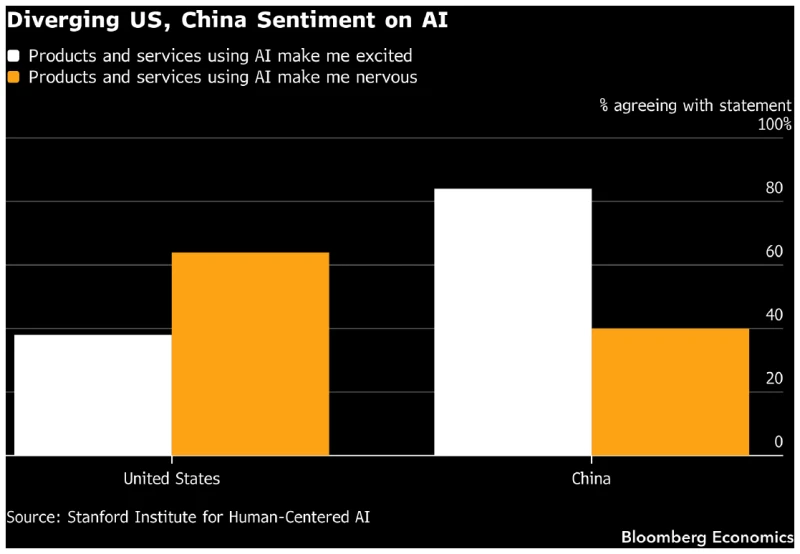
AI skepticism is bipartisan. A Gallup poll found that 80% want the government to maintain AI safety rules even if that slows development, a view held by 88% of Democrats and 79% of Republicans and independents. A separate poll from Pew Research found that only 16% of US adults expect AI to have a positive impact over the next 20 years. Ahead of the midterms, both parties have reason to channel that into stricter oversight.
The data included in these materials are for illustrative purposes only. The BLOOMBERG TERMINAL service and Bloomberg data products (the “Services”) are owned and distributed by Bloomberg Finance L.P. (“BFLP”) except (i) in Argentina, Australia and certain jurisdictions in the Pacific Islands, Bermuda, China, India, Japan, Korea and New Zealand, where Bloomberg L.P. and its subsidiaries (“BLP”) distribute these products, and (ii) in Singapore and the jurisdictions serviced by Bloomberg’s Singapore office, where a subsidiary of BFLP distributes these products. BLP provides BFLP and its subsidiaries with global marketing and operational support and service. Certain features, functions, products and services are available only to sophisticated investors and only where permitted. BFLP, BLP and their affiliates do not guarantee the accuracy of prices or other information in the Services. Nothing in the Services shall constitute or be construed as an offering of financial instruments by BFLP, BLP or their affiliates, or as investment advice or recommendations by BFLP, BLP or their affiliates of an investment strategy or whether or not to “buy”, “sell” or “hold” an investment. Information available via the Services should not be considered as information sufficient upon which to base an investment decision. The following are trademarks and service marks of BFLP, a Delaware limited partnership, or its subsidiaries: BLOOMBERG, BLOOMBERG ANYWHERE, BLOOMBERG MARKETS, BLOOMBERG NEWS, BLOOMBERG PROFESSIONAL, BLOOMBERG TERMINAL and BLOOMBERG.COM. Absence of any trademark or service mark from this list does not waive Bloomberg’s intellectual property rights in that name, mark or logo.
All rights reserved. © 2025 Bloomberg.