ARTICLE
US regulator’s AI data center rules nudge grids forward

BloombergNEF
- Large load rules cover 60% of 2035 US data center demand
- Ercot and vertically-integrated utilities not covered by rules
This article was written by BloombergNEF Analyst Derrick Flakoll. It appeared first on the Bloomberg Terminal.
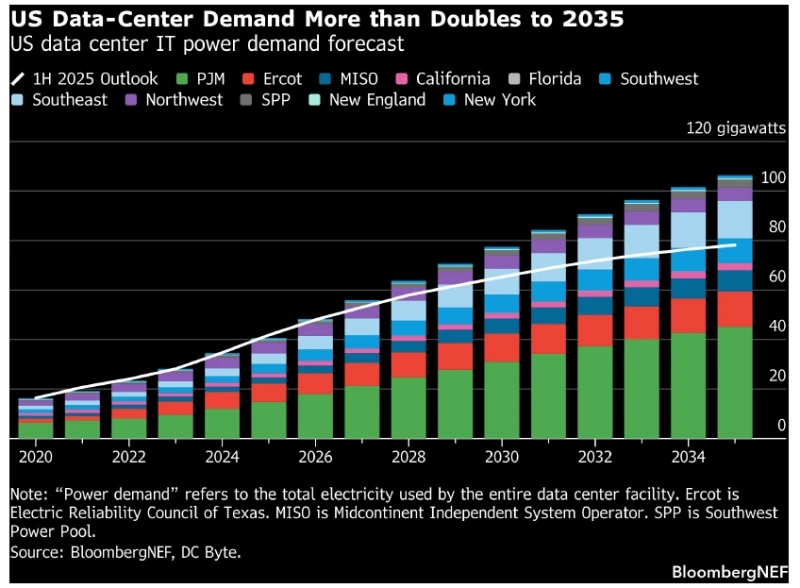
The US Federal Energy Regulatory Commission’s (FERC’s) long-awaited June 18 orders on grid connections for large loads could accelerate development for hyperscale data centers and protect consumer power bills in regions due to host over 60% of the nation’s projected data-center power demand in 2035.
Yet with major data center hubs like Texas, Georgia and Arizona not covered by these rules, and a months-long process to customize FERC’s rules for each major grid region, it remains unclear whether the orders will deliver on their objective.
Broadly, the FERC orders aim to:
- Prevent new large loads from raising costs for other customers, both by requiring large loads to pay for new generation and transmission upgrades they need and by reducing risks that utilities will overspend on those upgrades.
- Increase speed and minimize complexity and cost of interconnection studies needed for large loads, including by requiring the consideration of grid-enhancing technologies (GETs), which may be faster and cheaper than conventional transmission upgrades.
- Expedite interconnection studies for new generation matched to large loads, which may present fewer complexities and risks than generation or load studied alone.
- Create flexible transmission service for large loads, reducing peak power demand and related infrastructure costs and risks.
- Enable smaller and more flexible transmission tariffs for loads co-located with generation to support the four goals above.
The Commission emphasized that these orders were customized to each of the six major US regional power markets, and that they were meant to complement and accelerate, but not supersede, recent reforms in regions like the Southwest Power Pool (SPP) and PJM, the largest US grid and the nation’s data center capital. Yet with the future of AI potentially hanging in the balance — along with the power bills of over 200 million customers — the devil will be in the details of these six distinct orders, and in how each RTO puts them into practice.
Local experiments, national standards
FERC’s proposals build on, and try to generalize, innovations first proposed for PJM and SPP. The Commission has cited SPP as a model to other regional grids for its proposals to off er curtailable service to large loads during transmission upgrades and to accelerate interconnection studies for High Impact Large Loads (HILLs) and matching on-site or associated power supplies — an approach known as “bring your own new generation.” In their remarks, commissioners and staff also made clear that PJM’s new procedures for downsizing and expediting transmission upgrades for large loads that co-locate with a behind-the-meter power supply should be implemented throughout the other power regions.
Still, even regional leaders face regulatory pressure to accelerate implementation. The commissioners urged PJM to implement its co-location tariffs ahead of its 2029 target and to use next month’s technical conference to streamline its governance amid surging power prices. FERC also ordered the Midcontinent Independent System Operator (MISO) to change its demand response program. More broadly, the commission asked all independent system operators (ISOs) to move faster as massive data center loads rapidly approach.
FERC’s limits and the road ahead
Given the fast-moving challenge of the AI scale-up, there’s only so much FERC orders can accomplish. The federal regulator has limited jurisdiction over transmission interconnection within vertically-integrated utility states in the South and the Northwest or in the Electricity Reliability Council of Texas (Ercot), the islanded grid covering most of the Lone Star State. Its very authority to regulate large load interconnection has been disputed by state-level utility regulators and former FERC commissioners like ex-chair Mark Christie. Even with an RTO in its jurisdiction, FERC can take months or years to agree on a final rule for that region.
Ultimately, these moves by FERC on large load interconnection mostly aim to confirm and accelerate standards for large load study processes, flexibility and ratepayer protections emerging among many states and, increasingly, the RTOs themselves. Each RTO must now submit a filing explaining how it’s conforming to FERC’s orders within 60 days, kicking off a back-and-forth negotiation between the regions and federal regulators to arrive at a solution. As FERC walks a tightrope between promoting shared standards and respecting each market’s unique structure, the risk is that an ineffective reform proposal slips through the process – or that bureaucracy or federal-local infighting paralyze the regulatory process until it’s too late.
The data included in these materials are for illustrative purposes only. The BLOOMBERG TERMINAL service and Bloomberg data products (the “Services”) are owned and distributed by Bloomberg Finance L.P. (“BFLP”) except (i) in Argentina, Australia and certain jurisdictions in the Pacific Islands, Bermuda, China, India, Japan, Korea and New Zealand, where Bloomberg L.P. and its subsidiaries (“BLP”) distribute these products, and (ii) in Singapore and the jurisdictions serviced by Bloomberg’s Singapore office, where a subsidiary of BFLP distributes these products. BLP provides BFLP and its subsidiaries with global marketing and operational support and service. Certain features, functions, products and services are available only to sophisticated investors and only where permitted. BFLP, BLP and their affiliates do not guarantee the accuracy of prices or other information in the Services. Nothing in the Services shall constitute or be construed as an offering of financial instruments by BFLP, BLP or their affiliates, or as investment advice or recommendations by BFLP, BLP or their affiliates of an investment strategy or whether or not to “buy”, “sell” or “hold” an investment. Information available via the Services should not be considered as information sufficient upon which to base an investment decision. The following are trademarks and service marks of BFLP, a Delaware limited partnership, or its subsidiaries: BLOOMBERG, BLOOMBERG ANYWHERE, BLOOMBERG MARKETS, BLOOMBERG NEWS, BLOOMBERG PROFESSIONAL, BLOOMBERG TERMINAL and BLOOMBERG.COM. Absence of any trademark or service mark from this list does not waive Bloomberg’s intellectual property rights in that name, mark or logo.
All rights reserved. © 2025 Bloomberg.