
Bloomberg Professional Services
- Automation is moving beyond efficiency: Trading desks are increasingly looking at automation not only for speed and scale, but also for its impact on execution performance.
- Automated workflows can improve first-route outcomes: Orders executed using Bloomberg Rule Builder showed higher first-route fill rates, indicating that rules-based workflows can help identify dealers with sufficient liquidity at the point of execution.
- Client adoption continues to grow: From mid-year 2025 to mid-year 2026, Rule Builder saw a 15% increase in order count, a 38% increase in executed volume and a 20% increase in trading desks using the tool. The number of rules created rose by more than 50%.
Fixed income trading is changing quickly. As electronic adoption grows, we are seeing higher trading volumes through Bloomberg, while desks are asked to manage more activity. We are also seeing automation become a more important part of the execution workflow.
Bloomberg Rule Builder, part of Bloomberg Electronic Markets, enables trading desks to automate defined parts of their fixed income execution workflows while maintaining control over how and when orders are routed. For many desks, the focus is moving beyond speed and efficiency to whether automation can also support better execution performance.
PRODUCT MENTIONS
A recent Bloomberg Fixed Income Automation webinar explored how firms are approaching that shift towards greater automation in fixed income trading. The discussion drew on Bloomberg analysis across U.S., European and U.K. sovereign and credit markets, looking at measures including execution within benchmark spreads, adverse slippage and dealer interaction.
The data provides a clearer view of where automation can contribute to execution performance, particularly where workflows can be defined in advance and applied consistently.
The charts below provide a more recent view of Bloomberg Rule Builder performance across U.S. Treasuries, Sovereigns and Credit traded through Bloomberg Electronic Markets.
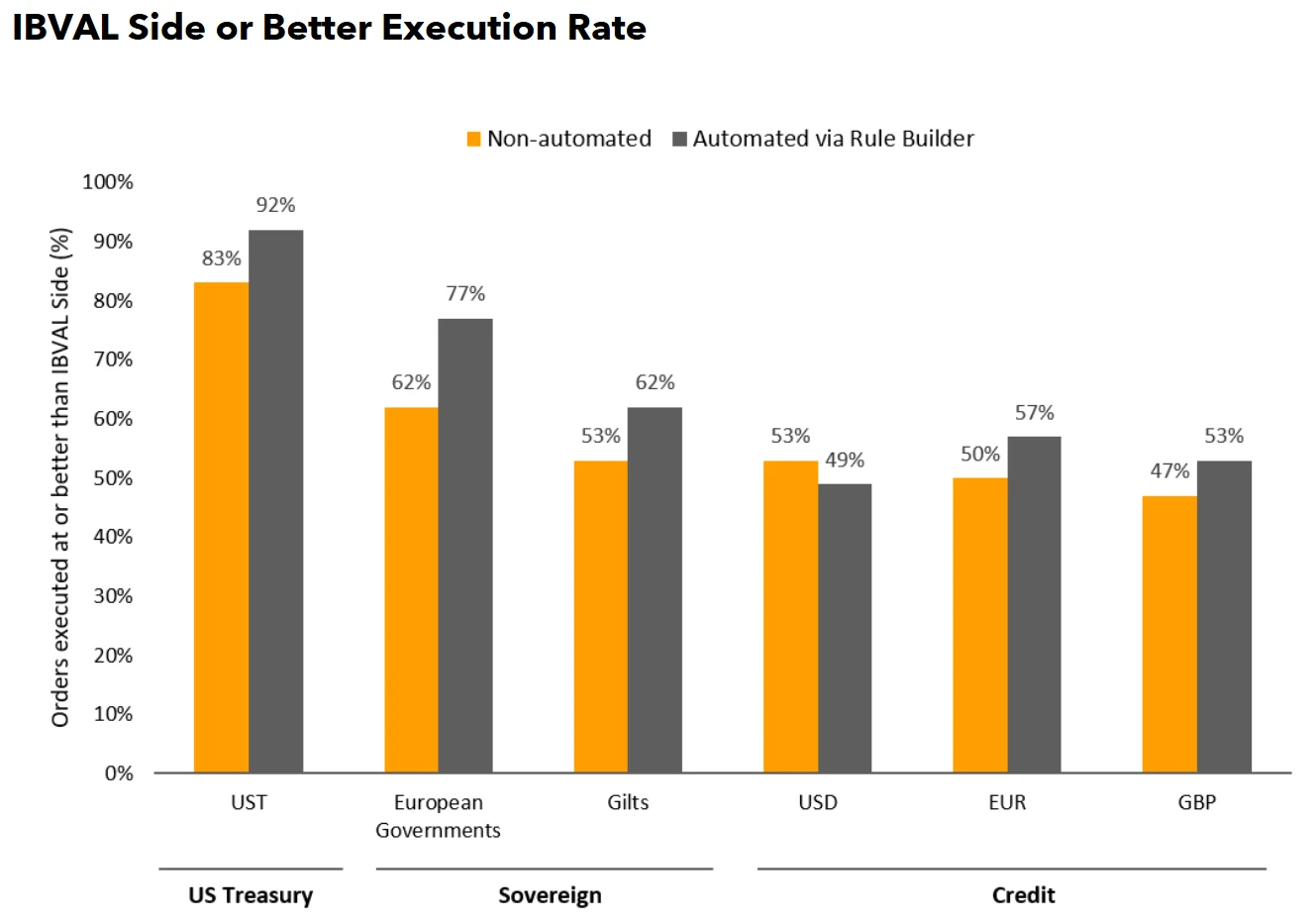
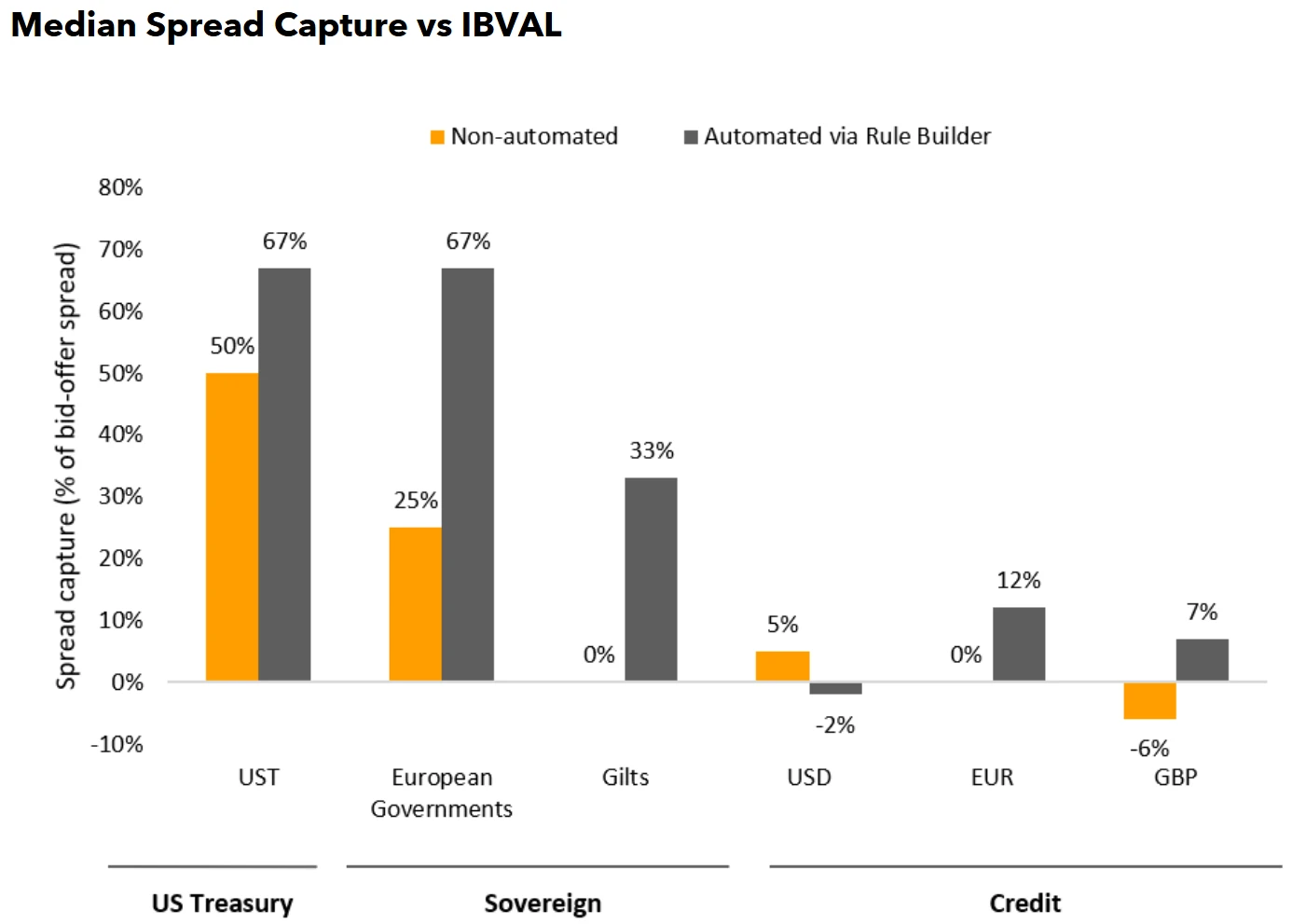
Across the data set, Rule Builder executed a high proportion of orders inside the arrival IBVAL spread, while also showing meaningful bid/offer spread capture across U.S. Treasuries, Sovereigns and Credit. Rule Builder executed 83% of U.S. Treasury orders inside the IBVAL spread, with 67% median bid/offer spread capture. In Sovereigns, the tool executed 77% of European Government orders and 62% of Gilt orders inside the spread, with median bid/offer spread capture of 67% and 33%, respectively. In Credit, Rule Builder executed 49% of USD orders, 57% of EUR orders and 53% of GBP orders inside the spread, with median spread capture ranging from -2 to 12% – compared to -6 to 5%.
The takeaway, according to Chris Clodius, Global Head of Trade Automation at Bloomberg, is not that every order should be automated. Rather, the data shows where rules-based workflows can support more consistent execution in areas of the market well suited to automation.
The third chart looks at another measure of execution quality: first-route fill rates, or inverse quit ratio.
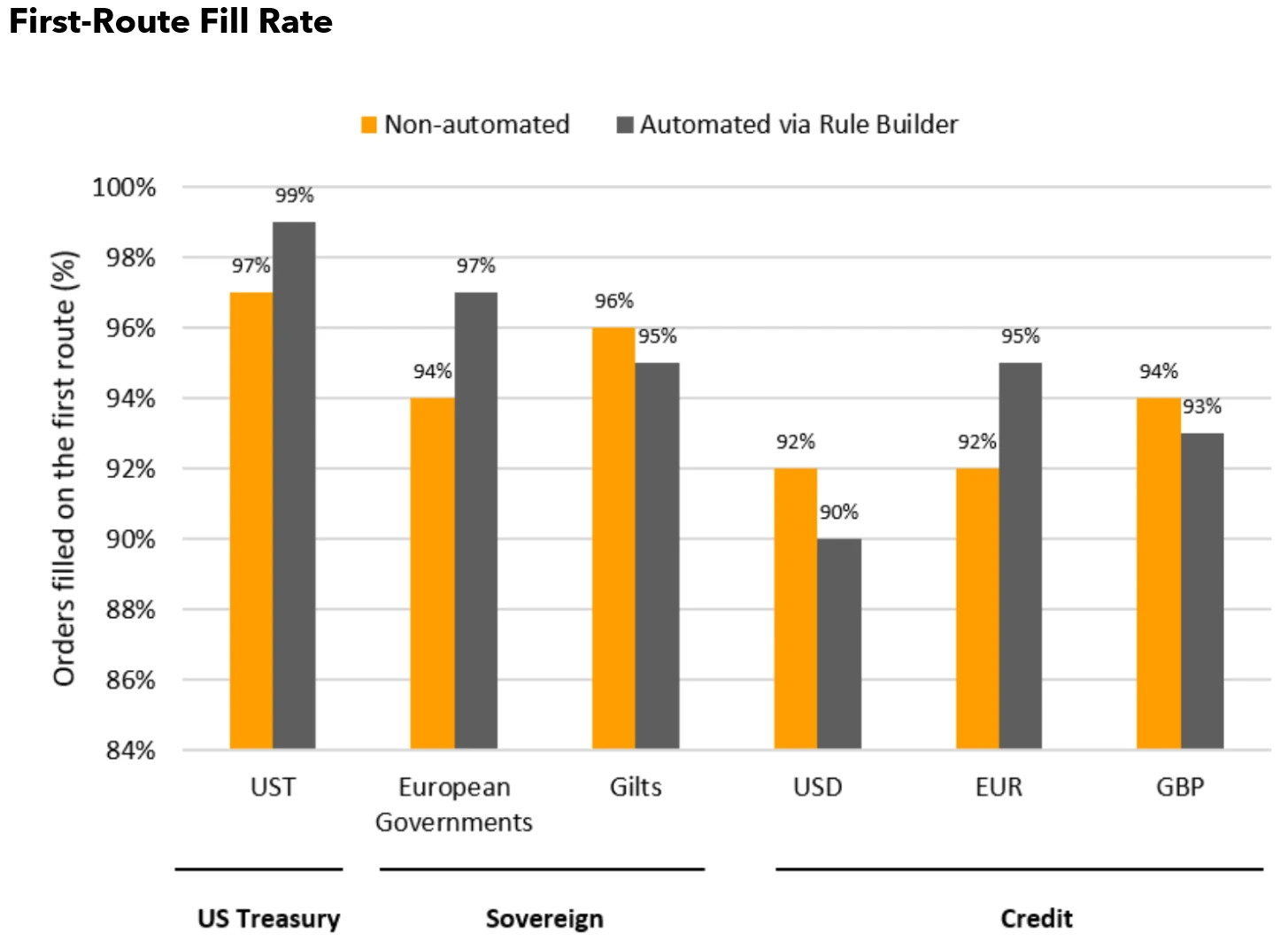
When Rule Builder is used, a higher proportion of orders that are ultimately filled are completed on the first attempt. This indicates that automated workflows can improve the likelihood of reaching a dealer with sufficient liquidity on the first route.
Adoption is also increasing. Comparing mid-year 2025 with mid-year 2026, Bloomberg Rule Builder saw a 15% increase in order count, a 38% increase in executed volume and a 20% increase in the number of trading desks using the tool. Over the same period, the number of rules created increased by more than 50%, showing that desks are applying rules across a broader range of fixed income execution workflows.
The webinar also highlighted that fixed income automation does not need to be an all-or-nothing decision. Different levels of automation can be applied depending on the order, product and trading objective.
At the other end are low-touch and zero-touch workflows, where orders that meet predefined criteria can be routed, monitored and, where appropriate, executed automatically.
Most desks build towards greater automation gradually. They typically start with the parts of the workflow that are easiest to define, such as smaller tickets, more liquid products, benchmark-based execution and dealer selection. From there, automation can extend into delayed routing, retry logic, slicing and other more advanced workflows.
Watch to learn more: Scaling Fixed Income Execution with Bloomberg Rule Builder