
Bloomberg Professional Services
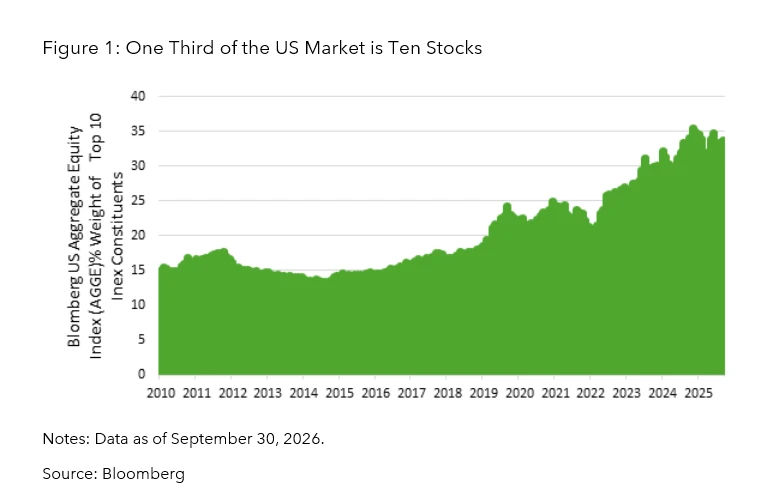
- The 10 largest companies in the Bloomberg US Aggregate Equity Index account for more than one-third of the index, more than double their share a decade ago.
- Developed markets outside the US provide exposure to AI-related growth alongside country-specific drivers, including corporate governance reforms in Japan.
- A broader developed markets allocation can expand the opportunity set across markets and companies while reducing concentration in the largest US stocks.
This article was written by Mike Pruzinsky, Equity Index Product Manager at Bloomberg Index Services Limited
US equity concentration has risen sharply over the last decade. Developed market stocks outside the US offer a broader opportunity set, including companies that are central to the same structural trends driving domestic portfolios.
PRODUCT MENTIONS
The top 10 companies in the broad Bloomberg US Aggregate Equity Index (AGGE) now account for more than a third of the index, more than double their share a decade ago. Those weights were earned. Revenues grew, margins expanded and shareholders were well rewarded, which is exactly how market cap weighting is supposed to work. But it also means a “diversified” US portfolio today is less a reflection of the broad economy and more a bet that mega-cap technology and AI leadership continues.
That is not a problem on its own. However, it is worth knowing what you own, especially when thinking about how a portfolio is positioned for what comes next.
This article looks at the rise in US equity concentration, the changing case for developed markets outside the US and how global exposure can broaden the sources of growth within an equity portfolio.
How has the case for international diversification changed?
For most of the last decade, the case for investing internationally produced mixed results. The arguments were reasonable: cheaper valuations, country diversification and a wider opportunity set. But US equities kept winning, and international diversification mostly showed up as lagging returns. That was technically diversification, just not the kind investors were hoping for. The diversification case remained, but the relative performance made maintaining that exposure challenging.
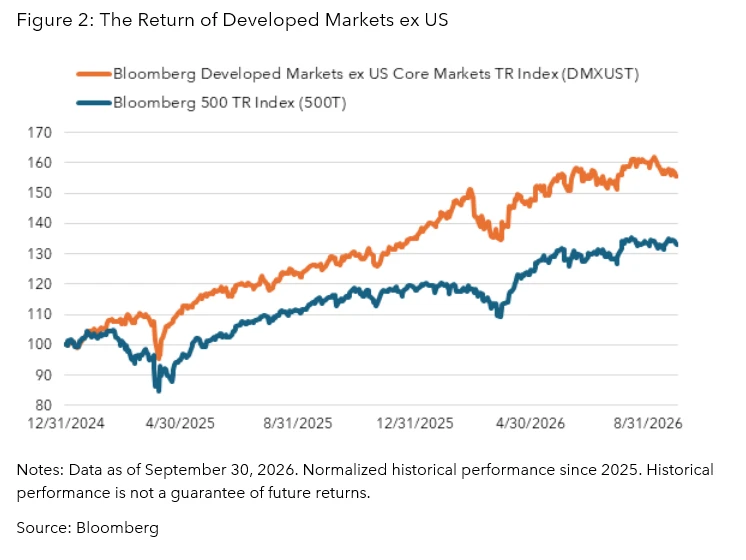
The case today looks different, and not because it is finally international equities turn. Earnings are growing, reforms are taking hold in key markets, capital allocation policies are changing, and the global buildout of AI infrastructure is reaching well beyond US borders. Since the start of 2025, core developed markets outside the US outperformed by over 22%.
Growth themes are more than a US story
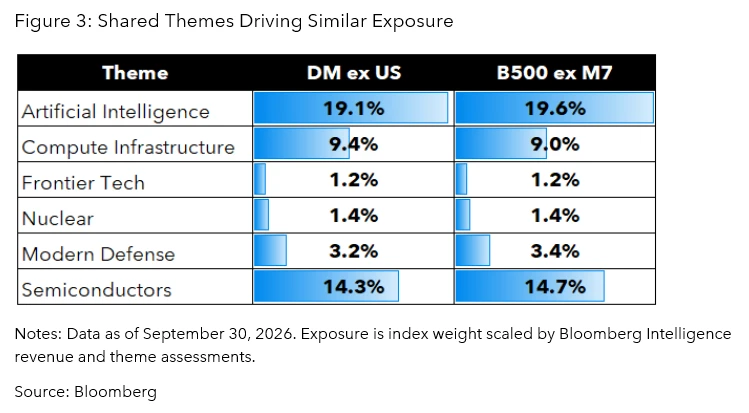
Many of the forces reshaping US equity markets are not uniquely American. AI is one example. The Magnificent 7 companies driving much of the AI investment cycle are US–listed, but the infrastructure supporting that buildout is distinctly global, spanning semiconductors, memory, manufacturing equipment, power systems and data centers across Europe and Asia.
That matters for portfolio construction. Developed Markets ex US has traditionally been a financials and industrials story, but it now carries meaningful AI exposure too. AI related companies make up 19.1% of DM ex US, in line with the 19.6% for the Bloomberg 500 ex Magnificent 7 Index.
Technology is only part of it. Idiosyncratic country drivers matter too. For example in Japan governance reforms have pushed companies toward capital efficiency and shareholder returns through dividends, buybacks and tighter balance sheets. That is a source of return with a different driver than the ones behind US markets, and it is one of several markets where local forces, not the AI cycle, are driving returns.
A broader vote for developed markets outside US
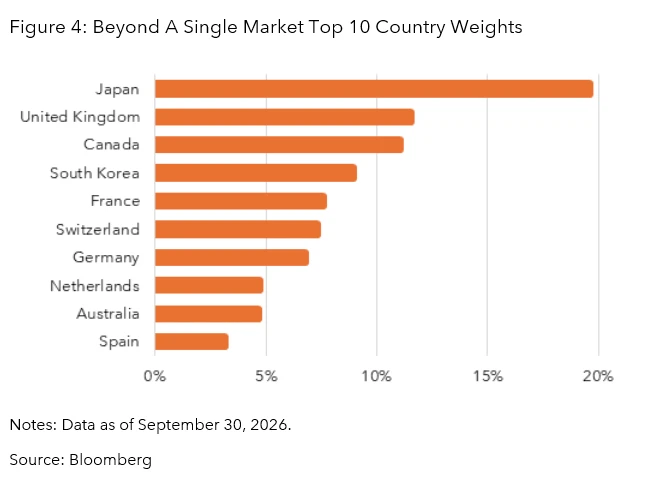
Where you draw the map of developed markets matters. The Bloomberg Developed Markets ex US Core Markets Index (DMXUS) provides broad exposure to large and mid–cap stocks across developed markets outside the United States, including the UK, Germany, France, Japan, Australia, Canada and South Korea. South Korea’s inclusion is particularly relevant as global supply chains evolve. Its leadership in semiconductors and memory, along with its growing role in the infrastructure behind the global AI buildout, makes it an increasingly important part of the global economic landscape.
Construction is intentionally simple: rules-based, free-float market-cap weighted, with transparent eligibility criteria and a regular rebalance. The objective is broad, representative exposure to developed markets outside the US that evolves as those markets change.
What does broader developed market exposure mean for portfolios?
The choice between US leadership and global diversification does not have to be binary for investors reconsidering international exposure. Many of the forces supporting US markets are increasingly global, and developed markets outside the US have catalysts of their own. The more useful framing is an expanded opportunity set, not a counterweight to US leadership.
Growth and investment increasingly cross borders, creating opportunities across more markets and sources of return. A broader developed markets allocation can provide exposure across a broader set of markets and companies with less concentration in a handful of largest US stocks. The Bloomberg Developed Markets ex US Core Markets Total Return Index is also used as the underlying benchmark for the Xtrackers Bloomberg Developed Markets ex US Equity ETF (DMXU).
The data and other information included in this publication is for illustrative purposes only, available “as is”, non-binding and constitutes the provision of factual information, rather than financial product advice. BLOOMBERG and BLOOMBERG INDICES (the “Indices”) are trademarks or service marks of Bloomberg Finance L.P. (“BFLP”). BFLP and its affiliates, including BISL, the administrator of the Indices, or their licensors own all proprietary rights in the Indices. Bloomberg L.P. (“BLP”) or one of its subsidiaries provides BFLP, BISL and its subsidiaries with global marketing and operational support and service. Certain features, functions, products and services are available only to sophisticated investors and only where permitted. Bloomberg (as defined below) does not approve or endorse these materials or guarantee the accuracy or completeness of any information herein, nor does Bloomberg make any warranty, express or implied, as to the results to be obtained therefrom, and, to the maximum extent allowed by law, Bloomberg shall not have any liability or responsibility for injury or damages arising in connection therewith. Nothing in the Services or Indices shall constitute or be construed as an offering of financial instruments by Bloomberg, or as investment advice or investment recommendations (i.e., recommendations as to whether or not to “buy”, “sell”, “hold”, or to enter or not to enter into any other transaction involving any specific interest or interests) by Bloomberg. Information available via the Index should not be considered as information sufficient upon which to base an investment decision. All information provided by the Index or in this publication is impersonal and not tailored to the needs of any person, entity or group of persons. Absence of any trademark or service mark from this list does not waive Bloomberg’s intellectual property rights in that name, mark or logo. For the purposes of this publication, Bloomberg includes BLP, BFLP, BISL and/or their affiliates.
BISL is registered in England and Wales under registered number 08934023 and has its registered office at 3 Queen Victoria Street, London, England, EC4N 4TQ. BISL is authorised and regulated by the Financial Conduct Authority as a benchmark administrator.
© 2026 Bloomberg. All rights reserved.