ARTICLE
Beyond low latency: Managing complexity in fixed income trading
Bloomberg Professional Services
- Speed matters in fixed income markets, but scale is becoming the harder problem as trading desks face more data, interactions and automated workflows at once.
- Automation can filter routine activity and direct human attention towards the high-impact opportunities and risks that warrant judgement.
- Competitive advantage increasingly depends on turning high volumes of market activity into clear, usable decisions.
This article is by Shawn Stern, Head of Sell-Side Integration & Toc at Bloomberg and Dan Tsou, Global Head of Sell-Side EMS at Bloomberg
In some parts of the fixed income market, a fraction of a millisecond can change the outcome of a trade.
In fixed income markets, electronic trading continues to expand, systematic trading is becoming more common and market participants increasingly compete on speed. What was once measured in milliseconds is now often measured in microseconds or nanoseconds.
PRODUCT MENTIONS
Speed matters beyond continuous order books. In request-for-quote markets, an early response can confer a meaningful advantage. Market makers also need to update prices quickly as conditions change, reducing the chance that faster participants capitalize on stale quotes.
Otherwise, systematic traders can arbitrage that gap before someone can react. That’s where the microseconds really matter. It’s not just the distance between a server and the exchange, but the software on that server, and the person’s ability to make a decision based on that software.”
But speed is just one part of the puzzle.
Trading desks are being asked to respond faster while handling more market data, execution venues, portfolios, electronic interactions and automated processes. More activity means more decisions arriving at once. The pressing question is not simply how quickly a desk can move, but how effectively it can distinguish signal from noise.
The volume problem
Electronic trading has greatly increased the number of interactions flowing through fixed income desks. Portfolio trading adds another layer. Instead of assessing a single security or request, firms may need to process baskets containing hundreds or thousands of instruments simultaneously.
Portfolio trading means you’re no longer sending one request at a time, you’re sending 1,000 at a time. Combined with more systematic participation, electronic markets and AI-driven activity, that creates a lot more volume. This is already happening, but it’s going to continue to escalate. The result is a market generating more and more information, and traders have to make sense of it all in real time.
That changes the role technology must play. A system that delivers every update, RFQ, venue signal and risk notification to a trader may be fast, yet still fail to help. When information multiplies, access is only the first step. The harder task is deciding what requires attention.
Human traders cannot examine every interaction manually. Nor should they. Their judgement is most valuable when applied to complex risks, important client relationships and high-impact opportunities, not routine decisions that can be handled consistently through rules pre-defined by a trader.
Automation as a filter for complexity
The purpose of automation is not to remove people from every decision. It is to make sure they are involved in the right ones.
Rules engines and automated workflows can filter RFQs according to factors such as size or risk profile. They can support venue selection, route orders, handle standard activity and escalate exceptions. Instead of presenting traders with an undifferentiated stream of information, technology can organize activity around urgency, value and risk.
The key is designing rule systems and automation that allow traders to focus on the most important things. You still need human eyes on the critical decisions, but it need to be on the right decisions. By filtering out the noise, traders can focus on the most alpha-generating activities.
This is a more useful way to think about the relationship between people and machines. The goal is not maximum automation. It is the right allocation of attention, leveraging the right tools at the right moment.
Routine, repeatable decisions can move through automated workflows. Complex or unusual cases can be surfaced to a trader with the relevant information attached. That helps desks absorb greater volumes without expanding the cognitive burden at the same rate.
Better automation starts with better data
Automation is only as useful as the information behind it. Faster workflows will not improve outcomes if they are based on incomplete, delayed or poorly connected data.
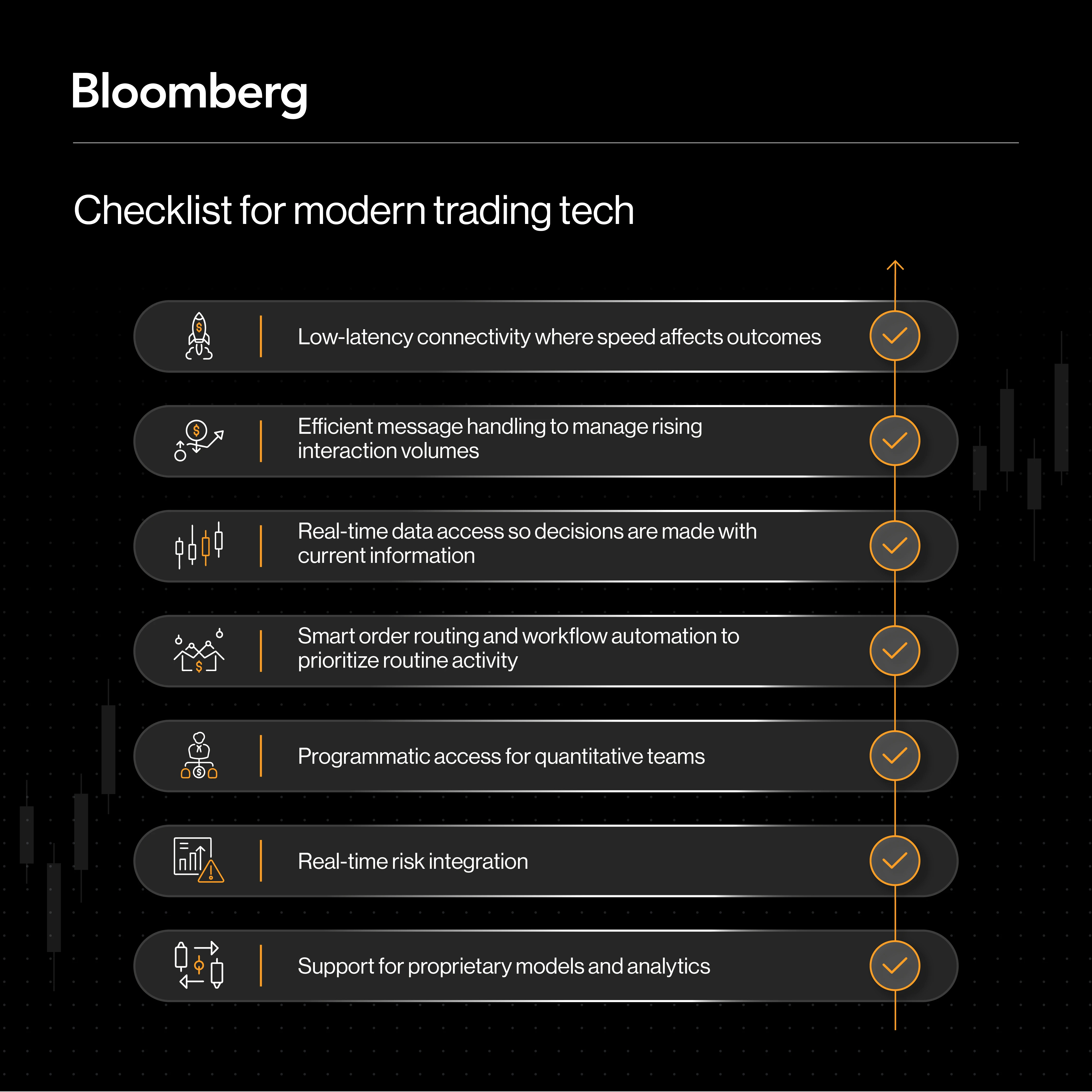
As trading becomes more systematic, traders, quantitative teams and risk functions need direct access to market data and analytics. They must be able to evaluate changing conditions, assess risk and refine models as new information becomes available.
Automation is important, but having access to the underlying datasets is crucial. For the most systematic firms, it’s about giving quantitative and algorithmic teams direct access to the data and systems so those traders can do more analysis, conduct more real-time risk evaluation and build models on the fly.
The objective is not automation for its own sake. It is better decision-making: bringing execution activity, market context, analytics and risk information together quickly enough to support a considered response.
From raw speed to decision clarity
Performance will increasingly depend on how effectively firms convert market activity into usable decisions.
That has implications for where firms direct their investment. Connectivity and routing remain essential, but they are the foundation rather than the source of differentiation. The greater opportunity lies in what firms build on top: proprietary models, sharper analysis and a stronger understanding of how markets may respond as conditions change.
The value for most customers comes from building models, understanding markets and predicting what happens when conditions change. The ideal approach is to use existing connections, routing and automation systems, then add your own special sauce on top.
Bloomberg Trade EMS brings execution, data, analytics and workflow automation into one solution. For trading desks, the aim is not simply to reduce latency. It is to manage growing complexity and make effective decisions at greater scale.
Low latency is table stakes when it comes to today’s trading ecosystem, but the defining test for trading desks will be what they do with the time it saves. In a market producing more signals, requests and decisions than any individual can absorb, speed delivers an advantage only when it leads to clarity.