ARTICLE
Harnessing AI’s disruption in the C-Suite to power growth

Bloomberg Intelligence
This analysis is by Bloomberg Intelligence Analysts Mathew Bloxham and Anurag Rana. It appeared first on the Bloomberg Terminal.
A Bloomberg Intelligence survey of companies across North America, Europe and Asia showed the depth of AI integration across multiple industries, with more than one-third of C-suite leaders now calling it their No. 1 strategic priority. An additional 47% put it in their top three.
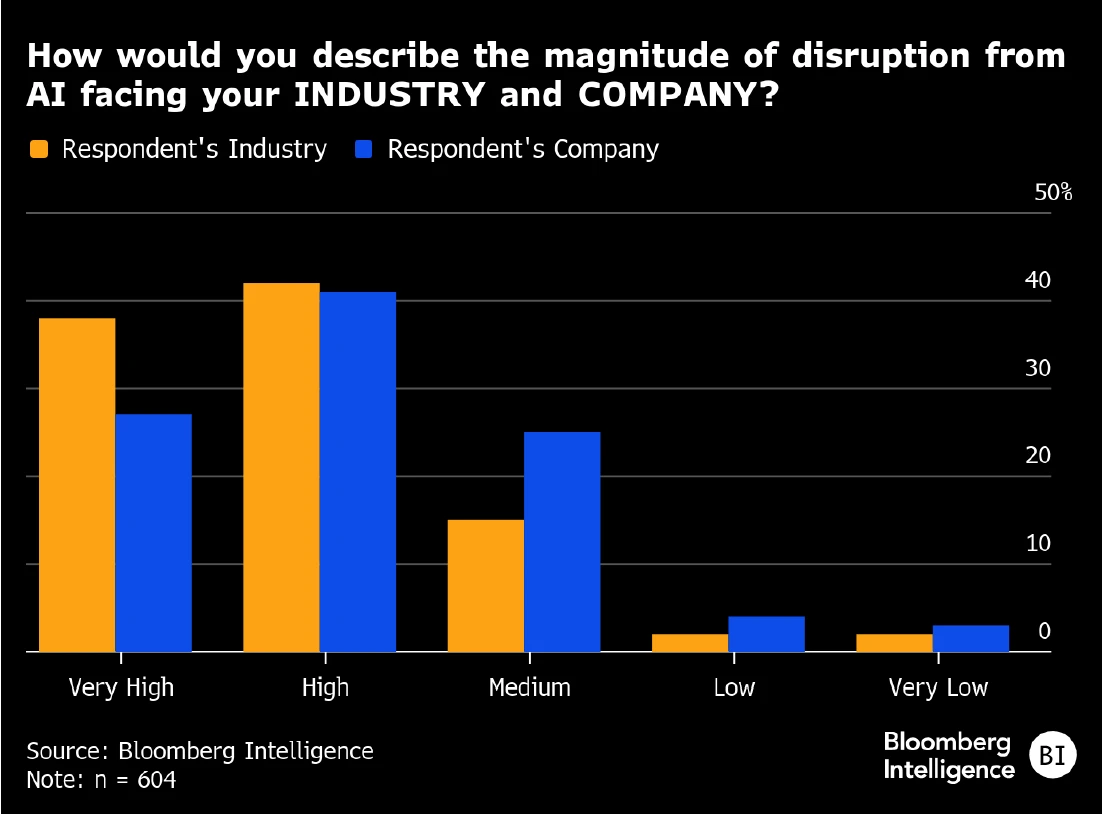
Most think their industries are on the verge of serious AI-driven shake-ups, with disruptions they expect to feel themselves, even if they believe competitors will get hit harder.
The survey released in December shows employees across nine major industries already are using the tools, and the scale of the ambition is global, as are the bottlenecks. Multinational firms are moving toward an AI arms race that executives expect to reshape margins, hiring and capital allocation far beyond the US.
Yet for all the fears of job loss, companies say they expect AI to increase head count, not shrink it. More than 60% of respondents anticipate adding workers over the next three years because of AI, not despite it, with an average expected growth of about 4%.
Here are six takeaways to watch:
AI has climbed to the top of the corporate agenda
The generational nature of AI’s transformation opportunity has propelled it to the top of the C-suite agenda. Roughly 80% of respondents expect their industry to face a “high” or “very high” level of disruption. Two-thirds expect the same inside their own companies.
Executives may disagree on when the payoff arrives, but they’re treating AI less as option value and more as inevitability. Employee adoption is already deep, with a majority of companies reporting that at least 40% of their staff are using AI tools in some capacity.
There are roadblocks: leaders cite data privacy, cybersecurity and clean data availability as top constraints to doing more now.
AI Is about both efficiency and revenue
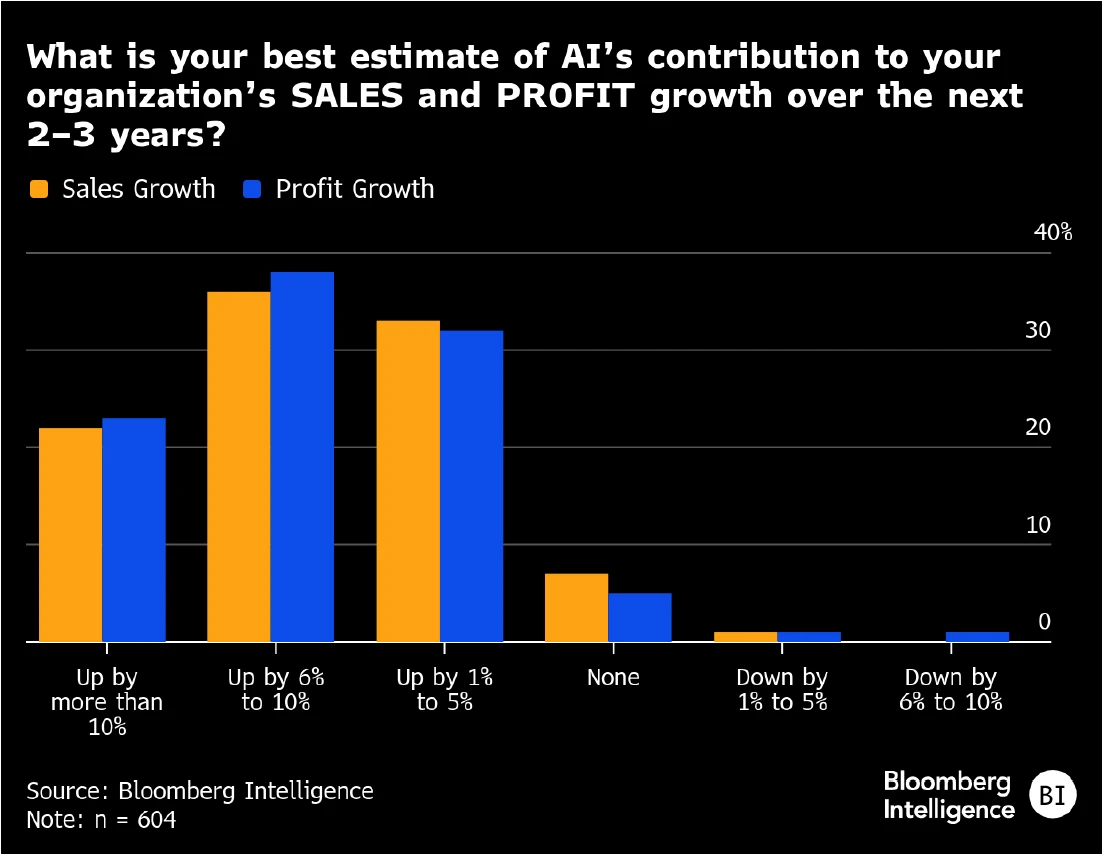
Respondents to BI’s survey don’t just view AI as an opportunity to cut costs and boost productivity. They believe the technology can also help to expand their top line. More than 90% of respondents expect AI to unlock sales growth, averaging 7% over the next three years, and a similar proportion anticipate a 7% profit gain over the same time period. That’s strikingly uniform optimism for a technology still in early days.
Efficiency still ranks as the top corporate objective but revenue generation has climbed into second place, signaling a belief that AI can help companies personalize products, sharpen underwriting, speed up content creation and engage customers in ways that traditional tools can’t. Survey respondents are betting that if AI helps employees work faster, smarter and more consistently, those gains should show up in the bottom line.
Companies are scaling AI even if budgets don’t reflect a frenzy
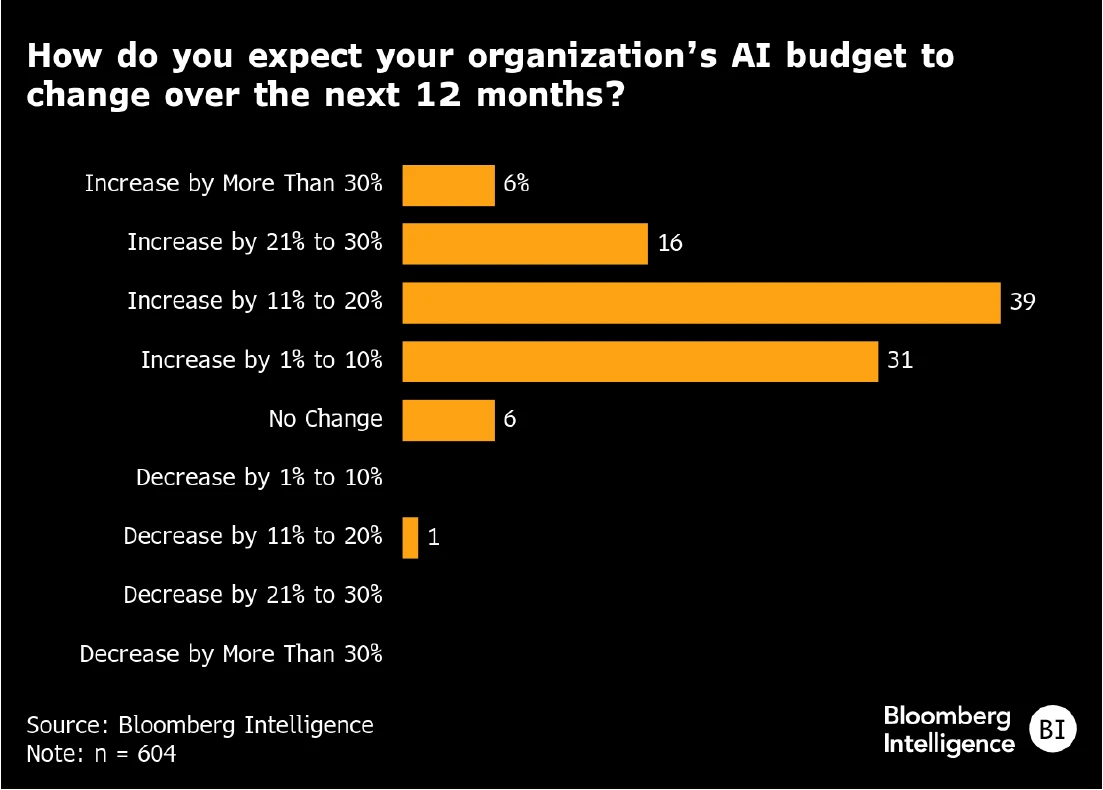
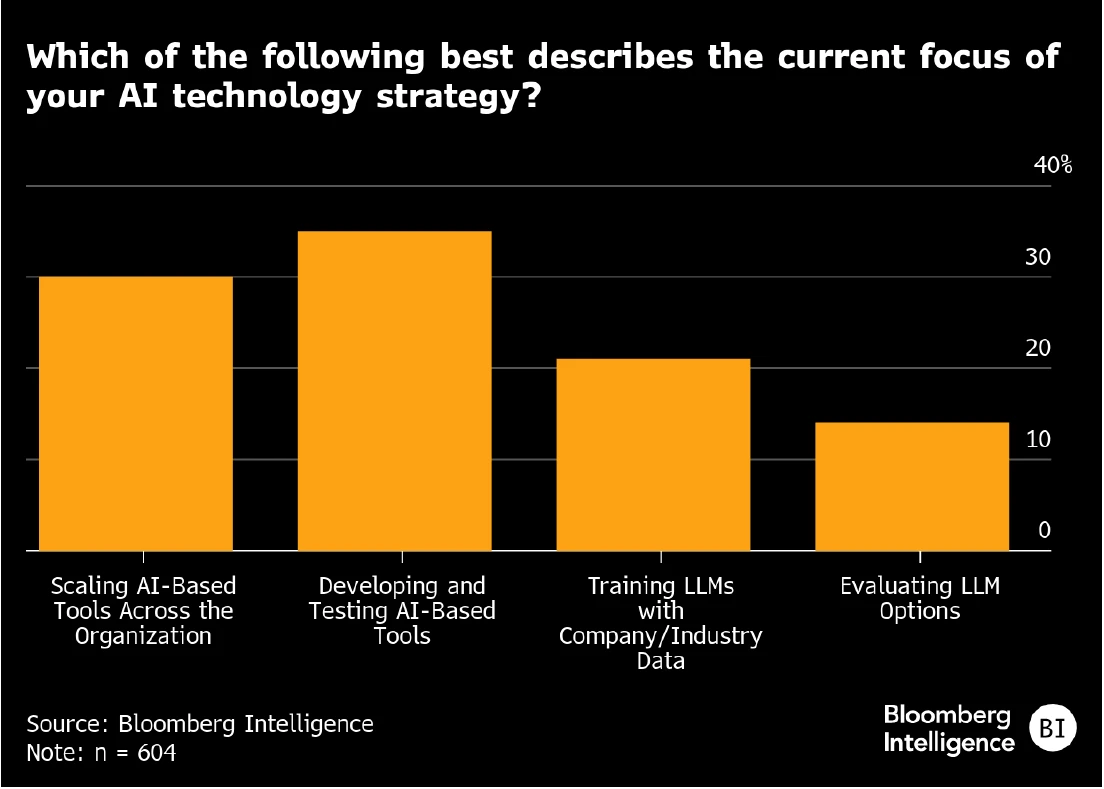
Ninety-three percent of executives say they’ll boost AI budgets in the next year, but the average increase is a modest 14%. Still, adoption is broad. Two-thirds of companies have moved beyond evaluating AI models and are now developing or scaling tools.
The platform race is also narrowing. OpenAI and Google dominated in the survey, with 74% and 62% penetration, respectively.
The workforce story is more nuanced than headlines suggest
The survey results don’t square with the popular notion of AI eventually taking all the jobs. That’s not to say it’s not affecting workforces: two-thirds of firms say they’ve made AI-related job cuts over the past year. But most look more like an effort to tighten overhead while re-engineering work flows rather than large-scale displacement.
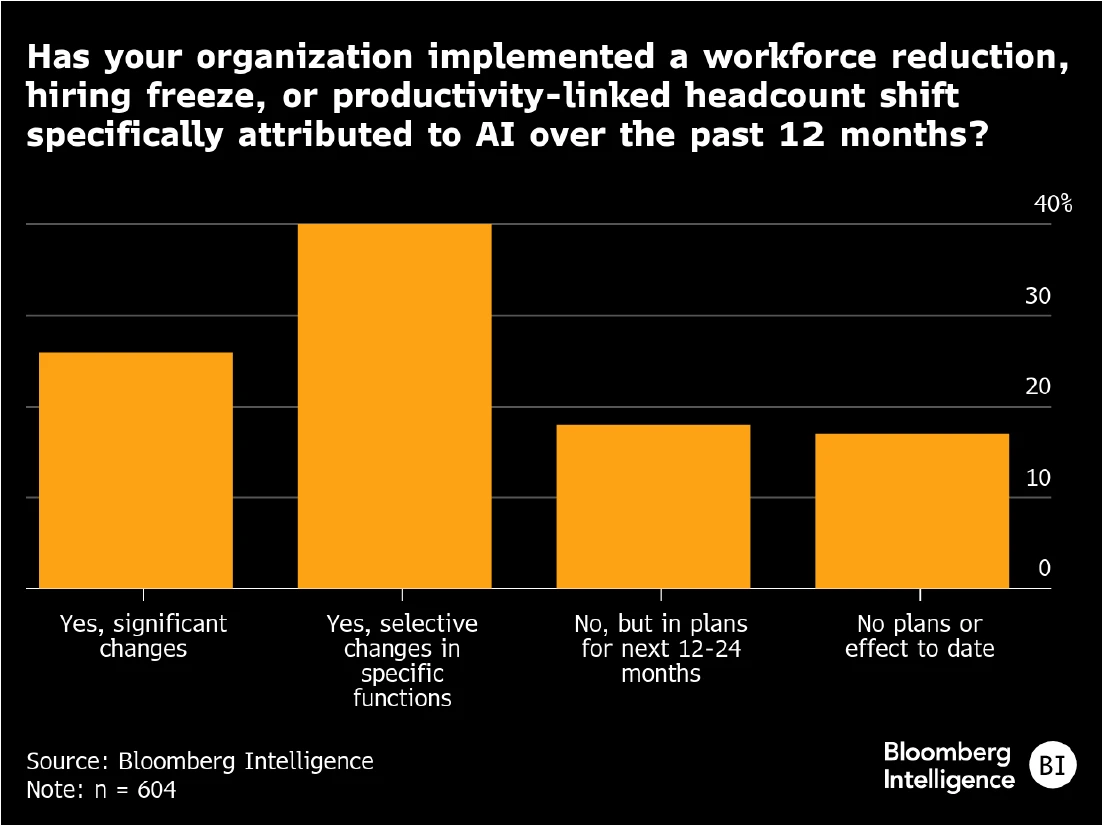
As AI tools spread, employee responsibilities are shifting toward exception handling, analytical work and judgment-based tasks. The market for people who understand data, workflows and model oversight is likely to grow, even as rote tasks fade.
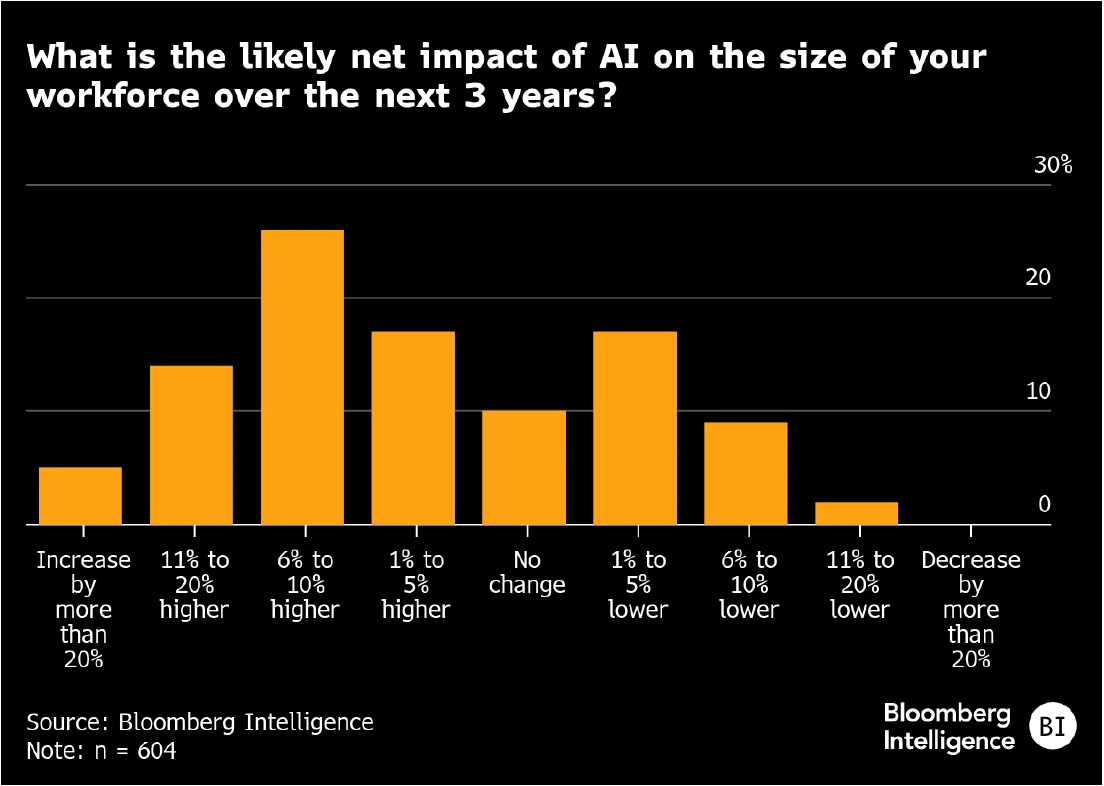
Customer-facing functions offer the fastest payoff
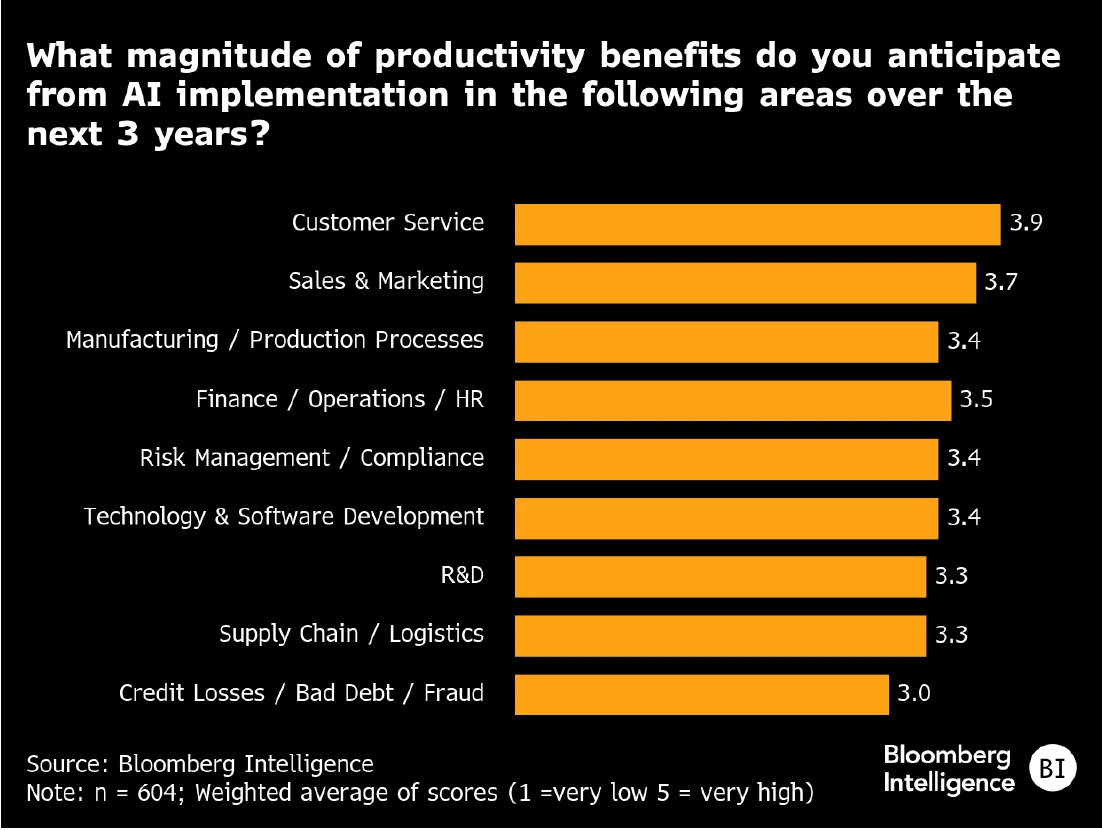
If you want to see where AI will make a visible difference, look at customer interactions. Executives say service, sales and marketing are the lowest-friction, highest-return domains for early adoption. These areas benefit from mature generative tools, like increasingly human-like chatbots to manage sales and service queries, and the rapid expansion of generative AI in producing advertising and marketing content.
Lower scores for areas such as finance and risk management likely reflect AI-models’ high error rates for quantitative tasks. The application of AI in these fields may be slow until there’s a marked uptick in quality and accuracy. Some AI-model companies, including Anthropic (developer of Claude), are working to optimize their technology for such tasks to carve out a leading position.
Customer-facing AI, by contrast, doesn’t have to be perfect. It just has to be better than form emails, long hold times and manual sorting. That’s why companies see it as the easiest place to add value quickly.
Different industries expect different AI gains
The survey shows that AI’s impact won’t be uniform across the economy. Pharma executives are looking for some of the biggest operational gains, expecting AI to handle 10–30% of preclinical work and reduce drug-development costs by roughly 16%, a shift that could shorten timelines and reshape early-stage R&D. Media companies, by contrast, see more immediate, tactical wins: lower content-production and post-production costs, paired with more personalized offerings for viewers.
Financial companies expect AI to lift sales and profit by as much as 10% within three years, though spending on data systems, technology and talent may push larger gains past 2027. The survey shows firms expanding AI from pilots to full rollout, with spending growing faster than IT budgets. Leaders like JPMorgan, Goldman Sachs, BlackRock and Visa are setting the pace on AI spending and adoption.
Consumer companies see AI less as a behind-the-scenes engine and more as a front-of-house experience. Walmart’s new AI assistant Sparky aims to become a fully agentic shopping companion for discovery, reorders and returns. This could mirror Amazon.com’s success with AI-driven recommendations — estimated by a case study to generate about 35% of its total revenue — emphasizing the powerful sales impact of intelligent retail automation.
Across sectors, the common thread isn’t the same benefit but the belief that AI will reshape the mechanics of how each industry operates, whether that be lower costs, speed or entirely new ways to reach customers. That notion took hold in the stock market this month, where investors punished shares of companies that looked like they could suffer as AI took over key parts of their businesses, from software to IT services to information services.
AI’s industry-by-industry impact
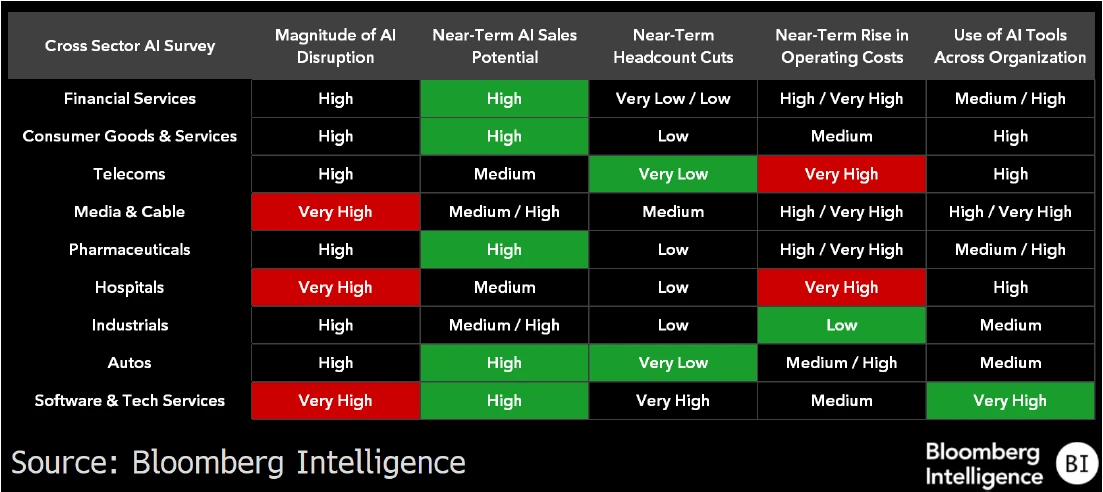
A snapshot of where AI is expected to hit hardest — and which industries think they’ll benefit first.
Methodology
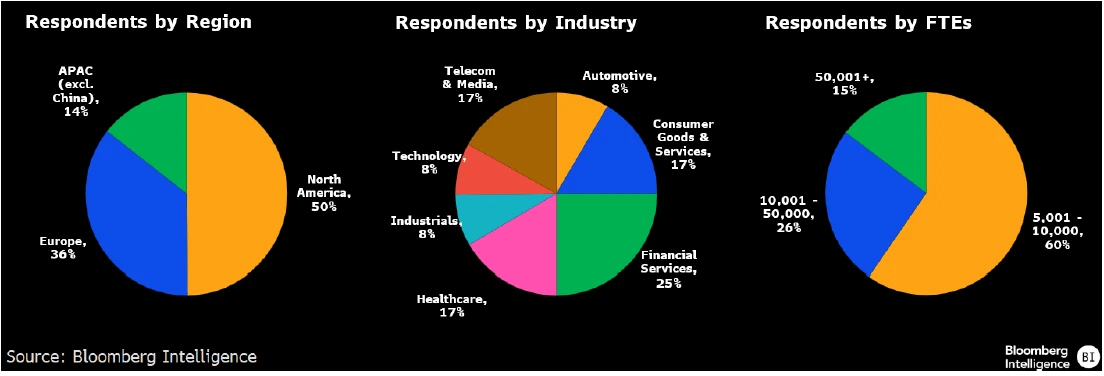
Bloomberg Intelligence’s survey of 604 senior executives at large companies (more than 5,000 FTEs) across a broad range of sectors and regions sought insights on the current status of AI deployments, future strategy and the potential magnitude and focus of cost savings and productivity gains. The survey was executed Sept. 10-Oct. 8 for BI by a third-party partner using an online questionnaire. Respondents self-identified as being knowledgeable about their company’s cost structure, and current and planned use of AI.
The data included in these materials are for illustrative purposes only. The BLOOMBERG TERMINAL service and Bloomberg data products (the “Services”) are owned and distributed by Bloomberg Finance L.P. (“BFLP”) except (i) in Argentina, Australia and certain jurisdictions in the Pacific Islands, Bermuda, China, India, Japan, Korea and New Zealand, where Bloomberg L.P. and its subsidiaries (“BLP”) distribute these products, and (ii) in Singapore and the jurisdictions serviced by Bloomberg’s Singapore office, where a subsidiary of BFLP distributes these products. BLP provides BFLP and its subsidiaries with global marketing and operational support and service. Certain features, functions, products and services are available only to sophisticated investors and only where permitted. BFLP, BLP and their affiliates do not guarantee the accuracy of prices or other information in the Services. Nothing in the Services shall constitute or be construed as an offering of financial instruments by BFLP, BLP or their affiliates, or as investment advice or recommendations by BFLP, BLP or their affiliates of an investment strategy or whether or not to “buy”, “sell” or “hold” an investment. Information available via the Services should not be considered as information sufficient upon which to base an investment decision. The following are trademarks and service marks of BFLP, a Delaware limited partnership, or its subsidiaries: BLOOMBERG, BLOOMBERG ANYWHERE, BLOOMBERG MARKETS, BLOOMBERG NEWS, BLOOMBERG PROFESSIONAL, BLOOMBERG TERMINAL and BLOOMBERG.COM. Absence of any trademark or service mark from this list does not waive Bloomberg’s intellectual property rights in that name, mark or logo. All rights reserved. © 2026 Bloomberg