
Bloomberg Professional Services
- Shifting commodity exposure further out the futures curve may help reduce drawdowns after strong price gains while maintaining upside participation in rising markets.
- Negative roll yield for commodity futures curves in contango can erode long-only returns, particularly for front month contracts where roll yield can be the most negative.
- Bloomberg Commodity Index 3 Month Forward (BCOMF3) has historically higher annualized returns and lower downside volatility than near-dated exposure such as BCOM.
This article was written by Jim Wiederhold, Commodity Indices Product Manager at Bloomberg.
Commodities are commonly used by market participants to support diversification and guard against inflation. However, one of the challenges many investors face when holding exposure over the long term is negative roll yield, which results from having to roll expiring futures contracts from the front month to the next.
Because most commodity futures curves often tend to be upward sloping (commonly referred to as in contango), a long position typically needs to be sold at a lower price and bought at a higher price for the next month future contract prior to contract expiration. In this article, we look at how shifting exposure further out the futures curve may help manage volatility after strong price gains.
How should investors position commodities in their portfolios?
A long commodities exposure tends to work best when it is a core, continuous allocation because commodities appreciate most during unexpected situations (as these inflection points are difficult to price in ahead of time), like an equity market downturn or surprise rise in inflation. It is very difficult to time the market.
PRODUCT MENTIONS
After periods like the start of 2026, when front month commodity futures contracts move higher with speed, some market participants may consider shifting exposure to places further out the curve like the third futures contract for example. These contracts tend to be less volatile during drawdowns but still allow for upside participation when commodity prices are on the rise in a procyclical environment.
The futures contracts for commodities further out the curve tend to demonstrate lower volatility than front month futures, which react more noticeably when news moves commodity prices. Part of the reason is that further dated futures contracts have more time before expiration, so near-term price moves may reverse before the contract expires, unlike near dated futures with less time to maturity.
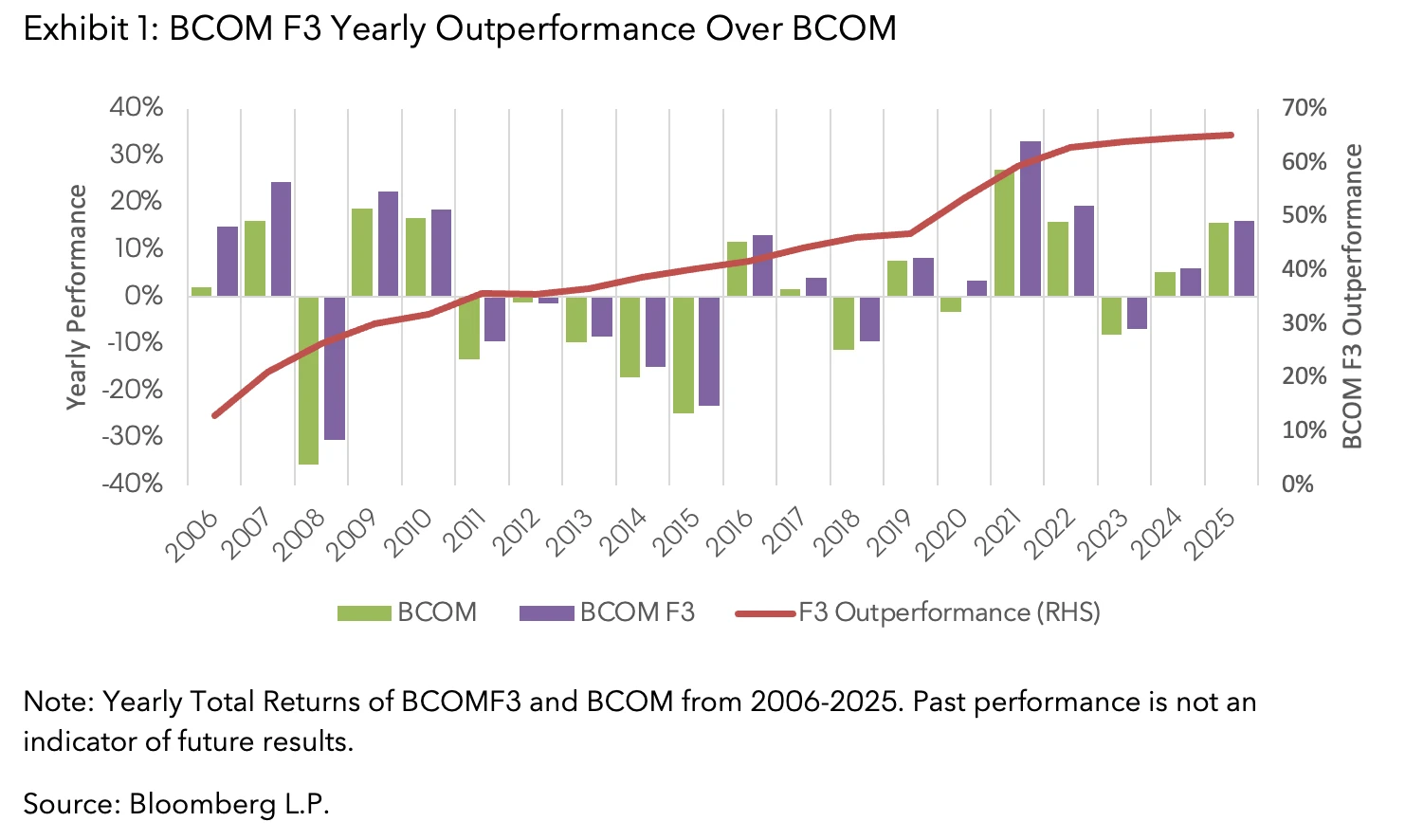
Exhibit 1 shows that over time, exposure to commodities through the third futures contract tends to outperform near dated exposure like BCOM to the upside and has less volatile yearly moves to the downside. Since 2016, the total annualized return for BCOM was +7% and for BCOMF3 it was +9%.
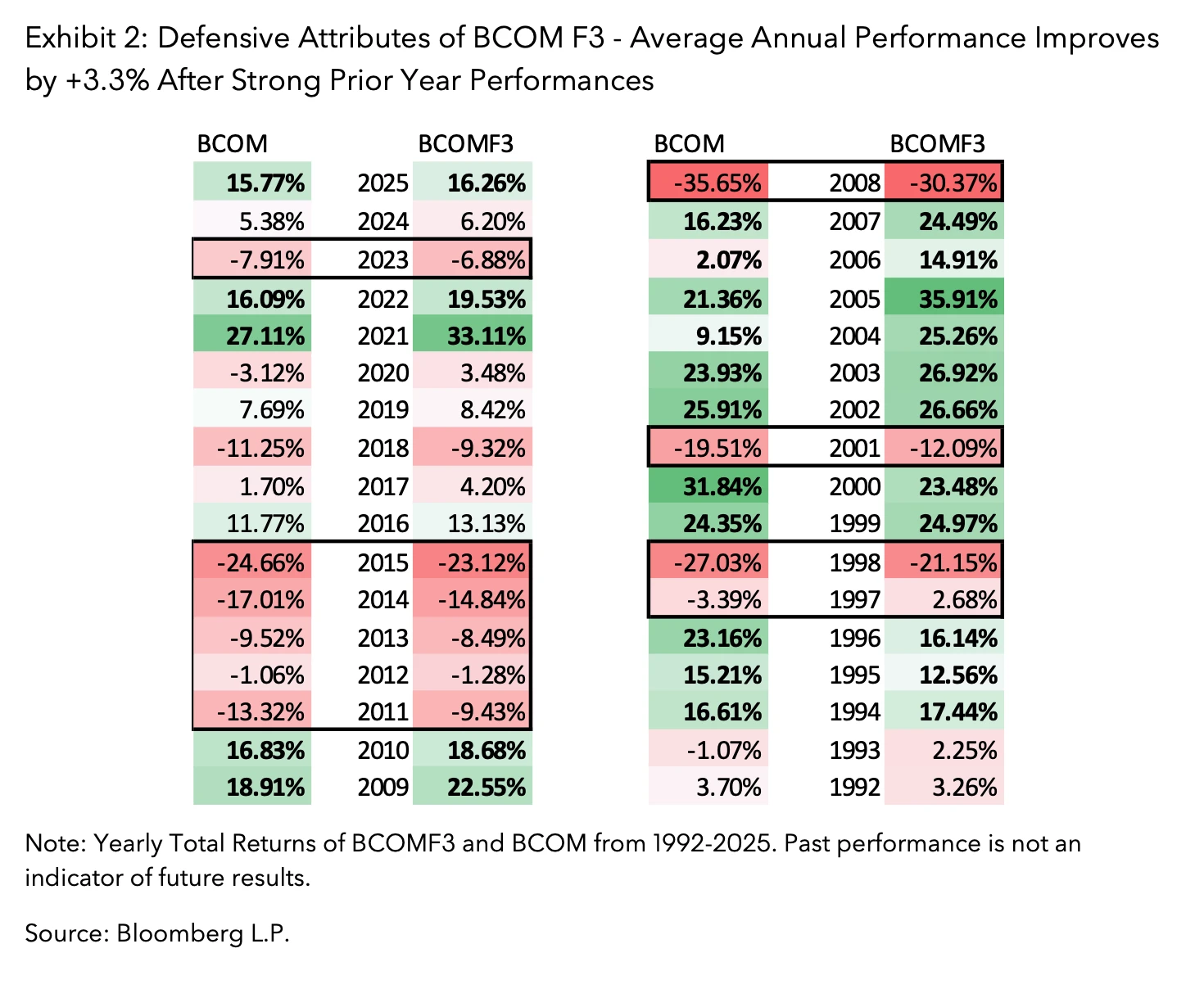
Tactically shifting exposure further out the curve after spot and front month futures prices rise could be of interest for sophisticated investors looking to ensure volatility does not hamper portfolio returns. Exhibit 2 illustrates how front month futures historically reacted following strong prior-year gains compared with third month futures exposure. Moving exposure away from the near dated contracts after gains would have allowed a market participant to experience fewer drawdowns historically.
Volatility dynamics and futures curve dispersion
Part of the reason for this is the lower volatility of the futures contracts further away from spot prices. Market participants want to see volatility to the upside when holding long exposure but are always concerned about volatility to the downside as with any asset class. A rotation after gains could be worthwhile after front month BCOM has risen over 11% annualized over the last five years.
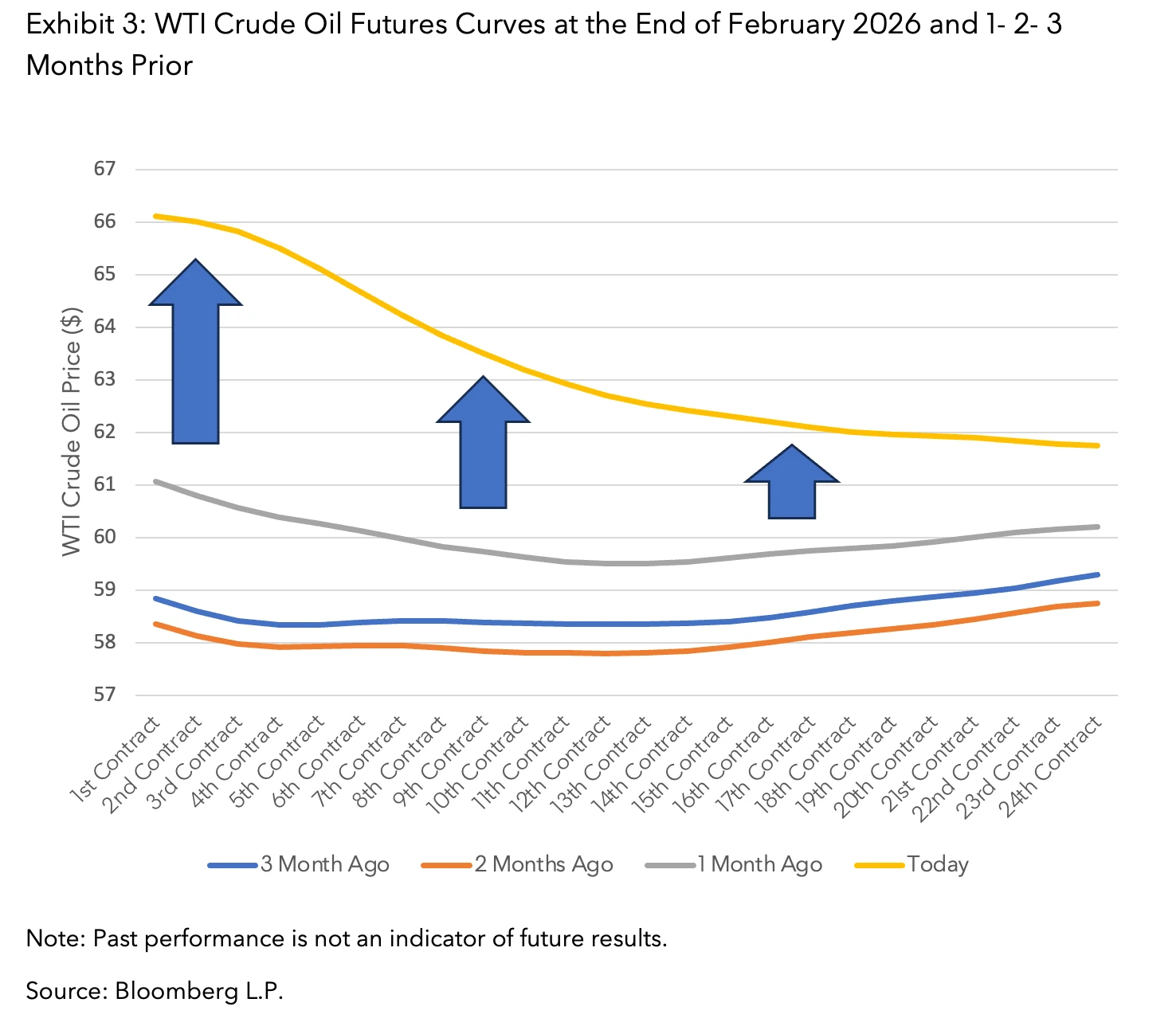
Exhibit 3 shows the WTI crude oil futures curve at the end of February 2026, as well as three months, two months, and one month before. As of this writing, WTI futures prices across the curve have moved higher as can be seen in yellow and a very large jump in near dated prices can be seen where crude is at $66 currently at the front of the curve while it was below $59 three months ago. But further out each curve, one can see prices have not moved up as aggressively.
Macro uncertainty and stagflation concerns
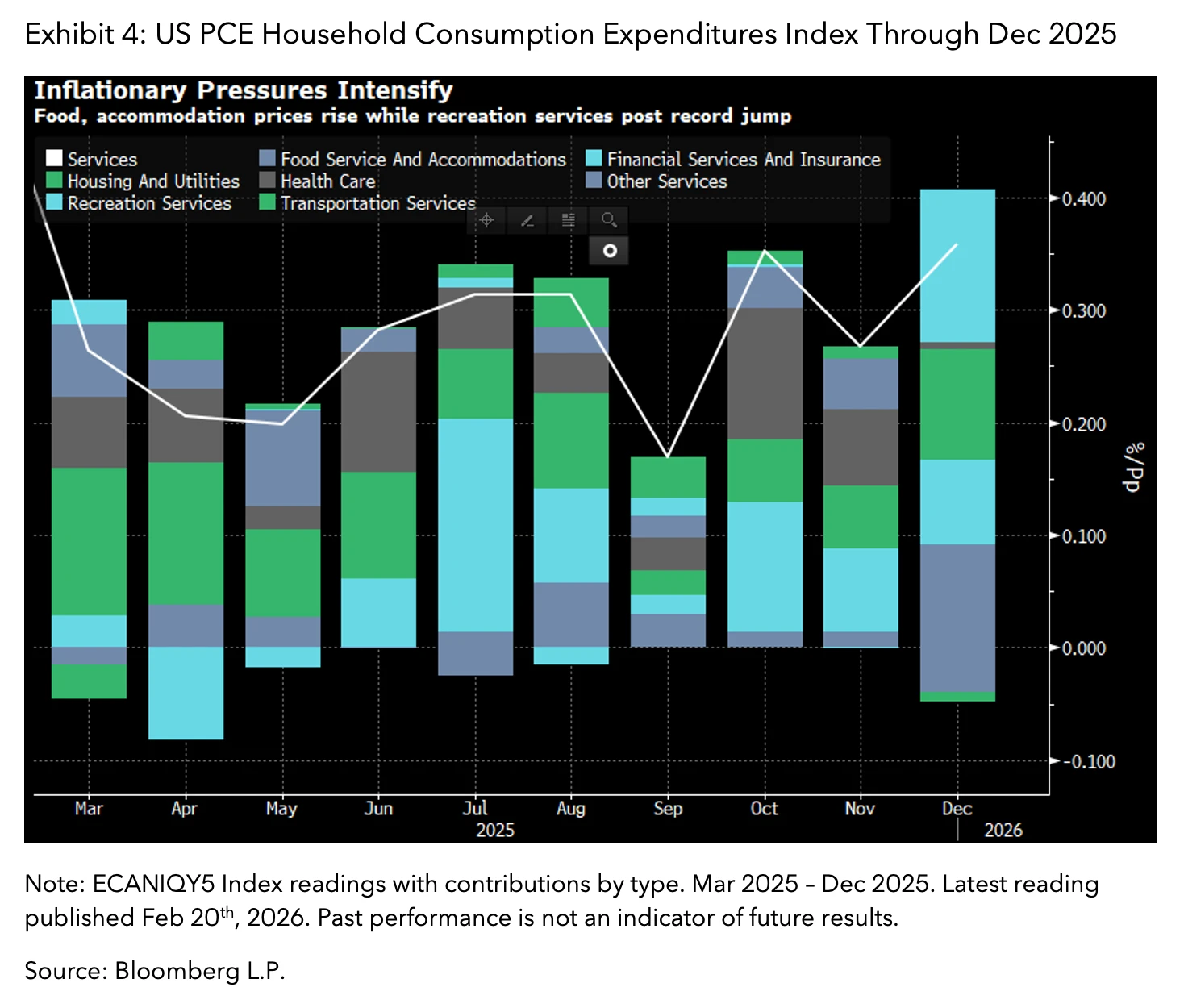
Stagflation concerns are starting to become more of a concern for market participants and commodities tend to perform well during these macroeconomic regimes. The recent delayed inflation data showed a higher uptick than expected with the core PCE price index rising 3% YoY versus the previous 2.8% reading. Exhibit 4 shows the breakdown of what contributed to the price increase, with food service and accommodation rising while recreation services recorded a record jump.
At the same time we see higher inflation than expected, we saw much lower growth with the 4Q 2025 GDP reading rising only 1.4% when 2.8% was expected. These inflation and growth data points came out the same day in February, and may suggest a potential stagflation bias after a recent disinflationary growth narrative was taking hold.
Commodities are back in the spotlight and we have seen a broader client mix reengaging in the asset class. BCOMF3 is a benchmark for a long-only core holding of commodities that has led to better roll yield characteristics over time. It fits within Bloomberg’s roll enhanced family of commodities indices and appears to demonstrate the power of a simple approach to index construction. Geopolitical tensions are ever present and diversifying a small portion of an allocation to commodities after a long run of equity outperformance could assist with portfolio performance in this new macro regime.
To learn more about Bloomberg Commodity Indices, click here.
The data and other information included in this publication is for illustrative purposes only, available “as is”, non-binding and constitutes the provision of factual information, rather than financial product advice. BLOOMBERG and BLOOMBERG INDICES (the “Indices”) are trademarks or service marks of Bloomberg Finance L.P. (“BFLP”). BFLP and its affiliates, including BISL, the administrator of the Indices, or their licensors own all proprietary rights in the Indices. Bloomberg L.P. (“BLP”) or one of its subsidiaries provides BFLP, BISL and its subsidiaries with global marketing and operational support and service. Certain features, functions, products and services are available only to sophisticated investors and only where permitted. Bloomberg (as defined below) does not approve or endorse these materials or guarantee the accuracy or completeness of any information herein, nor does Bloomberg make any warranty, express or implied, as to the results to be obtained therefrom, and, to the maximum extent allowed by law, Bloomberg shall not have any liability or responsibility for injury or damages arising in connection therewith. Nothing in the Services or Indices shall constitute or be construed as an offering of financial instruments by Bloomberg, or as investment advice or investment recommendations (i.e., recommendations as to whether or not to “buy”, “sell”, “hold”, or to enter or not to enter into any other transaction involving any specific interest or interests) by Bloomberg. Information available via the Index should not be considered as information sufficient upon which to base an investment decision. All information provided by the Index or in this publication is impersonal and not tailored to the needs of any person, entity or group of persons. Absence of any trademark or service mark from this list does not waive Bloomberg’s intellectual property rights in that name, mark or logo. For the purposes of this publication, Bloomberg includes BLP, BFLP, BISL and/or their affiliates.
BISL is registered in England and Wales under registered number 08934023 and has its registered office at 3 Queen Victoria Street, London, England, EC4N 4TQ. BISL is authorised and regulated by the Financial Conduct Authority as a benchmark administrator.
© 2026 Bloomberg. All rights reserved.