ARTICLE
The Iran conflict: Out-of-sample evidence for global energy diversification

Bloomberg Professional Services
- The Iran conflict highlights how geopolitical shocks drive divergence across crude oil and natural gas benchmarks, reflected in Bloomberg’s global energy indices.
- Global energy diversification can reduce exposure to localized shocks, as seen in widening spreads between Murban, WTI and European vs US natural gas markets tracked across Bloomberg indices.
- Structural constraints such as LNG transport limitations reinforce regional price dislocations, supporting multi-benchmark global energy exposure through Bloomberg global energy indices.
This article was written by Francisco Ibanez, Quant Researcher and Jim Wiederhold, Commodity Indices Product Manager at Bloomberg.
When we published Powering the Future: A Modern Benchmark for a Multi-Polar World report in September 2025, we argued that the global oil and natural gas landscape had undergone a structural transformation, and that traditional, geographically concentrated energy benchmarks may no longer capture the full global energy picture.
PRODUCT MENTIONS
The US-Iran conflict that erupted in early 2026 has provided a real-time, out-of-sample stress test of that thesis. The results so far are consistent with what the research predicted: regional energy contracts have diverged sharply, and globally diversified exposure has served as a buffer against localized shocks.
The Strait of Hormuz: A chokepoint under stress
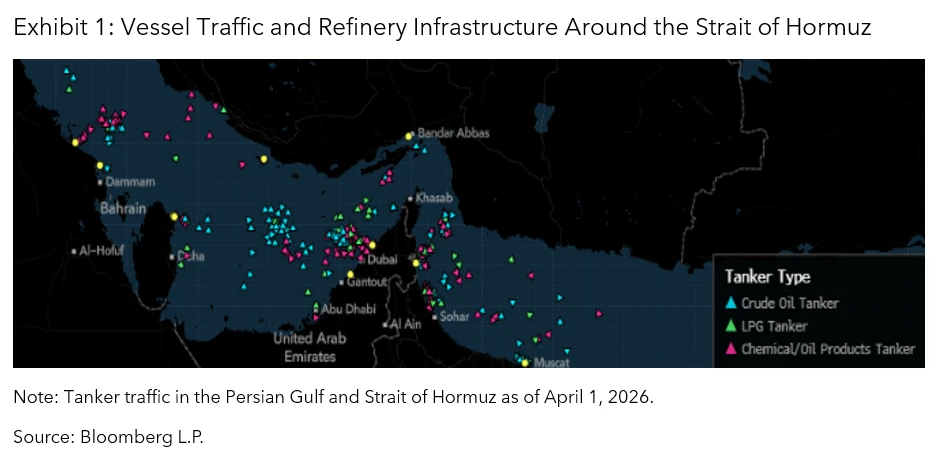
The unprecedented closure of the Strait of Hormuz has tested one of the most critical arteries of global energy supply. Roughly a fifth of global liquified natural gas (LNG) and a quarter of world seaborne oil transit the strait on any given day prior to the conflict, according to data from International Energy Agency (IEA).
As Exhibit 1 illustrates, the concentration of vessels and refining infrastructure in the region underscores the magnitude of the disruption. Iranian strikes on Qatar’s Ras Laffan complex, one of the world’s largest LNG export hubs, have compounded the physical blockage with lasting infrastructure damage. QatarEnergy indicated that restoring 17% of its capacity may take 3-5 years.
For investors benchmarking against a narrow set of North American energy contracts, these events register as noise. For a globally diversified energy basket, they represent exactly the kind of localized shock the benchmark is designed to reflect.
Crude oil: Murban crude diverges from WTI
The divergence across crude benchmarks has been sharp and instructive. Exhibit 2 tracks the performance of Murban crude (ticker: MUC) against West Texas Intermediate (ticker: CL) year–to–date. Murban surged to roughly $150 a barrel in mid-March as the conflict tightened supply from its primary production and delivery region, while WTI peaked near $103. The spread between the two contracts, shown in the lower panel, reached its historical maximum of $48 per barrel before narrowing as markets partially repriced the probability of a swift resolution.
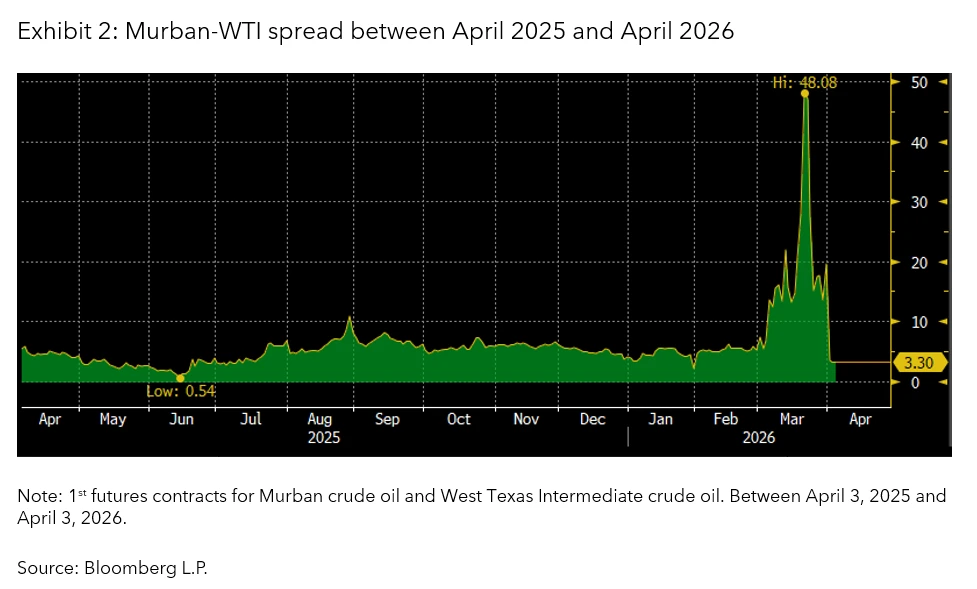
This is not a uniform oil shock. It is a regional dislocation concentrated at the Middle Eastern node of the global pricing network. The US market, as a net exporter with record domestic crude oil production approaching 13.6 million barrels a day, as information from the U.S. Energy Information Administration shows, is structurally insulated from the Persian Gulf bottleneck. The US share of crude oil imports travelling through the Strait of Hormuz fell from nearly a third in 2000 to 8% in 2025.
Bloomberg Intelligence’s energy team sees the December 2026 WTI future more likely heading toward $50 than $50 than staying above $100*. Bloomberg Terminal subscribers can access Bloomberg Intelligence research via BI<GO>.
Brent, while exposed to the global repricing, has also remained well below Murban’s peak. This three-way divergence across Murban, WTI, and Brent is precisely the kind of multi-polar pricing behavior we documented in the Powering the Future report and the reason the Bloomberg Global Commodity Oil and Gas Index includes all three benchmarks as distinct components.
Natural gas: Transatlantic decoupling intensifies
The Iran conflict is not only an oil story. Qatar accounts for roughly 20% of global LNG exports, with about 80% of those volumes serving Asian buyers and the balance flowing primarily to Europe, according to EIA.
The strikes on Ras Laffan and the closure of the Strait of Hormuz have effectively taken that supply offline, at least temporarily, and the ripple effects are global. Europe is particularly exposed. LNG now accounts for 40-45% of the EU’s total gas supply, according to Institute for Energy Economics and Financial Analysis, up from less than 25% before Russia’s curtailment of pipeline deliveries in 2022, and Qatari cargoes represent about 8% of those LNG imports, according to Bloomberg Intelligence analysis**.
In absolute terms, the volumes at risk are modest relative to the continent’s total consumption. But in a market already running on thin storage and record LNG dependence, even a partial loss of Qatari supply tightens the global competition for spot cargoes and amplifies price moves. This helps explain the pronounced transatlantic divergence shown in Exhibit 3.
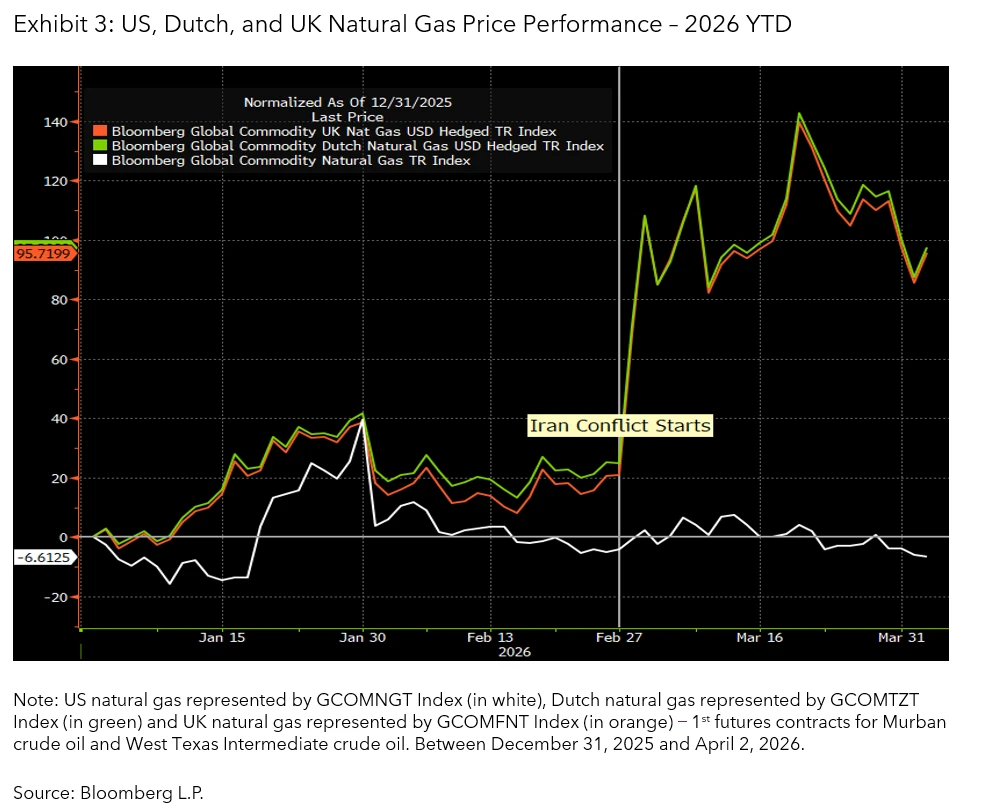
The mechanics of this decoupling are structural, not transient. As we emphasized in the white paper, natural gas is far less fungible than crude oil. Transporting it between continents requires the capital-intensive process of liquefaction, shipment via specialized carriers, and regasification at the destination hub.
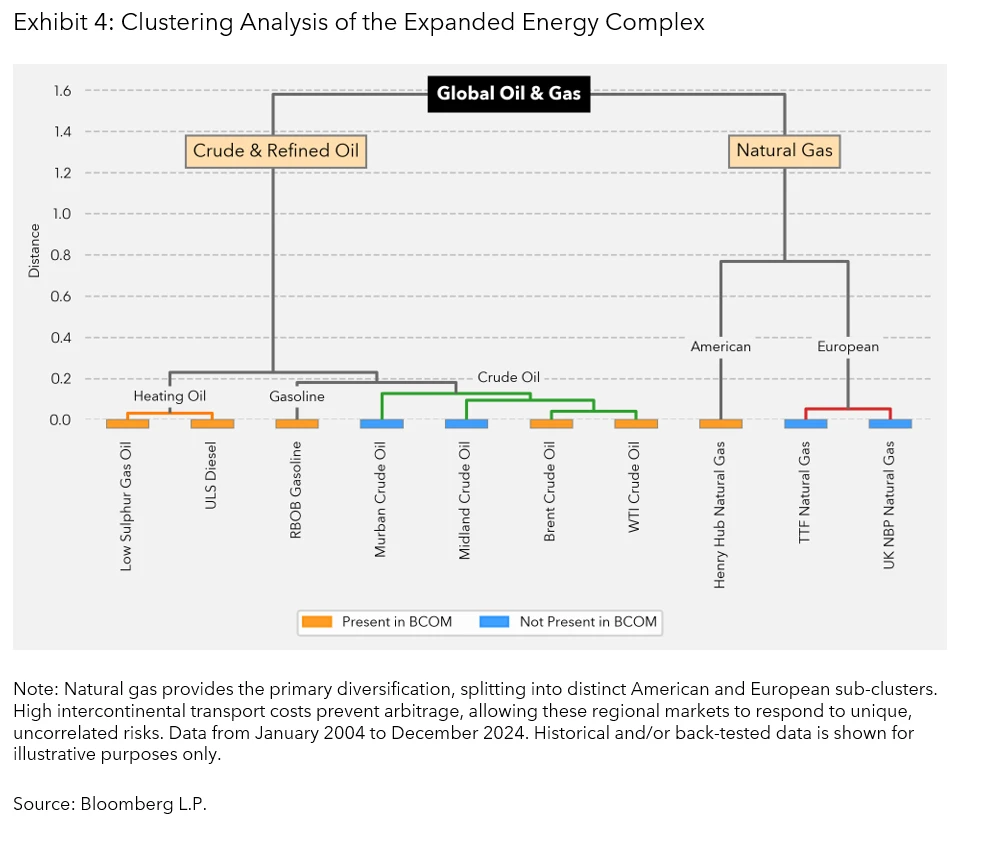
This physical barrier largely prevents arbitrage between the two markets, meaning the European and American natural gas complexes respond to different supply-demand dynamics and are exposed to different idiosyncratic risks.
This decoupling was statistically confirmed by the cluster analysis in our Powering the Future report, which showed American and European natural gas forming two distinct risk sub-clusters within the energy universe, as shown in Exhibit 4. A US-only natural gas benchmark might miss the drivers of European pricing entirely.
In the Powering the Future report, we presented three case studies illustrating how global diversification can shield portfolios from localized shocks: the Freeport LNG terminal explosion of 2022, the disruption of Russian gas to Europe, and the WTI negative price event of April 2020. The Iran conflict now serves as a fourth. The pattern is consistent: when a geopolitical or infrastructure shock hits one regional market, contracts tied to other geographies behave differently, and a globally diversified basket absorbs the impact more evenly.
For institutional investors allocating to the energy sector, the implication is straightforward. In a world where pricing power is distributed across the US Gulf Coast, Northwest Europe, and the Middle East, benchmarks need to reflect that reality.
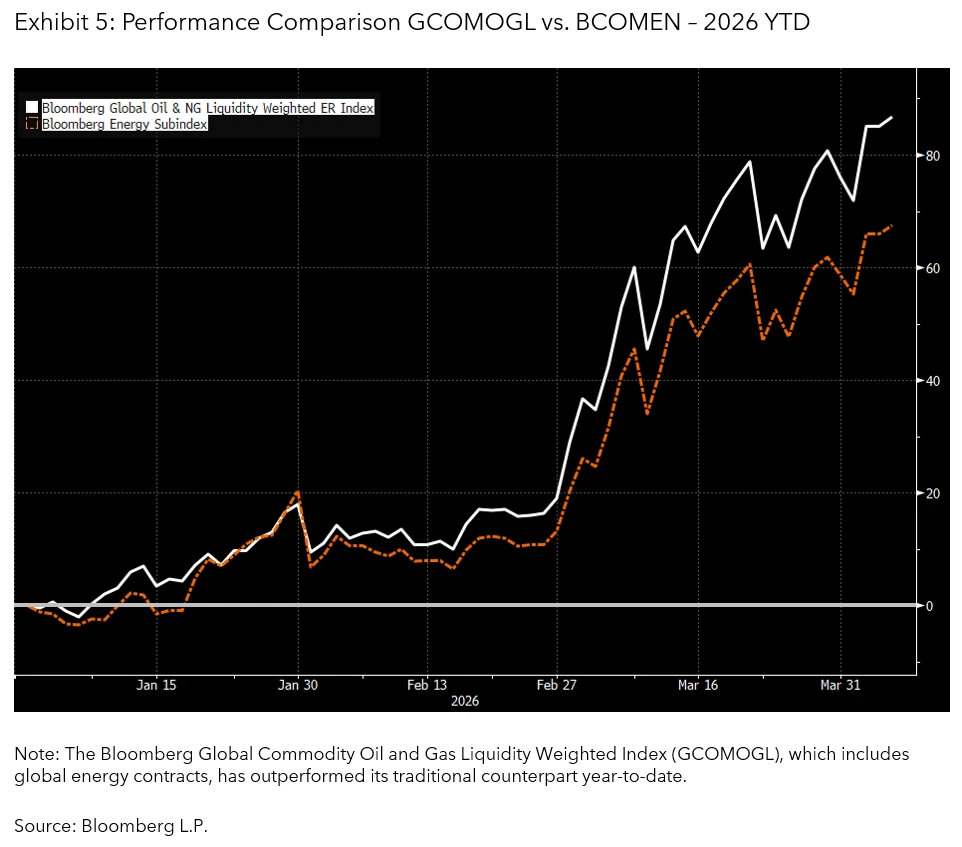
The Bloomberg Global Commodity Oil and Gas Liquidity Weighted Index (GCOMOGL) was built for this environment by adding four new contracts to the traditional Natural Gas and Crude Oil contracts: Midland WTI Crude Oil, Murban Crude Oil, Dutch TTF Natural Gas, and UK NBP Natural Gas.
As seen in Exhibit 5, the overall performance impact of the events of early 2026 suggests the design is working as intended, translating into year-to-date outperformance when compared to a more traditional energy basket.
* McGlone, M., & Piazza, V. G. (2026, March 30). US natural gas’ 100% 1Q pump-then-dump may guide 2026 crude oil. Bloomberg Intelligence.
** Alvarez, P., & Martins, J. (2026, March 20). Qatar outages set to dent supply even if war de-escalates. Bloomberg Intelligence.
BISL Disclaimer
The data and other information included in this publication is for illustrative purposes only, available “as is”, non-binding and constitutes the provision of factual information, rather than financial product advice. BLOOMBERG and BLOOMBERG INDICES (the “Indices”) are trademarks or service marks of Bloomberg Finance L.P. (“BFLP”). BFLP and its affiliates, including BISL, the administrator of the Indices, or their licensors own all proprietary rights in the Indices. Bloomberg L.P. (“BLP”) or one of its subsidiaries provides BFLP, BISL and its subsidiaries with global marketing and operational support and service. Certain features, functions, products and services are available only to sophisticated investors and only where permitted. Bloomberg (as defined below) does not approve or endorse these materials or guarantee the accuracy or completeness of any information herein, nor does Bloomberg make any warranty, express or implied, as to the results to be obtained therefrom, and, to the maximum extent allowed by law, Bloomberg shall not have any liability or responsibility for injury or damages arising in connection therewith. Nothing in the Services or Indices shall constitute or be construed as an offering of financial instruments by Bloomberg, or as investment advice or investment recommendations (i.e., recommendations as to whether or not to “buy”, “sell”, “hold”, or to enter or not to enter into any other transaction involving any specific interest or interests) by Bloomberg. Information available via the Index should not be considered as information sufficient upon which to base an investment decision. All information provided by the Index or in this publication is impersonal and not tailored to the needs of any person, entity or group of persons. Absence of any trademark or service mark from this list does not waive Bloomberg’s intellectual property rights in that name, mark or logo. For the purposes of this publication, Bloomberg includes BLP, BFLP, BISL and/or their affiliates.
BISL is registered in England and Wales under registered number 08934023 and has its registered office at 3 Queen Victoria Street, London, England, EC4N 4TQ. BISL is authorised and regulated by the Financial Conduct Authority as a benchmark administrator.
© 2026 Bloomberg. All rights reserved.
BI Disclaimer
Bloomberg Intelligence is a service provided by Bloomberg Finance L.P. and its affiliates (“Bloomberg”). Bloomberg is not an officially recognized credit rating agency in any jurisdiction, and customers should not use or rely on Bloomberg Intelligence to comply with applicable laws or regulations that prescribe the use of ratings issued by accredited or otherwise recognized credit rating agencies. Bloomberg Intelligence, including Credit and Company research, may not be available in certain jurisdictions.
No aspect of the Bloomberg Intelligence service is based on the consideration of a customer’s individual circumstances. Customers should determine on their own whether they agree with Bloomberg Intelligence. Bloomberg Intelligence should not be construed as tax or accounting advice or as a service designed to facilitate any Bloomberg Intelligence customer’s compliance with its tax, accounting, or other legal obligations. Bloomberg believes that the information it uses in Bloomberg Intelligence comes from reliable sources but does not guarantee the accuracy or completeness of the information contained in Bloomberg Intelligence, which is subject to change without notice, and nothing in this service shall be construed as such a guarantee. Employees involved in Bloomberg Intelligence may hold positions in the securities analyzed or discussed on Bloomberg Intelligence.
Bloomberg makes no claims or representations, or provides any assurances, about the sustainability characteristics, profile or data points of any underlying issuers, products or services, and users should make their own determination on such issues.
The data included in these materials are for illustrative purposes only. The BLOOMBERG TERMINAL service and Bloomberg data products (the “Services”) are owned and distributed by Bloomberg Finance L.P. (“BFLP”) except (i) in Argentina, Australia and certain jurisdictions in the Pacific islands, Bermuda, China, India, Japan, Korea and New Zealand, where Bloomberg L.P. and its subsidiaries (“BLP”) distribute these products, and (ii) in Singapore and the jurisdictions serviced by Bloomberg’s Singapore office, where a subsidiary of BFLP distributes these products. BLP provides BFLP and its subsidiaries with global marketing and operational support and service. Certain features, functions, products and services are available only to sophisticated investors and only where permitted. BFLP, BLP and their affiliates do not guarantee the accuracy of prices or other information in the Services. Nothing in the Services shall constitute or be construed as an offering of financial instruments by BFLP, BLP or their affiliates, or as investment advice or recommendations by BFLP, BLP or their affiliates of an investment strategy or whether or not to “buy,” “sell,” or “hold” an investment. Information available via the Services should not be considered as research analysis or research recommendation or an opinion concerning any financial products or securities or entity or as information sufficient upon which to base an investment decision. The following are trademarks and service marks of BFLP, a Delaware limited partnership, or its subsidiaries: BLOOMBERG, BLOOMBERG ANYWHERE, BLOOMBERG MARKETS, BLOOMBERG NEWS, BLOOMBERG PROFESSIONAL, BLOOMBERG TERMINAL and BLOOMBERG.COM. Absence of any trademark or service mark from this list does not waive Bloomberg’s intellectual property rights in that name, mark or logo. All rights reserved. © 2026 Bloomberg.