Bloomberg Professional Services
- Geopolitical risk and supply disruptions drove the Bloomberg Commodity Index (BCOM) up 24% in Q1 2026, with energy leading gains amid a sharp oil supply shock.
- Strait of Hormuz disruptions reduced tanker traffic and pushed transport costs sharply higher, increasing operating costs across industries and reinforcing inflation pressures.
- Broad commodity exposure supported portfolio diversification, with commodities showing low correlation to equities and helping mitigate volatility during a period of market stress.
This article was written by Jim Wiederhold, Commodity Indices Product Manager at Bloomberg.
Global commodity markets were already strengthening in early 2026, but geopolitical risk has accelerated price movements and reshaped supply dynamics. The Bloomberg Commodity Index (BCOM) was on the rise well before the start of the US-Iran war. By the end of February, BCOM was up 9% and outpaced other major asset classes by a significant margin as precious metals led the way.
After a full month of war in March, BCOM finished the first quarter of 2026 higher by 24%. The main catalyst driving the performance was highlighted in our second theme from the 2026 outlook of supply disruptions from increased geopolitical risk.
PRODUCT MENTIONS
We could not have forecasted one of the biggest oil supply shocks in history, but the knock-on effects of higher energy prices might likely feed through to the rest of the commodity complex and increase the costs of doing business for every company in the global economy.
How did energy supply disruptions drive commodity performance?
Most BCOM sectors rose in the first quarter of 2026 but energy was the standout. The total return of BCOM Energy was up 63% (the largest quarterly move since 1990). This occurs when at least 10 million barrels per day of oil are suddenly shut off from the global markets.
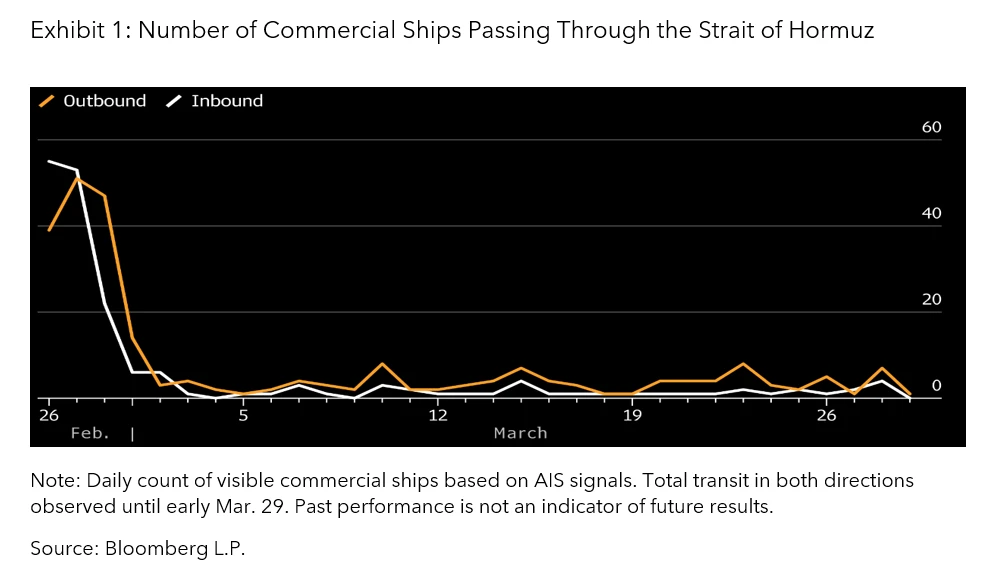
Exhibit 1 shows a sharp decline in tanker traffic through the Strait of Hormuz as the war started from about 50 vessels in each direction to almost down to zero. Movement of barrels of oil to feed the global economy has ground to a halt in one of the most important oil hubs in the world.
Why is the Strait of Hormuz disruption critical for global markets?
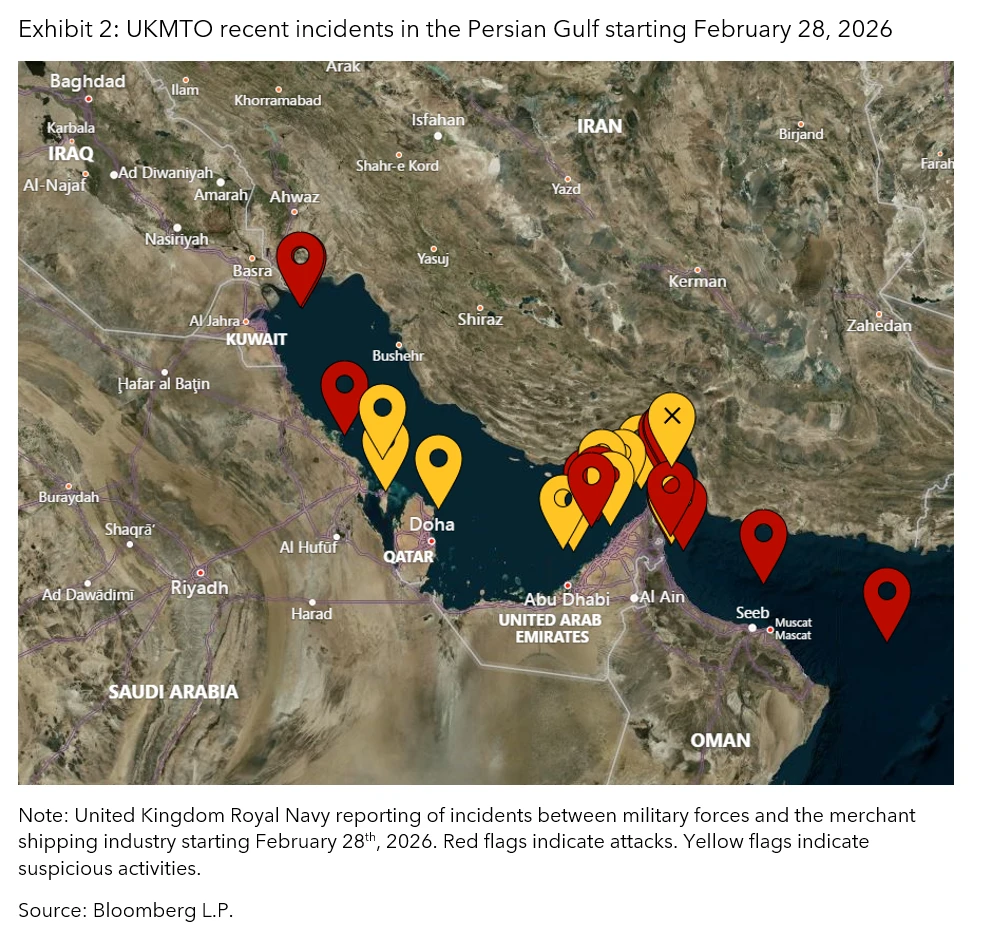
Commodities, once produced and refined, typically travel long distances as producers export to trade partners around the world. Maritime movement of commodities is the most common way to deliver product. Exhibit 2 shows the UK Maritime Trade Operations (UKMTO) reporting of attacks and suspicious activity with incidents over the last month.
With regular electronic interference and missile attacks, the ability to move significant quantities of commodities through this waterway has been disrupted for over a month-long period. Several banks and research firms have warned recently that if the Strait of Hormuz continues to be disrupted for two months, crude oil prices could rise to new all-time highs potentially reaching $200/barrel.
How rising energy and transport costs impact global businesses
When energy prices rise, it has historically led to recession as the cost of doing business rises for the majority of companies around the world. While the energy transition is still ongoing, the world is still highly reliant on fossil fuels and the cost of moving barrels of oil and other commodities has gone up exponentially this year. Margins for businesses can be squeezed not only if growth slows and demand for consumer goods suffers but on the other side of the equation, costs will likely continue to move higher.
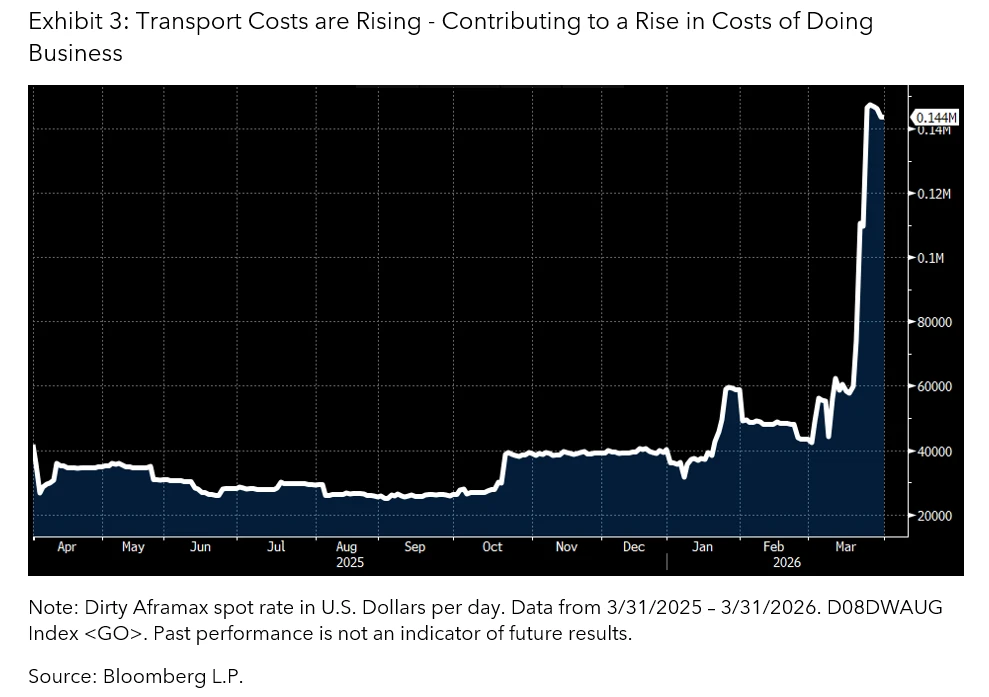
Exhibit 3 shows the costs of hiring a ship, crew, and fuel have risen dramatically in March based on Aframax tanker spot rates. What would typically cost less than $40,000 per day to ship has increased by nearly four times in March.
While the costs of doing business may rise if inflation takes hold, the risk to global growth forecasts means some growth-oriented commodities suffered during the quarter like copper. As countries reduced their expectations for economic growth due to the war, copper prices declined and the metal tends to be highly correlated to economic growth.
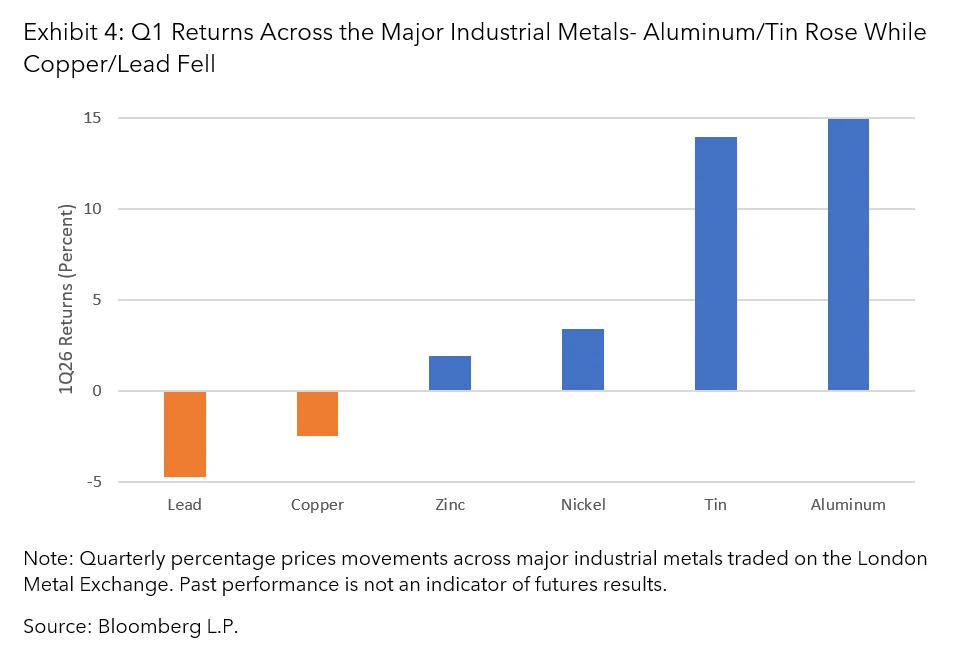
There were disparate returns in the industrial metals space where lead and copper underperformed while tin and aluminum rose higher. Aluminum rose due to production facilities damaged in March during the war. Exhibit 4 shows performance of the major industrial metals with aluminum rising the most due to these supply concerns.
Gold and silver finished the quarter slightly higher after a very strong multi-year run. Despite BCOM Precious Metals rising by only 7%, volatility during the quarter was the highest in over 10 years as prices peaked and then declined sharply before consolidating. Central bank buying of gold finally cooled off due to the high price sensitivity which was previously one of the strongest tailwinds over the last four years.
How commodities support portfolio diversification during market volatility
The first quarter of 2026 has proven to be an eventful one for markets. Diversified portfolios were able to weather the storm as most asset classes fell. Equities as measured by the B500T Index fell 5% and fixed income as measured by the LBUSTRUU Index was flat while BCOM rose 24%. Broad commodities exposure was an uncorrelated asset which dampened overall portfolio volatility as equities moved lower.
This price action was consistent with other historical scenarios where commodities tend to perform well during volatile stress events. With the potential for unexpected inflation to become an issue, continuously holding long commodities exposure by tracking a benchmark like BCOM could not only be a diversifier but has historically provided an inflation hedge.
Read more about BCOM methodology here or learn more about Bloomberg Commodities here.
The data and other information included in this publication is for illustrative purposes only, available “as is”, non-binding and constitutes the provision of factual information, rather than financial product advice. BLOOMBERG and BLOOMBERG INDICES (the “Indices”) are trademarks or service marks of Bloomberg Finance L.P. (“BFLP”). BFLP and its affiliates, including BISL, the administrator of the Indices, or their licensors own all proprietary rights in the Indices. Bloomberg L.P. (“BLP”) or one of its subsidiaries provides BFLP, BISL and its subsidiaries with global marketing and operational support and service. Certain features, functions, products and services are available only to sophisticated investors and only where permitted. Bloomberg (as defined below) does not approve or endorse these materials or guarantee the accuracy or completeness of any information herein, nor does Bloomberg make any warranty, express or implied, as to the results to be obtained therefrom, and, to the maximum extent allowed by law, Bloomberg shall not have any liability or responsibility for injury or damages arising in connection therewith. Nothing in the Services or Indices shall constitute or be construed as an offering of financial instruments by Bloomberg, or as investment advice or investment recommendations (i.e., recommendations as to whether or not to “buy”, “sell”, “hold”, or to enter or not to enter into any other transaction involving any specific interest or interests) by Bloomberg. Information available via the Index should not be considered as information sufficient upon which to base an investment decision. All information provided by the Index or in this publication is impersonal and not tailored to the needs of any person, entity or group of persons. Absence of any trademark or service mark from this list does not waive Bloomberg’s intellectual property rights in that name, mark or logo. For the purposes of this publication, Bloomberg includes BLP, BFLP, BISL and/or their affiliates.
BISL is registered in England and Wales under registered number 08934023 and has its registered office at 3 Queen Victoria Street, London, England, EC4N 4TQ. BISL is authorised and regulated by the Financial Conduct Authority as a benchmark administrator.
© 2026 Bloomberg. All rights reserved.