
Bloomberg Professional Services
- What does the revised U.S. Basel III Endgame proposal mean for banks? Regulators signal lower capital requirements, but key uncertainties remain around timelines and implementation details.
- Diverging global Basel III and FRTB frameworks increase complexity for banks’ operating jurisdictions.
- Data quality, regulatory classifications, and historical time series are critical to meeting FRTB requirements under both the Standardized Approach and Internal Models Approach.
This article was written by Kate Lee, Global Head, Regulatory & Accounting Data, William Troost, Director of US Government Relations and Regulatory Strategy, Ken Yanai, Global Product Manager, Capital, Accounting & Tax Data, and Joseph Alicata, Senior Policy Analyst, Head of Americas AI Regulatory Strategy at Bloomberg.
After two years of uncertainty, the U.S. Basel III “Endgame” has entered a new phase. On March 19, 2026, regulators unveiled a revised proposal recalibrating the 2023 proposed framework, which failed to reach consensus amongst regulators and received pushback from Congress and industry alike.
Federal Reserve Vice Chair Michelle Bowman indicated the update seeks to remove overlapping requirements and better align capital with underlying risk. While certain elements may still increase capital requirements, adjustments to the G-SIB surcharge could offset the impact. Regulators suggest the effect on large banks may be more modest than initially proposed. Comments are due by June 18, 2026.
PRODUCT MENTIONS
For banks preparing for the Fundamental Review of the Trading Book (FRTB), the proposal signals a departure from the 2023 ‘gold plating’ approach toward a framework that allows for greater modeling and promotes U.S. market liquidity.
Why Basel III Endgame triggered pushback
The July 2023 proposal was projected to increase aggregate capital requirements by 16-19%. Several additional areas emerged as focal points of concern:
- Timelines: Viewed as unclear given the operational complexity.
- Market risk under FRTB: Limited clarity around look-through requirements and the Index Benchmark Approach.
- Credit risk: Changes to risk weights for mortgages and corporate exposures were expected to increase RWAs.
- Scope: Extending the frameworks to banks with assets between $100 billion and $700 billion raised questions about proportionality.
What the revised proposal changes
The 2026 proposal reflects a strategic shift toward simplification and risk alignment while upholding Basel III’s core objectives. This pivot aims to preserve U.S. bank competitiveness and market liquidity by narrowing the capital gap that threatened to migrate lending out of the U.S. banking system.
A primary change is the removal of the “dual stack” framework, where banks calculate capital ratios using both standardized and internal models. The updated proposal emphasizes a simpler structure to reduce complexity and improve transparency. Regulators are signaling a clear preference for standardized methodologies—particularly for credit and operational risk—replacing bank-specific models with a “common language” that enhances comparability and provides long-term capital predictability.
The revised proposal also addresses the “cliff effect” in the G-SIB surcharge. Previously, minor footprint fluctuations could trigger disproportionate capital penalties. The new framework introduces 10-basis point increments (down from 50bps) and utilizes daily/monthly averaging rather than year-end snapshots. While this increases the reporting burden on Treasury and Risk functions, it reduces “window dressing” and allows for more stable capital planning.
Market risk requirements have been significantly tailored. Key adjustments include preferential treatment for certain government-sponsored entities and indexing large market capitalization thresholds to the consumer price index.
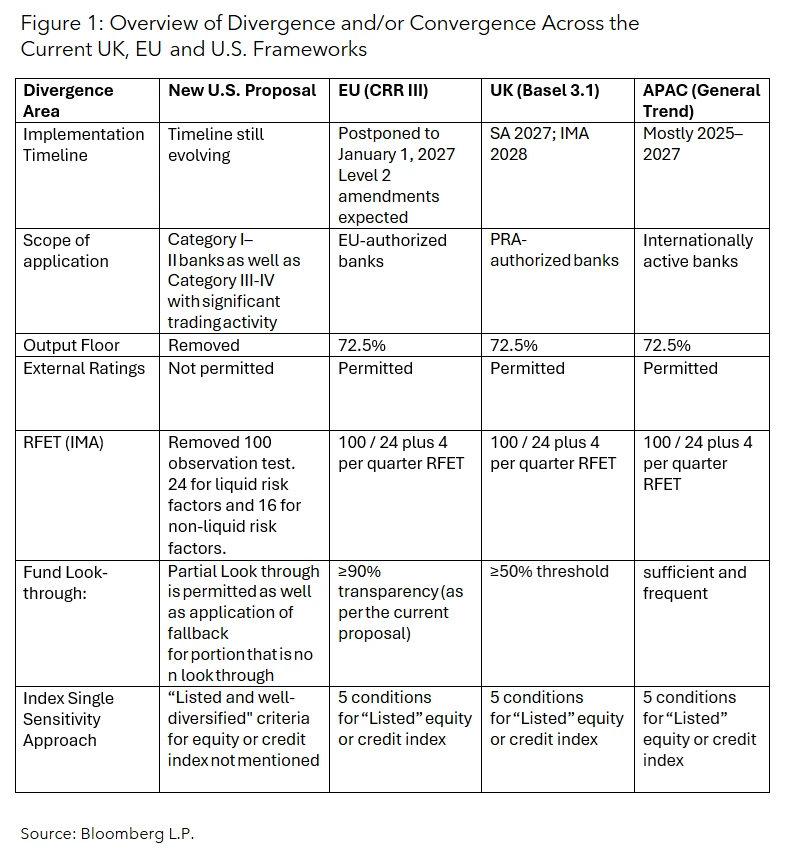
Most notably, rules for indices and funds were relaxed. The removal of “listed and well-diversified” language for indices simplifies the single-sensitivity approach. For funds, a “partial look-through” now allows banks to split funds into look-through and non-look-through portions. Additionally, funds tracking an index can now use the index benchmark approach without calculating tracking differences if they meet specific reporting criteria.
By adopting flexible thresholds and workable implementation strategies, regulators have responded to industry concerns regarding operational feasibility and inflationary decay. These technical recalibrations shift the focus from punitive capital floors toward a risk-sensitive regime that preserves market liquidity and prevents core banking activities from shifting to the shadow banking sector.
Divergence across global frameworks
Following the Global Financial Crisis, the FRTB was developed by the Basel Committee on Banking Supervision to overhaul how banks calculate minimum capital requirements for market risk. Finalized in January 2016 and revised in January 2019, the framework was intended to address key weaknesses in the pre-crisis regime, including the blurry boundary between the trading book and banking book and the inability of Value-at-Risk (VaR) models to capture severe tail risk and market illiquidity.
In response, FRTB introduced stricter trading book boundary rules, tougher model approval standards, and replaced VaR with the more conservative Expected Shortfall metric. Although the Basel framework was designed as a common global standard, implementation has become increasingly uneven as major jurisdictions have adapted timing and calibration in light of domestic competitiveness and cross-border considerations.
That divergence is now most visible in the implementation timelines across the U.S., EU, and UK.
- In the United States, regulators re-proposed the broader Basel endgame package in March 2026, following extensive industry pushback to the 2023 proposal.
- In the EU, concerns about preserving an international level playing field led the European Commission to postpone FRTB implementation first to 1 January 2026 and then to 1 January 2027. At the end of 2025, the Commission consulted on temporary Level 2 measures, including targeted adjustments and a possible multiplier, to mitigate capital impacts from 2027 to 2029.
- The UK has taken a similarly pragmatic but more operationally focused approach: at the beginning of 2026, the Prudential Regulation Authority (PRA) finalized the wider Basel 3.1 package for 1 January 2027, and deferred the FRTB Internal Model Approach (IMA) to 1 January 2028, recognizing the added complexity for internationally active firms.
Together, these developments highlight that while the prudential end-state remains broadly aligned with Basel, implementation is evolving in a more jurisdiction-specific manner.
What are the data challenges behind FRTB implementation
As FRTB takes shape across jurisdictions, banks must ensure they can produce consistent market risk capital results despite differing regulatory calibrations.
This challenge is as much operational as it is regulatory.
Under the Standardized Approach (SA), capital calculations rely on accurate regulatory classifications across asset classes and jurisdictions. Bloomberg supports this by providing SA bucketing and risk weights for both the Sensitivities-Based Method (SBM) and the Default Risk Charge (DRC) for seven regimes.
A significant share of the implementation challenges, however, arises from the treatment of indices and investment funds, whether under a look-through or non look-through approach. Firms must determine whether funds fall within the trading book or banking book, which requires applying a series of regulatory tests.
These tests depend on multiple data inputs, including fund holdings, pricing information, and jurisdiction-specific thresholds. As transparency requirements vary across jurisdictions, access to high-quality, consistent data becomes a key driver of accurate capital calculations.
For banks adopting the Internal Models Approach (IMA), additional data requirements arise through the Risk Factor Eligibility Test (RFET). Institutions must demonstrate sufficient historical observations to classify risk factors as modellable, which directly influences capital charges and model approval.
Consistent pricing data, reference data, and long historical time series therefore become essential components of the infrastructure required to support FRTB implementation.
How Bloomberg supports regulatory workflows
Bloomberg provides data and analytics designed to support market risk and regulatory reporting workflows as banks prepare for FRTB and broader Basel III reforms. Bloomberg’s FRTB SA and IMA solutions help institutions address key implementation challenges by delivering standardized regulatory classifications, transparent fund holdings data, and robust historical time series to support both the Standardized and Internal Model Approaches.
Bloomberg’s Multi-Asset Risk System (MARS) utilizes Bloomberg data and the instrument-level pricing models that power the Terminal to calculate full FRTB-SA analytics and capital based on jurisdiction-specific rules and parameters, including risk buckets, weights, and correlations.
Transparency remains central to Bloomberg’s solutions, helping firms not only meet regulatory requirements but also better understand the inputs behind their calculations. Bloomberg provides clear methodologies and SOC 2–certified controls, enabling clients to understand how regulatory classifications are applied.
By integrating consistent pricing, reference data, and analytics into trading and risk systems, Bloomberg enables firms to align front-office, risk, and finance teams around a common set of regulatory inputs.
As the Basel III Endgame continues to evolve across jurisdictions, access to reliable and consistent data will remain critical in helping banks navigate the final stages of implementation.
Click here to learn more about Bloomberg FRTB solutions.
The data and other information included in this publication is for illustrative purposes only, available “as is”, non-binding and constitutes the provision of factual information, rather than financial product advice. BLOOMBERG and BLOOMBERG INDICES (the “Indices”) are trademarks or service marks of Bloomberg Finance L.P. (“BFLP”). BFLP and its affiliates, including BISL, the administrator of the Indices, or their licensors own all proprietary rights in the Indices. Bloomberg L.P. (“BLP”) or one of its subsidiaries provides BFLP, BISL and its subsidiaries with global marketing and operational support and service. Certain features, functions, products and services are available only to sophisticated investors and only where permitted. Bloomberg (as defined below) does not approve or endorse these materials or guarantee the accuracy or completeness of any information herein, nor does Bloomberg make any warranty, express or implied, as to the results to be obtained therefrom, and, to the maximum extent allowed by law, Bloomberg shall not have any liability or responsibility for injury or damages arising in connection therewith. Nothing in the Services or Indices shall constitute or be construed as an offering of financial instruments by Bloomberg, or as investment advice or investment recommendations (i.e., recommendations as to whether or not to “buy”, “sell”, “hold”, or to enter or not to enter into any other transaction involving any specific interest or interests) by Bloomberg. Information available via the Index should not be considered as information sufficient upon which to base an investment decision. All information provided by the Index or in this publication is impersonal and not tailored to the needs of any person, entity or group of persons. Absence of any trademark or service mark from this list does not waive Bloomberg’s intellectual property rights in that name, mark or logo. For the purposes of this publication, Bloomberg includes BLP, BFLP, BISL and/or their affiliates.
BISL is registered in England and Wales under registered number 08934023 and has its registered office at 3 Queen Victoria Street, London, England, EC4N 4TQ. BISL is authorised and regulated by the Financial Conduct Authority as a benchmark administrator.
© 2026 Bloomberg. All rights reserved.