
Bloomberg Economics
This article was written by Bloomberg Economics Economist Ana Andrade. It appeared first on the Bloomberg Terminal.
Artificial Intelligence is poised to transform the global economy. Near the top of the list of concerns for policymakers, religious leaders and workers is the impact on jobs. To gauge exposure across countries, we combine granular occupational exposure data from the US with jobs data from the
International Labor Organization.
We find that 27% of workers in advanced economies — more than 120 million in the 31 countries we cover — are likely to be meaningfully affected by AI. By way of comparison, between the late 1970s and the 2008 Global Financial Crisis, the share of US workers employed in manufacturing fell from above 20% to 10%, a wrenching transition in which automation played a significant role. For good or ill, the impact of AI could be bigger.
- A common fear regarding AI is that it will wipe out any job where it’s deployed. But technology rarely works that way. Instead, it tends to disrupt a bounded set of tasks within a role – reshaping jobs more often than eliminating them outright.
- Task-level AI exposure scores from researchers at Open AI show cognitive work is far more at risk from the technology than manual work. That means differences in the composition of jobs across countries will determine AI’s first-order effects. Building on these scores, we estimate the share of workers threatened by disruption.
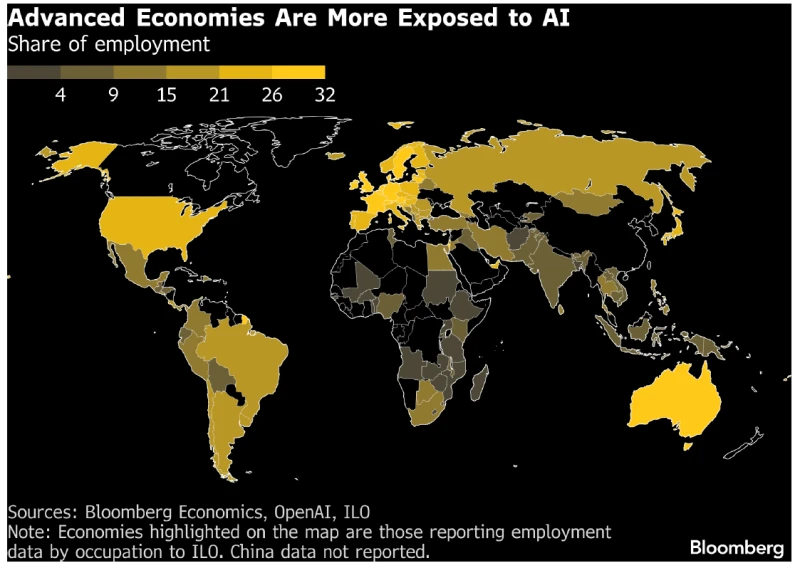
- In general, the results point to significantly higher exposure among advanced economies than emerging economies — reflecting the larger share of workers engaged in white collar knowledge work. For the US, the share is 26%. Among emerging markets, the share is 10%.
- These figures offer a starting point to assess which economies may be most affected by technological change. The gauge does not tell us how quickly and widely AI will be adopted. Neither does it tell us whether the exposed jobs will be augmented or eliminated.
AI is widely viewed as the next general-purpose technology. While its applicability is poised to be far-ranging, its impact will still be uneven across the economy. To get a handle on the scale of disruption, economists turn to the labor market because that’s where transformation is most clearly observed.
Technological innovation disrupts some of the work people do, not — in general — entire jobs. That makes the task level a natural starting point for measuring its impact.
We draw on work by Open AI researchers, who assign AI exposure scores to more than 19,000 tasks across US occupations. A task is defined as exposed if access to Large Language Models — mostly through interfaces like ChatGPT but also indirectly via software systems built on top of them — reduces the time it takes to complete it by at least half.
We then aggregate the scores at the corresponding job level and classify jobs as exposed if at least half of the tasks are exposed. To ensure global comparability, we map job titles to the international classification system of occupations (ISCO-08).
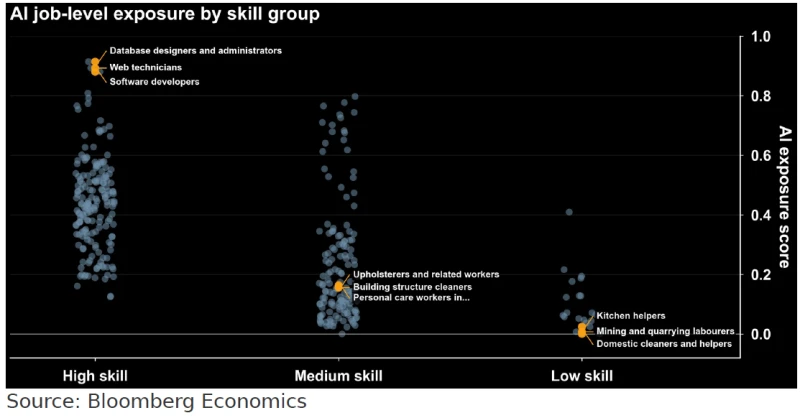
The data show a clear pattern: occupations where the complex and cognitive nature of the work typically requires higher levels of education – such as software developers, translators, and actuaries – have a higher share of tasks exposed to AI.
Those that mostly involve routine physical work and don’t typically require higher levels of education – like cleaners, butchers, and carpenters – sit at the other end of the spectrum.
That means that the type of jobs that make up an economy will be key in assessing the overall impact of technological change.
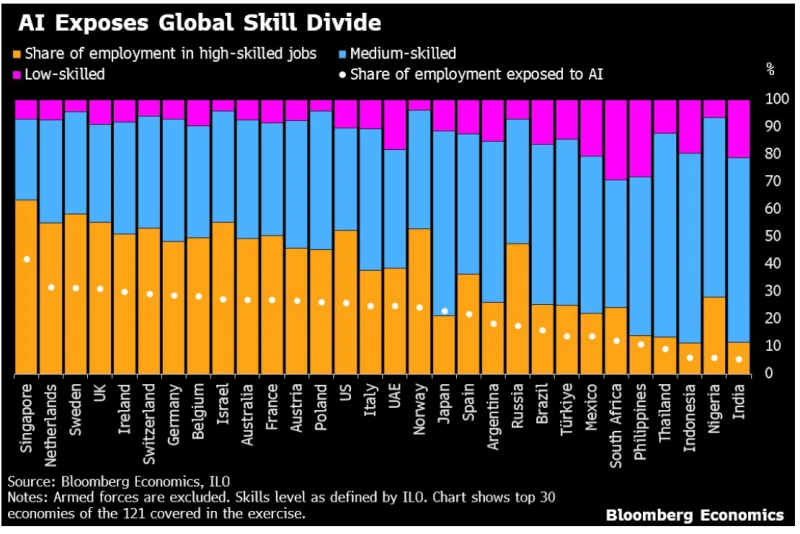
Mapping AI scores to occupational employment data from the ILO shows that advanced economies – where jobs are more knowledge-intensive and education levels higher – are more exposed to the technology, with 27% of workers on average at risk of disruption. Singapore tops the list, with roughly 40% of employment exposed, followed by Sweden and the UK at around 30%. For the US, the share is 26%.
Emerging markets, in turn, are relatively shielded, with 10% of employment on average exposed. At the very low end sit India and Indonesia where exposure is around 5%. That doesn’t mean there won’t be a significant impact. In India, for example, the software industry, which is facing major disruption as LLMs accelerate coding, is one of the star sectors contributing to GDP.
Employment exposure is only part of the story
Exposure figures offer a useful starting point for understanding AI’s economic impact. They fall well short of a comprehensive answer.
For one, it’s still unclear whether exposed workers will see their productivity augmented or their jobs automated away. If it’s the former — growth accelerates and everyone is better off . If it’s the latter, higher unemployment and inequality would be significant costs.
Another unknown is the pace and extent of technology adoption. A number of factors (including cost, labor market policies, and regulation) will determine how fast and widespread adoption will be.
Understanding these dynamics will be just as important as occupational structure to assess the first-order effects of AI on the economy.
Methodology
For this exercise, we chose the Beta measure, which defines tasks as exposed if the time to complete them with access to LLMs — mostly through interfaces like ChatGPT but also indirectly via software systems built on top of them — falls by at least 50%. We aggregate the scores at the six-digit job title level, which follow US Standard Occupation Classification 2018, giving equal weight to tasks.
We use a detailed crosswalk from the European Commission to translate 923 US SOC18 occupations into 436 job titles under Standard International Classification of Occupations (ISCO-08). We collapse many-to-one matches via simple average.
We aggregate AI scores at the two-digit level (43 occupations), so that they can be matched to employment data by occupation at the two-digit level published by the ILO. We maintain a binary definition of exposure: jobs are considered exposed if 50% or more of their tasks are exposed to AI. We calculate the share of those that are labeled as exposed as a percentage of total employment.
ILO’s employment data isn’t exhaustive. Big economies that aren’t covered include China, Canada and South Korea. We use 2024 employment data for most countries; where a full occupation breakdown isn’t available for that year, we rely on the most recent data.
To confirm we didn’t lose meaningful information by carrying this analysis at the two-digit level, we conducted the same exercise for countries where more granular data is available. In particular, we mapped Eloundou’s scores to the UK’s 412 four-digit occupations under SOC 2020 and to the US’s 568 four-digit occupations under the Current Population Survey. They yielded similar results.
The data included in these materials are for illustrative purposes only. The BLOOMBERG TERMINAL service and Bloomberg data products (the “Services”) are owned and distributed by Bloomberg Finance L.P. (“BFLP”) except (i) in Argentina, Australia and certain jurisdictions in the Pacific Islands, Bermuda, China, India, Japan, Korea and New Zealand, where Bloomberg L.P. and its subsidiaries (“BLP”) distribute these products, and (ii) in Singapore and the jurisdictions serviced by Bloomberg’s Singapore office, where a subsidiary of BFLP distributes these products. BLP provides BFLP and its subsidiaries with global marketing and operational support and service. Certain features, functions, products and services are available only to sophisticated investors and only where permitted. BFLP, BLP and their affiliates do not guarantee the accuracy of prices or other information in the Services. Nothing in the Services shall constitute or be construed as an offering of financial instruments by BFLP, BLP or their affiliates, or as investment advice or recommendations by BFLP, BLP or their affiliates of an investment strategy or whether or not to “buy”, “sell” or “hold” an investment. Information available via the Services should not be considered as information sufficient upon which to base an investment decision. The following are trademarks and service marks of BFLP, a Delaware limited partnership, or its subsidiaries: BLOOMBERG, BLOOMBERG ANYWHERE, BLOOMBERG MARKETS, BLOOMBERG NEWS, BLOOMBERG PROFESSIONAL, BLOOMBERG TERMINAL and BLOOMBERG.COM. Absence of any trademark or service mark from this list does not waive Bloomberg’s intellectual property rights in that name, mark or logo.
All rights reserved. © 2025 Bloomberg.