
Bloomberg Professional Services
- Bitcoin’s role in portfolios is evolving through three layers: spot exposure, CME futures markets and institutional index integration across ETFs and structured products.
- Forward curve dynamics, roll yield and cash-and-carry strategies materially influence total returns for futures-based bitcoin investors, particularly during periods of contango and elevated leverage demand.
- Bloomberg Bitcoin indices and analytics tools help investors assess spot prices, futures curves, volatility and digital asset correlations in real time.
This article was written by Jigna Gibb, Head of Commodities and Digital Assets Product Management at Bloomberg.
Bitcoin is shaping up to be one of the most closely watched assets of 2026 after an eventful 12 months and recent price declines. Over the last year, it climbed from early-year volatility to trade near record highs as institutional adoption, ETF inflows, and macro uncertainty fuel renewed demand.
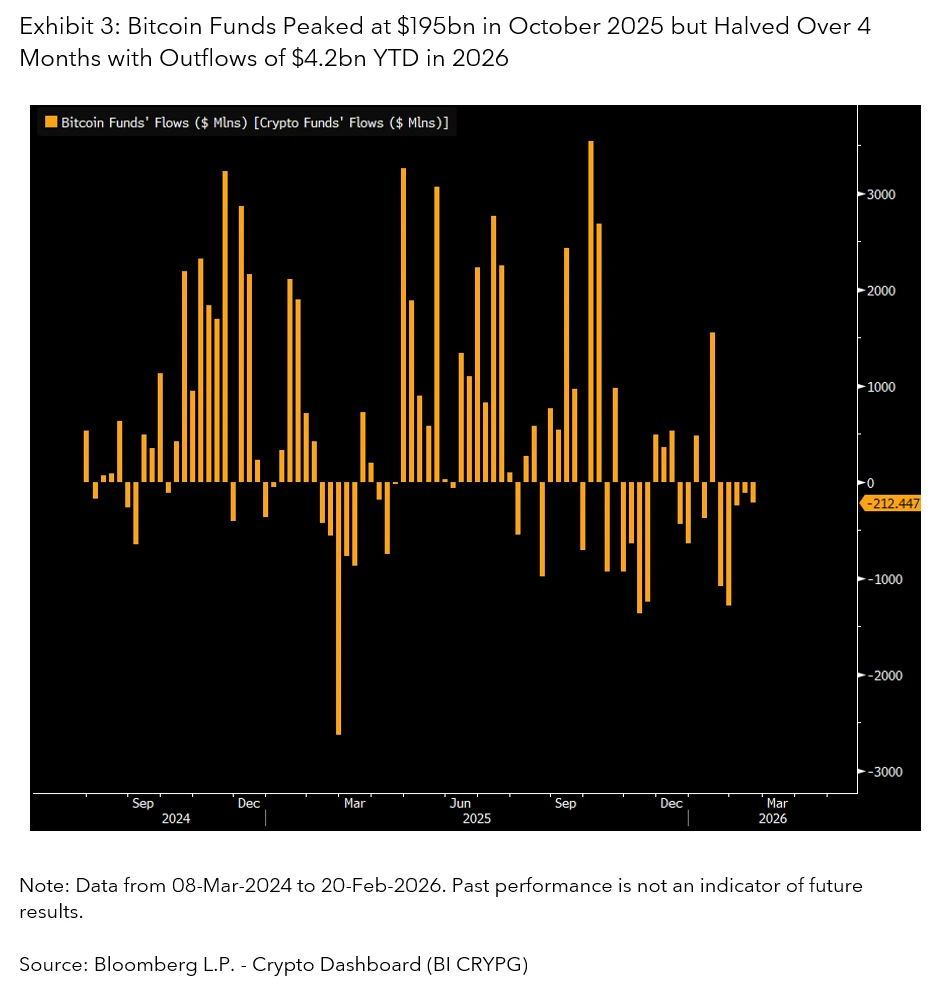
Much like gold, Bitcoin has captured headlines amid persistent concerns over sovereign debt, currency debasement, and the long-term credibility of fiat systems. Yet unlike traditional safe havens, this digital, decentralized monetary network sits at the intersection of technology and finance. It attracted billions in ETF assets, deepening liquidity across global markets and reinforcing its position as an emerging alternative store of value in a rapidly evolving financial system.
Bitcoin is often described as digital gold – previously we discussed the role of Bitcoin and its fundamentals in Bitcoin versus Gold: The Heavyweights Duel. Like gold, Bitcoin can be understood through three distinct lenses: The Spot — the asset itself and its underlying scarcity. The Future — the forward market and price discovery. The Financial — the expanding application within indices, derivatives, and structured exposure. Understanding these layers is essential to understanding how Bitcoin functions in modern portfolios – the strategic asset allocation assessment is discussed in The Power of A Crypto Allocation with An Institutional Perspective.
PRODUCT MENTIONS
Unlike traditional asset classes where market factor driven prices are well established, Bitcoin’s price dynamics are increasingly shaped by a reflexive mix of liquidity conditions. An evolving dynamic is AI-driven disruption which accelerates digital infrastructure buildout, increasing energy and semiconductor demand, and amplifying speculative capital cycles. All of which can influence mining economics, risk appetite, and the velocity of capital flowing into digital assets like Bitcoin.
Bitcoin – the spot
How does spot Bitcoin function as a scarce digital asset?
Since its launch in 2009, spot Bitcoin has established itself as a scarce, borderless digital asset operating on a decentralized network without reliance on any sovereign issuer. Historically, Bitcoin has increasingly been viewed as a high-conviction alternative store of value due to its fixed supply cap of 21 million coins, of which the vast majority has already been mined.
Unlike physical commodities, Bitcoin exists purely in digital form, secured by cryptography and a global network of miners and nodes that validate transactions. Spot Bitcoin can be purchased directly on cryptocurrency exchanges or via regulated spot ETFs, allowing investors to gain exposure without handling private keys.
However, when held directly, Bitcoin requires secure storage through hardware wallets or custodial solutions, introducing considerations around cybersecurity, custody risk, and regulatory oversight. Beyond its monetary narrative, the Bitcoin network represents a foundational layer of financial infrastructure, enabling peer-to-peer value transfer globally and operating as an open, censorship-resistant settlement system in the digital age.
Bitcoin – the future
How Bitcoin futures and roll yield can affect investor returns?
Since 2018, Bitcoin futures contracts have been listed on the CME and other offshore exchanges, referencing cash-settled Bitcoin prices and enabling investors to gain exposure without holding the underlying asset. Similar to gold futures, positions are typically leveraged, requiring only initial margin and brokerage fees at inception, which makes them capital efficient but introduces mark-to-market volatility and margin call risk. Unlike physical commodities, Bitcoin has no physical storage or insurance costs in the traditional sense; however, futures pricing reflects funding rates, interest rates, and demand for leverage, which can cause the forward curve to trade in contango or backwardation depending on market positioning.
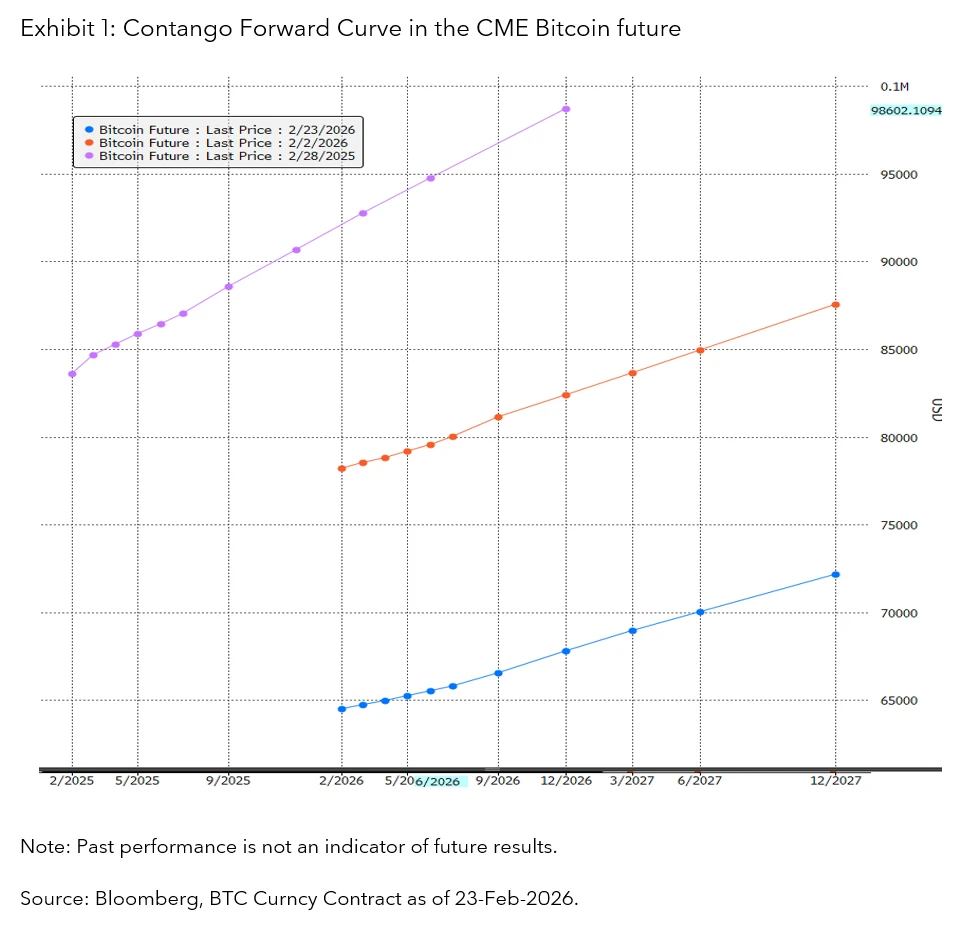
As seen in Exhibit 1, during periods of strong bullish sentiment and elevated demand for long exposure, Bitcoin futures often trade at a premium to spot, creating a negative roll yield for passive long index strategies. Conversely, during risk-off environments or deleveraging phases, the curve can flatten or move into backwardation which historically, in some cases, coincided with price inflection points. As with gold, the shape of the Bitcoin forward curve increasingly reflects broader liquidity conditions and the prevailing interest rate regime, making roll yield an important component of total return for futures-based investors. Historically since February 2018, the negative roll yield has been around ~25% p.a., which is quantified as difference between the annualised returns between the rolling futures and spot indices.
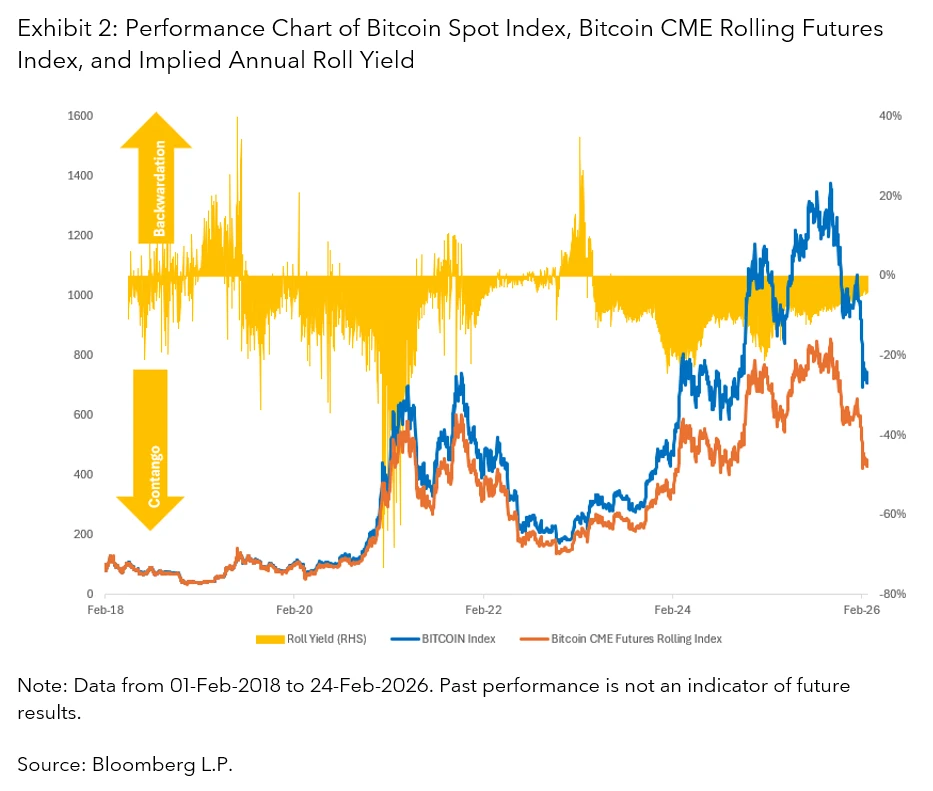
With this phenomenon in spot and futures market, certain market participants have been active in the cash-and-carry trade involves buying spot Bitcoin while simultaneously shorting Bitcoin futures when futures trade at a premium to spot, allowing investors to capture the price difference as it converges at expiry. The return primarily comes from the futures basis (the premium), rather than from Bitcoin’s price direction, making it a market-neutral strategy.
Further, there has been an expansion of products such as Bitcoin perpetual swaps which are leveraged futures contracts with no expiration date that trade 24/7, allowing investors to maintain continuous long or short exposure as long as sufficient margin is posted.
Bitcoin – The Financial
How do Bloomberg Bitcoin indices support institutional digital asset exposure?
For the financial layer, Bitcoin is available in index form via the Bloomberg Bitcoin Index {BITCOIN Index} (spot-based) and the Bloomberg Bitcoin Futures Index {BTCFTR index}. The Bloomberg Bitcoin Index reflects spot Bitcoin prices using aggregated pricing from multiple contributors, while the Bloomberg Bitcoin Futures Index tracks CME Bitcoin futures contracts. Exposure to the futures index can be replicated by rolling CME Bitcoin futures contracts, in which the excess return captures spot price movements and roll yield. Bitcoin is often partnered with other digital asset tokens, such as Ethereum in the Bloomberg Bitcoin and Ethereum Equal-Weighted {XBTXETEW Index} and Market-Cap Weighted indices {XBTXETMC Index}. These indices are often referenced as benchmarks in ETFs including those with leverage and inverse payouts.
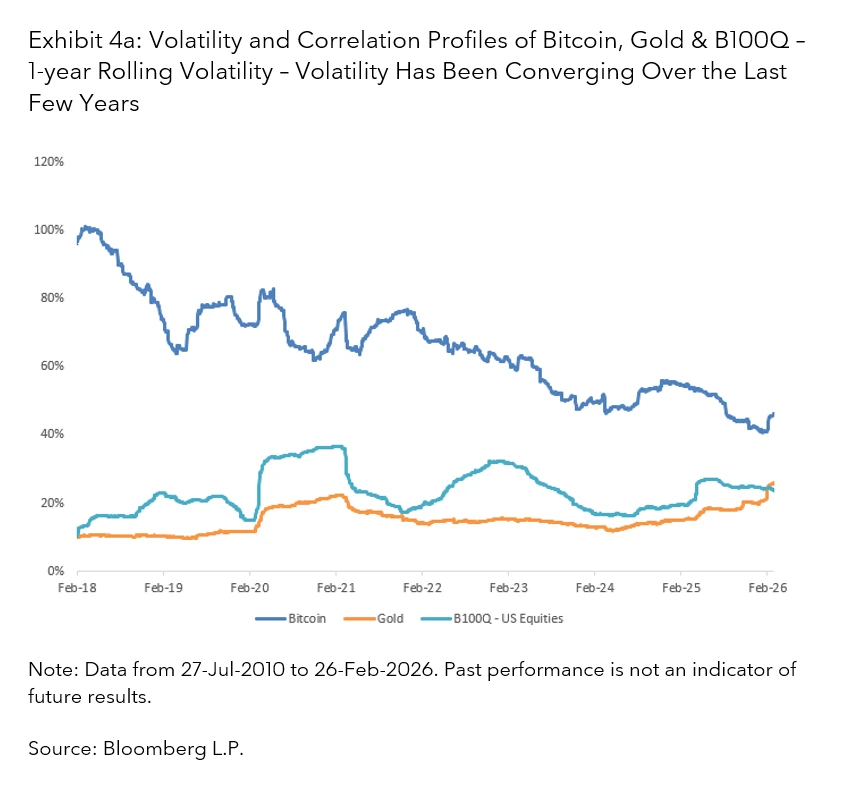
In Exhibit 4a, we show the 1-year rolling volatilities of bitcoin, gold and US 100 technology equities over time. Interestingly, we observe that over the past few years the volatility of bitcoin and gold has been converging, with the digital asset’s volatility halving from 100% to 46% and gold grinding higher to 26%.
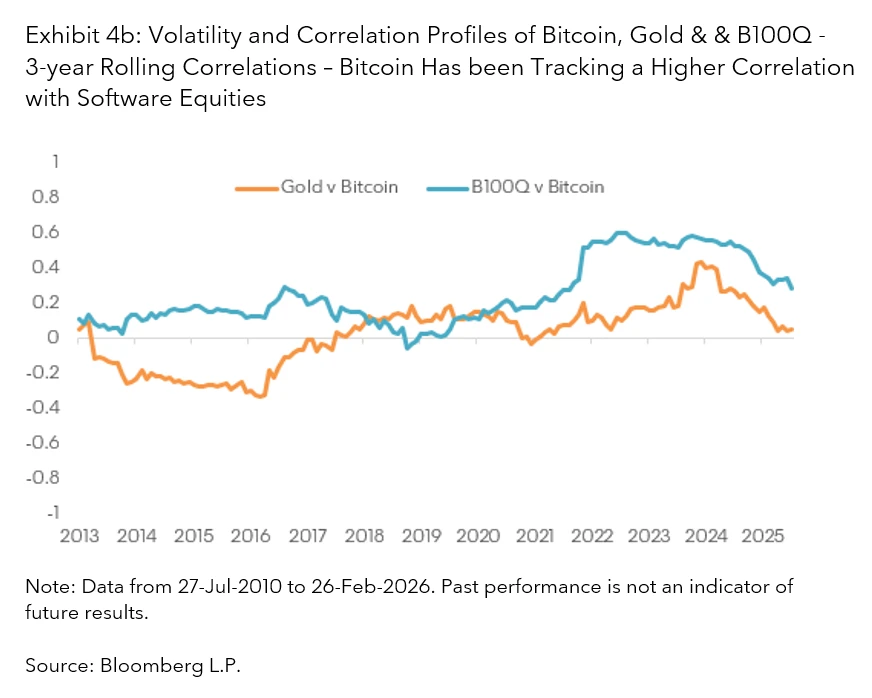
In terms of influences on price movements, it has been well-documented that Bitcoin and gold exhibit neutral correlations with each other while 3-year rolling correlations between Bitcoin and US 100 technology equities {B100Q Index} has been peaking around 60% over the past few years (Exhibit 4b). This trend highlights that price moves in these two assets have been more interlinked of late with the recent tech sell-off acting as catalyst for declines in digital asset prices.
The spot, the future, the financial – Bitcoin as the basis for a new monetary era
Bitcoin’s evolution from a niche digital experiment into a multi-layered financial asset is reshaping how investors evaluate stores of value, liquidity, and portfolio construction. Through the lenses of Spot, Future, and Financial, Bitcoin now spans physical-like scarcity, sophisticated derivatives markets, and institutional index integration — placing it firmly within mainstream capital markets. Its forward curve, roll dynamics, and expanding product set reflect a market increasingly driven by liquidity cycles, macro conditions, and structural adoption rather than purely speculative flows.
At the same time, smoothing volatility and deeper institutional involvement suggest maturation, even as correlations with technology equities underscore its sensitivity to broader risk appetite. Whether viewed as digital gold, a macro liquidity barometer, or a technological monetary network, Bitcoin is no longer operating at the fringe of finance. As capital markets continue to digitize, understanding these structural layers will be essential to evaluating Bitcoin’s role in strategic asset allocation and the evolving architecture of global portfolios.
The data and other information included in this publication is for illustrative purposes only, available “as is”, non-binding and constitutes the provision of factual information, rather than financial product advice. BLOOMBERG and BLOOMBERG INDICES (the “Indices”) are trademarks or service marks of Bloomberg Finance L.P. (“BFLP”). BFLP and its affiliates, including BISL, the administrator of the Indices, or their licensors own all proprietary rights in the Indices. Bloomberg L.P. (“BLP”) or one of its subsidiaries provides BFLP, BISL and its subsidiaries with global marketing and operational support and service. Certain features, functions, products and services are available only to sophisticated investors and only where permitted. Bloomberg (as defined below) does not approve or endorse these materials or guarantee the accuracy or completeness of any information herein, nor does Bloomberg make any warranty, express or implied, as to the results to be obtained therefrom, and, to the maximum extent allowed by law, Bloomberg shall not have any liability or responsibility for injury or damages arising in connection therewith. Nothing in the Services or Indices shall constitute or be construed as an offering of financial instruments by Bloomberg, or as investment advice or investment recommendations (i.e., recommendations as to whether or not to “buy”, “sell”, “hold”, or to enter or not to enter into any other transaction involving any specific interest or interests) by Bloomberg. Information available via the Index should not be considered as information sufficient upon which to base an investment decision. All information provided by the Index or in this publication is impersonal and not tailored to the needs of any person, entity or group of persons. Absence of any trademark or service mark from this list does not waive Bloomberg’s intellectual property rights in that name, mark or logo. For the purposes of this publication, Bloomberg includes BLP, BFLP, BISL and/or their affiliates.
BISL is registered in England and Wales under registered number 08934023 and has its registered office at 3 Queen Victoria Street, London, England, EC4N 4TQ. BISL is authorised and regulated by the Financial Conduct Authority as a benchmark administrator.
© 2026 Bloomberg. All rights reserved.