
Bloomberg Professional Services
The narrative surrounding the South Korean economy has reached a definitive turning point, shifting from a historical “discount” to a burgeoning “premium”. As the global financial landscape navigates geopolitical shifts and the rapid integration of artificial intelligence, Korea is positioning its capital markets as a primary engine for regional growth. For Asia-Pacific investors, particularly those in Japan, the internationalization of the Korean Treasury Bond (KTB) market represents more than just a diversification play—it is the opening of a sophisticated, transparent, and highly accessible gateway to what policymakers are calling “K-Alpha”.
A Structural Shift: Beyond the “Korea Discount”
For years, global investors discussed the “Korea Discount”—a perceived undervaluation of Korean equities and debt due to regulatory hurdles and governance concerns. Today, that conversation is being systematically dismantled by aggressive structural reform and a proactive government stance.
During a recent Bloomberg seminar in Tokyo, South Korean Deputy Prime Minister and Minister of Finance and Economy, Koo Yun Cheol, signaled a clear departure from the status quo. The government’s top priority is upgrading the capital market to global standards, aiming for inclusion in developed equity market indices and the World Government Bond Index (WGBI).

“In Korea, there is no more discount in stock markets… Soon we will enter an age where ‘K’ itself represents alpha.” — Koo Yun Cheol, Deputy Prime Minister and Minister of Finance and Economy
This transition is underpinned by robust fundamentals. Despite global headwinds, Korea’s GDP growth is projected to reach 2% this year, following a rebound that saw the KOSPI index rise 160% between early 2025 and February 2026. This resilience is powered by a strategic pivot toward a “Physical AI” transformation—applying AI to shipbuilding, robotics, and semiconductors to maintain global leadership in the tech supply chain.
Modernizing the Plumbing: Accessibility and Liquidity
A market is only as strong as its infrastructure. To attract stable global capital, the South Korean government has overhauled the “plumbing” of its financial system. The goal is a market that is “frictionless” for foreign investors, particularly those looking to capitalize on the WGBI inclusion.
Key operational reforms include:
- 24-Hour FX Operations: Starting July 2026, the domestic FX market brokerage hours will be extended to a full 24-hour cycle, eliminating trading hour gaps and allowing the KRW to be traded anytime, anywhere.
- Omnibus Account Integration: The effective use of omnibus accounts managed by global custodians significantly reduces the administrative burden. Real-name verification and KYC can now be processed at the custodian level rather than for each individual fund.
- Extension of Settlement Hours: To solve the perennial “pre-funding” issue caused by time-zone differences, operating hours for bond settlement (BOK-Wire+ and KSD e-SAFE) have been extended to 8:00 PM KST.
These changes are already yielding results. Secondary market liquidity remains healthy despite geopolitical tensions, with the KTB market showing enough resilience to absorb large-scale issuances, such as the 5 trillion won ultra-long 30-year tenure issuance in March 2026.
The Role of Technology: Human Expertise Meets Electronic Precision
While policy provides the framework, technology provides the bridge. The shift toward electronic trading is a critical component of the KTB market’s evolution. For the APAC workflow, this means a move away from manual, opaque processes toward execution efficiency and transparency.
Bloomberg’s electronic trading solutions are at the forefront of this shift, supporting KTB transactions with seamless integration into existing Order Management Systems (OMS). This allows investors to achieve “Best Execution” by instantly comparing yields across multiple dealers, while ensuring that complex data—such as decimal point precision in KTB pricing—is handled with automated accuracy.
However, the “human” element remains the differentiator. Behind the data and the Terminals are the market specialists and policymakers working to ensure that global investors have a voice in the market’s development.
Outlook: The 2026 Strategic Roadmap
As we move through 2026, the KTB market is set to become a pillar of APAC portfolio construction. The anticipated WGBI inclusion is expected to drive between $50 billion and $70 billion in new inflows, potentially lowering long-term yields by 20 to 50 basis points.
For finance professionals, the takeaway is clear: the Korean market is no longer a peripheral destination but a core, high-standard environment. The combination of sound fiscal health—with a debt-to-GDP ratio significantly lower than the G7 average—and a relentless drive for innovation makes the KTB market a primary venue for those seeking stability and alpha in equal measure.
The invitation from Seoul is open. As the market moves toward a more digital, connected, and international future, those who engage now will be best positioned to capture the value of the coming decade.
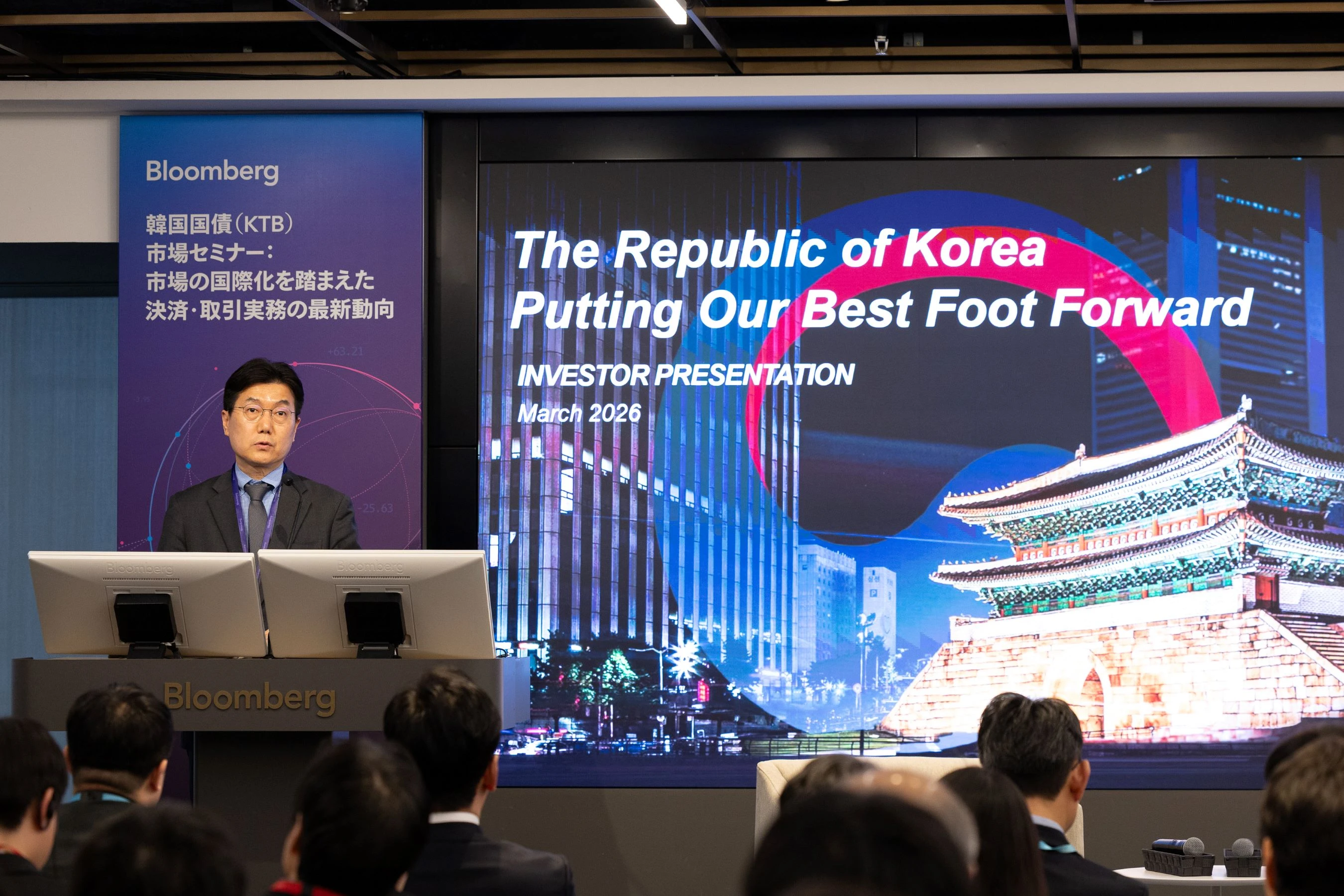
“The goal is to make sure that there will be no difficulties for the investors in accessing the Korean market… If you have any ideas or suggestions, then please let us know. It will become my number one priority.” — Lee Hyoung Ryoul, Director General for International Finance, Korean Ministry of Finance and Economy