REPORT
Redrawing the Institutional Investment Map: Shifting Beyond Legacy Benchmarks
KEY TAKEAWAYS
-
Geopolitical fragmentation, protectionist inflation and the AI infrastructure boom are transforming global equity markets, prompting investors to rethink their reliance on legacy benchmarks.
- Changing trade patterns, capital flows and national-security priorities are redrawing the investment map across AI infrastructure, perceived safe havens and strategic autonomy.
- Generative AI annual revenue could reach $2.3 trillion by 2032, accelerating infrastructure investment, while big-tech capex is projected to reach approximately $750 billion in 2026 as AI infrastructure demand grows.
Introduction
The Great Divergence of 2026
As 2026 progresses, the world has been propelled into a period of divergence, where geopolitics has become the macro.
Markets around the world are shifting and repositioning in response to seismic geopolitical changes.
The changes are grounded in a sweeping realignment forged by US foreign and economic policy, particularly the US tariff agenda under the Trump administration in 2025-2026, which brought strategic autonomy and protectionist inflation to the forefront of global trade and debate.
This year’s divergence marks the beginning of a sustained shift into what we’re calling “the divergence decade” for market players around the world.
Against this backdrop of divergence, strategic autonomy and protectionist inflation, equity markets and investors are navigating a corporate investment boom in AI infrastructure (AI/Infra).
Investors are evolving in response to shifting geopolitics and markets − and Bloomberg is evolving with them.
Across global markets, shifting trade patterns, changing capital flows, and widening differences in regional performance are prompting market participants to rethink how they invest. As geopolitics reshapes the investment landscape, investors are increasingly looking beyond legacy benchmarks and toward index methodologies designed for a more fragmented and rapidly evolving global market.
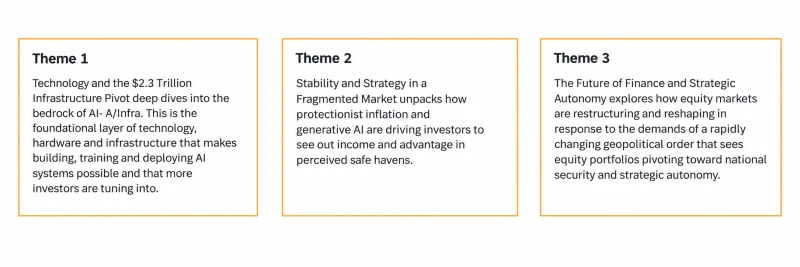
In this report, we explore the emerging divergence decade and its impact on institutional investors and equity markets through three core themes:
The Bloomberg Edge
We also showcase Bloomberg’s own leading innovation in the Equity space.
This combines our signature advanced design, flexibility, and ecosystem integration with cross-channel synergy and flexible customizations that legacy providers often cannot match.
While many legacy providers continue to focus on broad, market-cap-weighted efficiency, Bloomberg is detecting and responding to an increasing demand for rules-based, transparent benchmarks that can thrive within this rapidly emerging paradigm.
The Bloomberg Equity Indices universe spans over 30,000 equities and covers more than 99% of investable free-float market cap across 47+ countries.
With an unparalleled depth of perspective, our natively integrated Indices solutions position our clients to successfully navigate the divergence decade, and beyond.
Enter your details to access the report:
Theme 1: Technology and the $2.3 Trillion Infrastructure Pivot
The Physical Constraint Gem
Artificial intelligence is the defining technology of our time.
Bloomberg Intelligence has estimated that generative AI is set to skyrocket from $40 billion in 2022 to an estimated $2.3 trillion+ in annual revenue by 2032. This represents a staggering Compound Annual Growth Rate (CAGR) of 50% and is prompting a deeper, parallel focus for developers and investors, from software to the foundational layer of technology, hardware and infrastructure that makes building, training and deploying AI systems possible: AI infrastructure (AI/Infra).
This deeper focus is borne of necessity. With AI workloads already accounting for more than 20% of global server revenue, and that share is projected to rise to 40% in the coming years, it’s clear that sustained and strategic investment in the physical constraints underpinning AI/Infra is not a “nice to have,”, but vital to generative AI and its growth trajectory.
It is tempting to zero in on the companies building the AI models that dominate the news. But history reminds us that when new technologies take off, the long-term beneficiaries often include the enabling companies supporting innovation across the supply chain.
We have previously used the Bloomberg AI Value Chain Equal Weight Index (BAIVT:IND) to examine how indices can help to observe companies building the foundations of AI.
The Energy Demand Overlap
As we explored in the Bloomberg Global Index 2026 Outlook, energy security is a defining investment theme. Data-center electricity use is poised to surge 4–10x by 2030, and there is significant investment overlap with interest in energy demand, capacity and security.
Training and running large AI models requires connecting thousands of graphics processing units (GPUs) in data centers, which in turn means moving vast amounts of data at extremely high speeds. Every time that data moves, energy is consumed.
Yet years of underinvestment have left developed-world power systems ill-equipped to support growing energy demand. Power prices surged in 2025. Consumer costs have risen as growing power demand from AI and data centers has pushed utility bills higher.
The geopolitical realignment we have entered this year (explored in more detail in Theme 3 of this report) creates an added layer of significance to the divergence decade − the collision of supply chains across the US, Europe and allied economies with energy and grid capacity.
The Rise of AI/Infra
AI, together with future technology more broadly, is the primary battleground in the intensifying rivalry between the United States and China, with both governments treating leadership in AI, including the journey toward superintelligence, as critical to economic strength and national security.
Effective exposure requires looking beyond the most visible technology leaders and deeper into the AI value chain.
Power equipment manufacturers, grid and transmission providers, storage solutions, logistics networks, and suppliers of critical materials all stand to benefit in a world where energy capacity increasingly constrains economic growth.
There is a clear relationship between equities and commodities here, as AI/Infra is heavily reliant on commodities for its all-important current and future energy supply.
Some investors are exploring which commodities will be in higher demand due to higher power use, and a projected pickup in overall global and regional economic activity.
Meanwhile, perceived “safe havens” are attracting significant AI-driven investment, with Microsoft announcing new AI investments in Japan and the US in April 2026.
By systematically capturing segments across the AI value chain in our index design and construction, we offer investors both breadth and depth of perspective.
AI/Infra Market Players to Watch
Leading AI/Infra market players to watch include NVIDIA and Broadcom, two companies at the center of the global AI infrastructure buildout.
NVIDIA (NASDAQ: NVDA) has evolved from the world’’s leading AI chip designer into the company at the center of the global AI infrastructure buildout. Its business now extends beyond GPUs to high-speed networking, AI software, and integrated AI factory platforms that power the world’’s largest data centers. As hyperscalers and enterprises continue to invest heavily in AI infrastructure, NVIDIA remains a key beneficiary, with its financial performance often viewed as a barometer for global AI capital expenditure and adoption.
Broadcom (NASDAQ: AVGO) has become one of the most important players in AI infrastructure through its leadership in custom AI chips and high-performance networking. The company works with major hyperscale cloud providers to develop AI silicon, while supplying the networking technologies that connect large-scale AI clusters. As demand for purpose-built AI infrastructure grows, Broadcom is well positioned to benefit from the next wave of AI investment.
How the AI Boom Can Be Tracked Through Bloomberg Indices
As AI adoption grows, market participants are turning to tools and data that can quantify its influence. Bloomberg provides these tools through indices that offer thematic exposure.
Four Bloomberg indices are especially pertinent for investors looking to get beyond legacy benchmarks:
Bloomberg Artificial Intelligence Total Return Index (BAIT:IND) tracks the performance of the top 50 companies that develop, facilitate, or use solutions such as deep learning, machine learning, natural language processing, and image and speech recognition utilizing research from Bloomberg Intelligence.
Bloomberg AI Value Chain Equal Weight Index (BAIVT:IND) takes a structured, rules-based approach, using BI research to map companies aligned to the backbone of the AI ecosystem, with a focus on cloud, AI hardware, and AI semiconductors. Only firms with clear, material exposure to AI are eligible for inclusion in the index. Once the eligible universe is established, companies are grouped into these three categories, with the 15 largest companies in each group, ranked by free-float market capitalization, selected for inclusion. An equal weight approach can help reduce concentration in the largest constituents, while broadening exposure across the eligible AI value chain.
US Listed Semiconductors Index (BCHIPT:IND) is constructed to track the performance of the top 30 US-listed companies in the semiconductors sector, as determined by Bloomberg Intelligence.
Bloomberg Electrification Select Index (BELECT:IND) tracks the performance of companies that provide products and services including, but not limited to, renewable energy generation, grid infrastructure modernization, and large-scale battery storage that support the acceleration of global electrification across transportation, buildings, and industry, with securities screened for involvement in controversial activities. Up to 100 securities that are part of Grid Tech, Decentralized Energy, Solar, Wind, or Nuclear themes, as defined by Bloomberg Intelligence, are included.
Why an Index Approach Matters in Assessing AI Investments
Less a single product and more an ecosystem, AI models require substantial infrastructure (data centers, advanced semiconductors, and reliable storage systems) to function. Each layer is complex and capital intensive and has its own essential contributors.
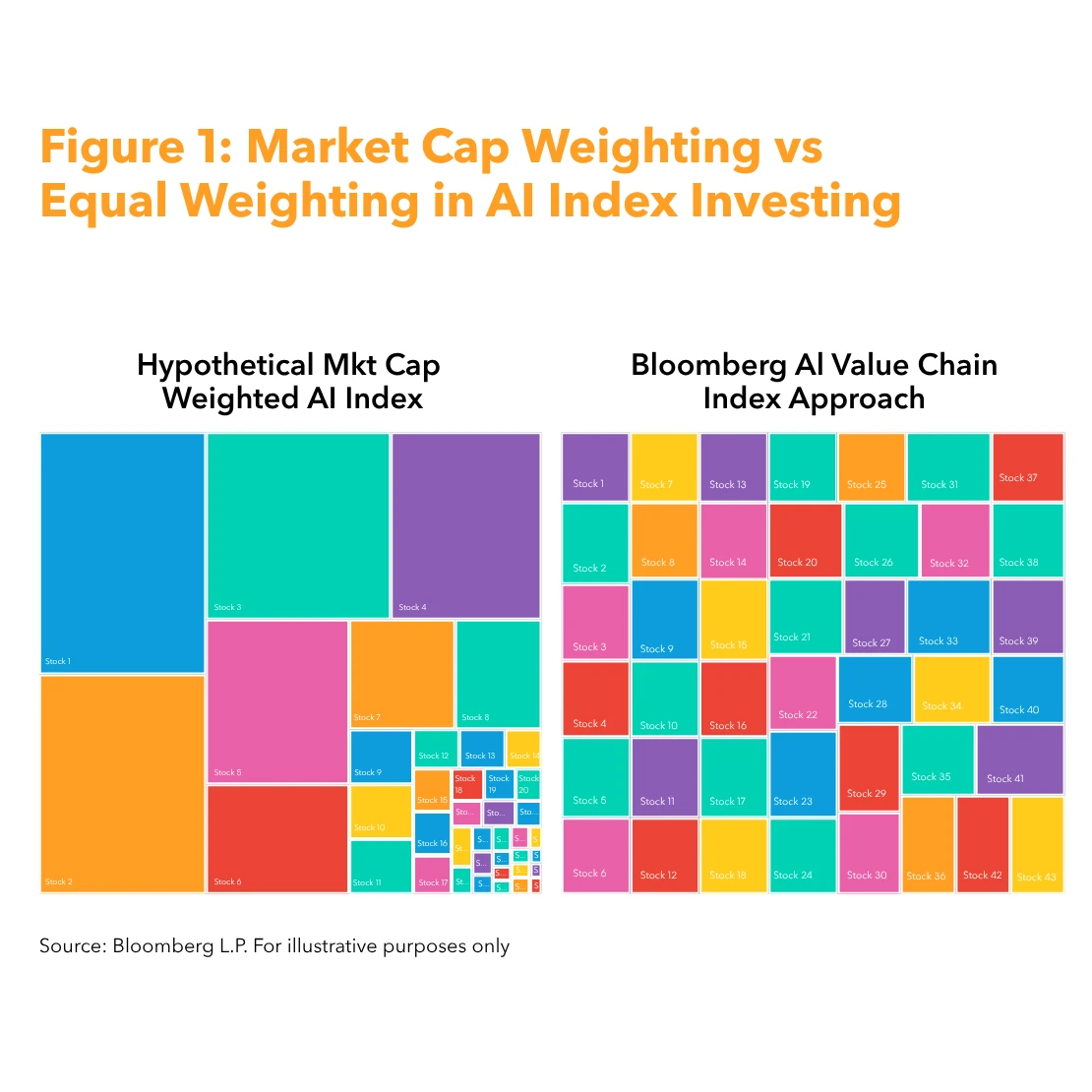
Focusing on a narrow set of AI stocks may lead to concentration or exposure gaps. From an index design perspective, we seek to offset two key structural risks: high weighting to a few large-cap constituents, and underrepresentation of companies providing critical but less conspicuous contributions to AI innovation.
Think of AI as a skyscraper. The model developers are the architects celebrated on magazine covers, but without the steelmakers, electricians and manufacturers, the building will never be completed.
Indices such as the Bloomberg AI value chain index aim to capture all these roles and efforts through equal weighting and diversified exposure, and show how we get beyond legacy benchmarks in our index design in both principle and practice.
Theme 2: Stability and Strategy in a Fragmented Market
The Safe Haven Shift
In a world shaped by protectionist inflation, capital is seeking resilience.
As geopolitical fragmentation reshapes the global economy, investors are increasingly seeking markets that offer relative stability amid rising uncertainty. Capital is flowing toward economies with resilient institutions, strategic industries, and policy settings that can better withstand the effects of protectionist inflation and supply chain realignment.
Much of this shift has been driven by protectionist inflation, a consequence of trade policies such as tariffs, export controls, and industrial policy that have reshaped global supply chains since 2025. Unlike traditional inflationary cycles, protectionist inflation is structural rather than cyclical, making it more persistent and less responsive to monetary policy. The result is a more fragmented investment landscape, where regional performance is diverging and country selection is becoming increasingly important.
Corporate investment trends continue to shape financial market opportunities. As governments and companies invest in AI infrastructure, semiconductor manufacturing, energy security, defense, and critical supply chains, investors are increasingly allocating capital toward markets positioned to benefit from these long-term structural themes. Rather than relying solely on broad regional exposure, investors are becoming more selective, seeking markets with strong policy support, resilient domestic demand, and attractive corporate fundamentals.
Against this backdrop, several developed markets are emerging as relative safe havens for global capital. Countries including the United States and, Japan,, and parts of Northern Europe are attracting investment through a combination of political stability, deep capital markets, strategic industrial investment, and growing exposure to the technologies and infrastructure underpinning the next phase of economic growth.
Spotlight on the United States
The United States remains at the center of the global AI infrastructure investment cycle. Despite a more uncertain geopolitical and trade environment, the country continues to lead in AI innovation, cloud computing and advanced semiconductor design. Supported by deep capital markets, strong private sector investment, and government initiatives to strengthen domestic manufacturing, the US remains a key destination for global capital.
Corporate investment in AI infrastructure continues at an unprecedented pace. According to Bloomberg Intelligence’s Generative AI 2026 Outlook, big-tech capital expenditure is projected to reach approximately US$750 billion in 2026, up roughly 70% from 2025, as demand for AI infrastructure accelerates. Bloomberg Intelligence also expects inference computing to surpass AI training at least three years earlier than previously forecast, driven by the rapid adoption of reasoning models and enterprise AI deployment. With generative AI projected to become a US$2.3 trillion market by 2032, representing 22% of total technology spending, the US remains at the forefront of the technologies underpinning the next phase of global economic growth.
Just as important, the corporate landscape is entering a new investment cycle. Companies are shifting from AI experimentation toward enterprise deployment, with capital increasingly flowing into the infrastructure required to support large-scale AI adoption. This investment is benefiting a broad ecosystem spanning semiconductor designers, cloud providers, networking companies, data center operators, and industrial suppliers. Together, these trends position the United States as one of the most influential markets shaping global equity performance throughout the divergence decade.
Spotlight on Japan
Japan entered 2026 as one of the more quietly compelling developed market stories. After decades of stagnation, its economy is showing signs of renewed momentum. Nominal GDP growth has accelerated, fiscal policy remains supportive, and Japanese companies are deepening their role in global supply chains tied to automation, semiconductors and advanced manufacturing.
Meanwhile, a weaker yen continues to support export demand, while government incentives aimed at productivity and technological upgrades are reinforcing domestic investment. Together, these forces position Japan as a developed market with improving cyclical and structural fundamentals.
The country is attracting foreign investment, with Microsoft investing $10 billion (approx. ¥1.6 trillion) in AI infrastructure, cybersecurity and workforce.
Just as important, the corporate landscape is undergoing a meaningful transformation. Long criticized for balance sheet conservatism and limited shareholder focus, Japanese companies are responding to governance reforms and stock exchange pressure to improve capital efficiency. The result is a tangible shift toward shareholder returns, particularly through dividends.
The Bloomberg Japan High Dividend 50 (BJHD50:IND) Index highlights this change, with the index’s payout ratio rising a remarkable 94% over the past three years.*
*Past performance is not indicative of future results.
Stability + Strategy for US Investors
Bloomberg US Domestic Equity Indices provide broad, transparent exposure across the US equity market through a comprehensive suite of benchmarks covering approximately 99% of the investable market by capitalization. Built using a rules-based, free-float market capitalization methodology, the index family is designed for benchmarking, asset allocation and the creation of investment products across the full market capitalization spectrum. Our flagship US domestic equity indices include:
| Bloomberg US Aggregate Equity Index | AGGE:IND |
| Bloomberg 500 Index | B500:IND |
| Bloomberg US 200 Index | B200:IND |
| Bloomberg US 1000 Index | B1000:IND |
| Bloomberg US Mid Cap Index | BMID:IND |
| Bloomberg US Micro Cap Index | BMIC:IND |
Beyond broad market benchmarks, Bloomberg also offers growth, value, dividend yield and equal weight indices to support a range of investment objectives. These include:
| Bloomberg US 500 Growth Index | B500G:IND |
| Bloomberg US 500 Value Index | B500V:IND |
| Bloomberg US 500 Dividend Yield Index | B500D:IND |
| Bloomberg US 500 Equal Weight Index |
B500PSE:IND |
All of our indices can be accessed on the Bloomberg Terminal at {IN <GO>}.
Equity Product Focus
Bloomberg Indices provides a comprehensive solution designed to support comparison across countries and size segments. A consistent methodology, minimum liquidity requirements, and buffer rules support commonality across markets and investability.
The indices offer flexibility across size groups, sectors, factors, and hedging capabilities, supported by Bloomberg data, research, analytics, and integration with the Bloomberg Terminal and PORT.
This approach extends across dividends, covered calls, and REITs, helping investors track and analyze strategies across these areas.
Dividends
We provide institutional-grade dividend data and forecasting tools, primarily via the Bloomberg Terminal and enterprise feeds. Our core tool, Bloomberg Dividend Projections (BDVD), offers multiple actionable insights.
Covered calls
We have a dedicated, fast-growing Covered Call Index suite where we monitor long equity or ETF positions combined with systematically written call options. See our Bloomberg Covered Call Index Methodology.
REITs
We maintain dedicated REIT indices with defined inclusion criteria designed to categorize and track REIT performance. REITs can provide exposure to different segments of the real estate market, including areas linked to evolving investment themes, such as data centers and the growth of generative AI.
Theme 3: The Future of Finance and Strategic Autonomy
The Fragmentation Gem
Equity markets are restructuring and reshaping in response to the demands of a rapidly evolving geopolitical order.
This reshaping and restructuring is being driven by US economic policy’s increasing shift away from a universal global system toward a sharper, fragmented model.
As we explored in-depth in the Bloomberg Global Index 2026 Outlook, for decades the US has played an expansive role in the global economy by anchoring trade, underwriting security and sustaining the postwar system.
However, the underlying arithmetic has shifted, and that model is now changing. The new, sharper model prioritizes preferential supply chains, trusted investment corridors, and selective and regional security.
This has arguably impacted and fragmented the G7, with some allies preferencing bilateral talks with the US over collective agreements, and the G7 share of global GDP no longer supporting the same breadth of commitments.
In response, we are seeing heightened concerns with national security and strategic autonomy redefining equity portfolios.
Strategic autonomy is the capacity to make and act on decisions without external constraint or coercion. It is emerging as a key priority for nation-states seeking to de-risk and build resilience in the wake of the US’ political agenda.
Western allies are increasing defense spending to narrow the technology gap.
Defense policy is also recalibrating toward resilience, regional stability, and control over critical inputs. This shift is extending beyond traditional military spending to encompass energy security, critical materials, the grid and supply-chain infrastructure.
For investors, the implication is clear. Defense and security-related capital expenditure is becoming a structural feature of the global economy rather than a cyclical response to isolated risks. Along with resource security, defense and security-related capital expenditures are no longer niche allocations, but secular investment themes worthy of closer attention.
Against this backdrop, the most important questions for investors are: who is inside the preferred system, who is outside, and what equity markets are levered to that redesign?
Redrawing the Investment Map
Inside this preferred system are countries that align with US strategic objectives, have exposure to industries deemed critical to national resilience, and share key attributes such as civil liberties, relatively stable governance and transparent regulatory environments. This includes Australia, Germany, the UK and Canada, reflecting markets positioned within an increasingly strategic global system.
Australia is particularly central to the US’ defense strategy of building a network of reliable partners in the APAC region that allow operational access, possess sophisticated weapons, and that it can count on in the event of conflict in the Western Pacific.
The Australian Government has responded by allocating an extra $38 billion (A$53 billion) in defense spending in the next 10 years in its 2026-2027 budget. It aims to strengthen its response, including investments in nuclear-powered submarines, drones and upgraded frigates.
Germany’s export engine is showing resilience even as global trade fragments. A surge in exports, alongside higher government spending, helped Europe’s largest economy expand 0.3% in the first quarter of 2026. With Germany also increasing its focus on defense, infrastructure and strategic resilience, its deep industrial base could be well positioned as Europe directs more capital toward security and greater strategic autonomy.
Long overshadowed by its global peers, the UK stock market is finding new momentum in 2026. As the US redraws its trade relationships, the UK faces an effective US tariff rate of 7.8%, according to Bloomberg Economics, below the 8.9% faced by the EU and 11.2% by Germany. That relative advantage adds another dimension to the UK equity story, where the Bloomberg United Kingdom Large & Mid Cap Index offers exposure to financials, energy, defense and other industries increasingly relevant to a more fragmented global economy.
Canada’s deep economic ties with the US put it at the center of the changing global trade order. That relationship has become more strained after trade talks broke down in August, with the US imposing 50% tariffs on about $20 billion of Canadian goods.** Canada responded dollar-for-dollar, doubling tariffs on US steel and aluminum to 50% and adding new duties on products including dairy, furniture and electronics. The US has also threatened to double tariffs on Canadian autos to 50% from January 1 and is weighing further trade measures. Despite the escalation, the US remains heavily reliant on Canadian aluminum, energy and other critical resources, reinforcing Canada’s strategic role as security, resilience and access to key inputs become more important.
Countries where political risk, state control of capital, proximity or geopolitical misalignment hinder integration arguably sit outside the new system. China remains a clear example as trade restrictions and strategic competition reshape capital, technology and supply chains. Canada’s latest dispute with the US shows that even deeply integrated markets are not immune from rising protectionism. Yet the scale of cross-border trade and Canada’s importance in key resources continue to differentiate it from less integrated economies. For global investors, these shifts can create both headwinds and opportunities, making localized equity indices increasingly relevant for diversifying market exposure.
**As of Aug. 26, 2026
Equity Indices for Evolving Dynamics
To track these evolving dynamics, Bloomberg Indices has developed a targeted suite of benchmarks spanning defense, critical materials, energy security and strategic infrastructure.
Together, these indices provide investors with transparent, rules-based gauges to monitor thematic performance.
Two Bloomberg Equity products are especially worthy of closer examination here: the Bloomberg Transatlantic Defense Fixed Selection Index and the FAANG Select 2.0 Index.
- Bloomberg Transatlantic Defense Fixed Selection Index (DEFPE:IND) is an equal-weighted fixed basket of 10 companies classified in the United States or Europe Developed Markets regions that derive a large portion of their revenues manufacturing aerospace and defense products as of January 2024.
- Bloomberg FAANG Select 2.0 Index (BFAANGST:IND) is constructed to track the performance of companies in the US and Canada with exposure to national and natural resource security. Companies must have their primary business activities involved in Fuel (F), Aerospace & Defense (A), Agriculture (A), Nuclear (N), and Gold and other Base & Precious Metals (G).
- It has demonstrated significant outperformance*** versus the broader stock market and remarkable resilience during market turbulence. FAANG 2.0 companies can be associated with sectors that underpin national stability and economic resilience.
**Past performance is not indicative of future results.
Conclusion: Harnessing Indices Innovation
When markets and companies change, the indices that are built to track them must change, too.
Investors are quickly grasping how fiscal realignment, sustainability mandates and technological innovation intersect and in doing so, are positioning themselves to identify and align with the divergence decade’s winners.
Choosing the right index partner, one who is responsively tracking the intersection of finance, infrastructure and national security, while offering flexible pricing that represents true value, has never been more important.
The Modern Benchmark Choice
At Bloomberg, we are well positioned to collaborate with clients to transform their investment ideas into rules-based indices via our flexible architecture.
The Bloomberg Equity Indices universe spans over 30,000 equities and covers more than 99% of investable free-float market cap across 47+ countries.
Bloomberg Equity Indices provide a modern benchmark framework designed for today’s evolving equity markets. While many legacy providers continue to focus on broad, market-cap-weighted efficiency, Bloomberg is detecting and responding to an increasing demand for rules-based, transparent benchmarks that can thrive within this rapidly emerging paradigm. This combines our signature advanced design, flexibility and ecosystem integration with cross-channel synergy and flexible customizations for genuine stability, strategy and edge, as together we navigate the divergence decade.
The data and other information included in this publication is for illustrative purposes only, available “as is”, non-binding and constitutes the provision of factual information, rather than financial product advice. BLOOMBERG and BLOOMBERG INDICES (the “Indices”) are trademarks or service marks of Bloomberg Finance L.P. (“BFLP”). BFLP and its affiliates, including BISL, the administrator of the Indices, or their licensors own all proprietary rights in the Indices. Bloomberg L.P. (“BLP”) or one of its subsidiaries provides BFLP, BISL and its subsidiaries with global marketing and operational support and service. Certain features, functions, products and services are available only to sophisticated investors and only where permitted. Bloomberg (as defined below) does not approve or endorse these materials or guarantee the accuracy or completeness of any information herein, nor does Bloomberg make any warranty, express or implied, as to the results to be obtained therefrom, and, to the maximum extent allowed by law, Bloomberg shall not have any liability or responsibility for injury or damages arising in connection therewith. Nothing in the Services or Indices shall constitute or be construed as an offering of financial instruments by Bloomberg, or as investment advice or investment recommendations (i.e., recommendations as to whether or not to “buy”, “sell”, “hold”, or to enter or not to enter into any other transaction involving any specific interest or interests) by Bloomberg. Information available via the Index should not be considered as information sufficient upon which to base an investment decision. All information provided by the Index or in this publication is impersonal and not tailored to the needs of any person, entity or group of persons. Absence of any trademark or service mark from this list does not waive Bloomberg’s intellectual property rights in that name, mark or logo. For the purposes of this publication, Bloomberg includes BLP, BFLP, BISL and/or their affiliates.
BISL is registered in England and Wales under registered number 08934023 and has its registered office at 3 Queen Victoria Street, London, England, EC4N 4TQ. BISL is authorised and regulated by the Financial Conduct Authority as a benchmark administrator.
© 2026 Bloomberg. All rights reserved.