
Bloomberg Professional Services
- As fiscal policy plays a larger role in sovereign bond markets, investors are looking beyond inflation and policy rates to assess debt sustainability, financing needs and the market’s capacity to absorb rising issuance.
- The distinction between developed and emerging markets increasingly resembles a continuum rather than a binary classification.
- Investors have responded to this concentration risk in several ways, including country caps and alternative weighting approaches based on economic size or fiscal characteristics.
This article was written by Vikas Jain, Index Quant Research and Yingjin Gan, Head of Index Research at Bloomberg
For decades, sovereign fixed income investing, the practice of investing in bonds issued by national governments, rested on two assumptions: major developed market government bonds were effectively risk-free, and debt-weighted benchmarks were a reasonable representation of the investable opportunity set because differences in sovereign risk were relatively small, particularly in G10.
PRODUCT MENTIONS
The global sovereign landscape has changed dramatically over the last several years. The post-pandemic inflation shock ended an era characterized by synchronized monetary policy, falling yields and abundant central bank liquidity. Today, investors face a world of diverging policy paths, rising debt burdens and increasingly differentiated sovereign fundamentals.
In many ways, sovereign investing is evolving from a focus on duration alone toward a broader consideration of sovereign-specific risk, return and diversification characteristics.
The end of a four decade regime?
For much of the last thirty years, declining inflation, globalization and falling interest rates supported a secular bull market in government bonds. Yields declined across developed markets, providing both attractive returns and powerful diversification benefits.
Since 2021, many of these tailwinds have begun to reverse. Deglobalization, supply-chain restructuring and geopolitical fragmentation have contributed to a structurally higher inflation environment, while fiscal deficits remain elevated across many developed economies despite relatively resilient growth.
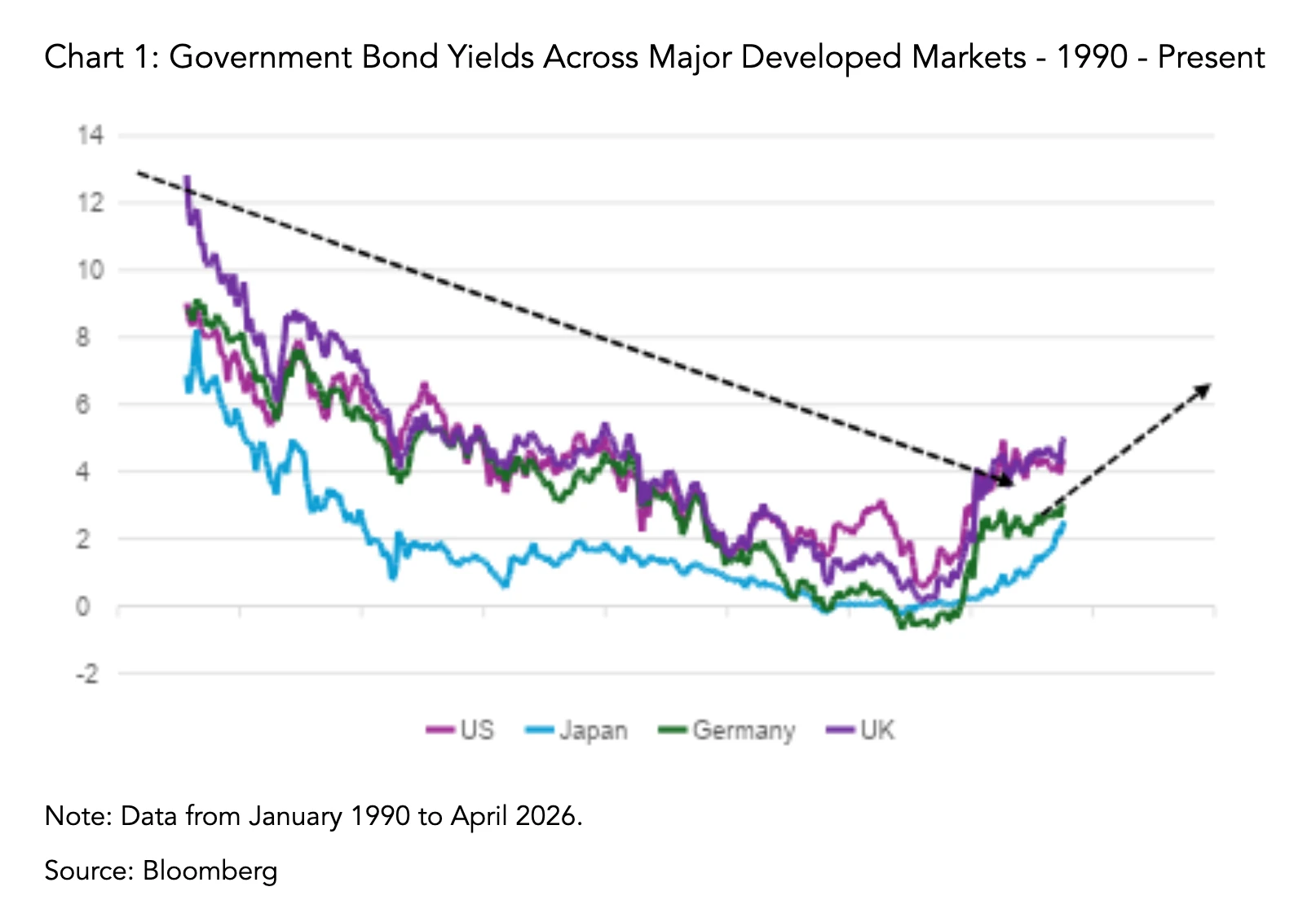
As fiscal policy plays a larger role in sovereign bond markets, investors are looking beyond inflation and policy rates to assess debt sustainability, financing needs and the market’s capacity to absorb rising issuance. These pressures have contributed to greater divergence in sovereign balance sheets, challenging the assumption that developed market government bonds share similar risk characteristics.
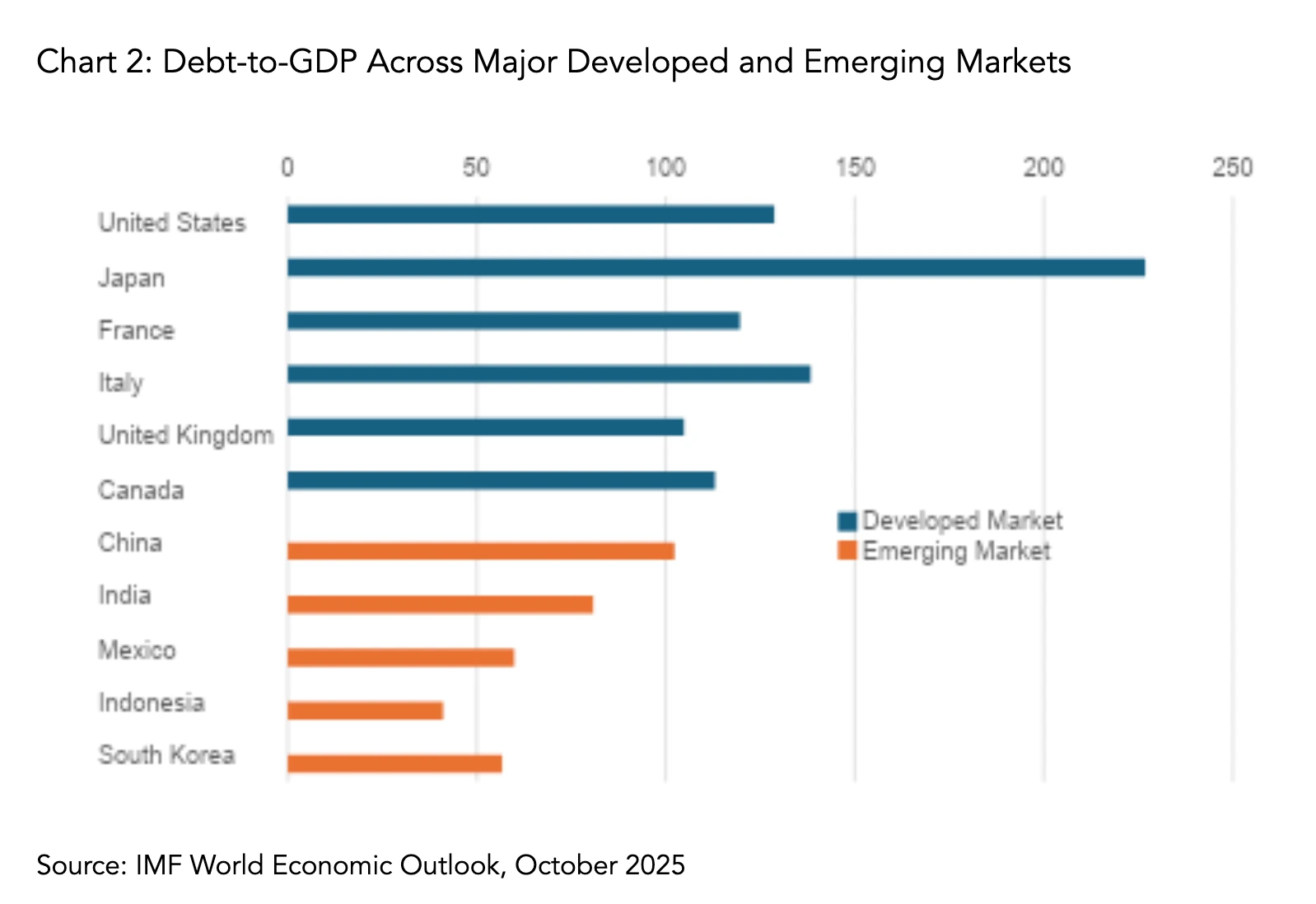
The narrowing divide between developed and emerging markets
Several large emerging economies now carry lower debt burdens than some major developed markets, making geography a less reliable guide to sovereign risk. Notably, South Korea illustrates the challenge of traditional classifications, sitting at the intersection of developed and emerging market characteristics.
At the same time, emerging market debt has undergone significant structural development over the past two decades. Many local currency emerging market sovereign markets now exhibit characteristics once associated mostly with developed economies: deeper domestic investor bases, improved liquidity, credible monetary frameworks and increasingly investment-grade sovereign universes. This has also reduced reliance on foreign-currency borrowing in parts of the emerging markets, making currency composition an increasingly important dimension of sovereign risk.
Note, many emerging market sovereigns have benefited from the development of deeper local currency debt markets, stronger monetary policy credibility and broader domestic investor participation over the past two decades. See IMF Global Financial Stability Report (October 2025, Chapter 3) and BIS Quarterly Review (March 2024).
In developed markets, meanwhile, quantitative tightening, rising issuance and shifting liability structures have contributed to higher term premia and a broader reassessment of sovereign duration risk.
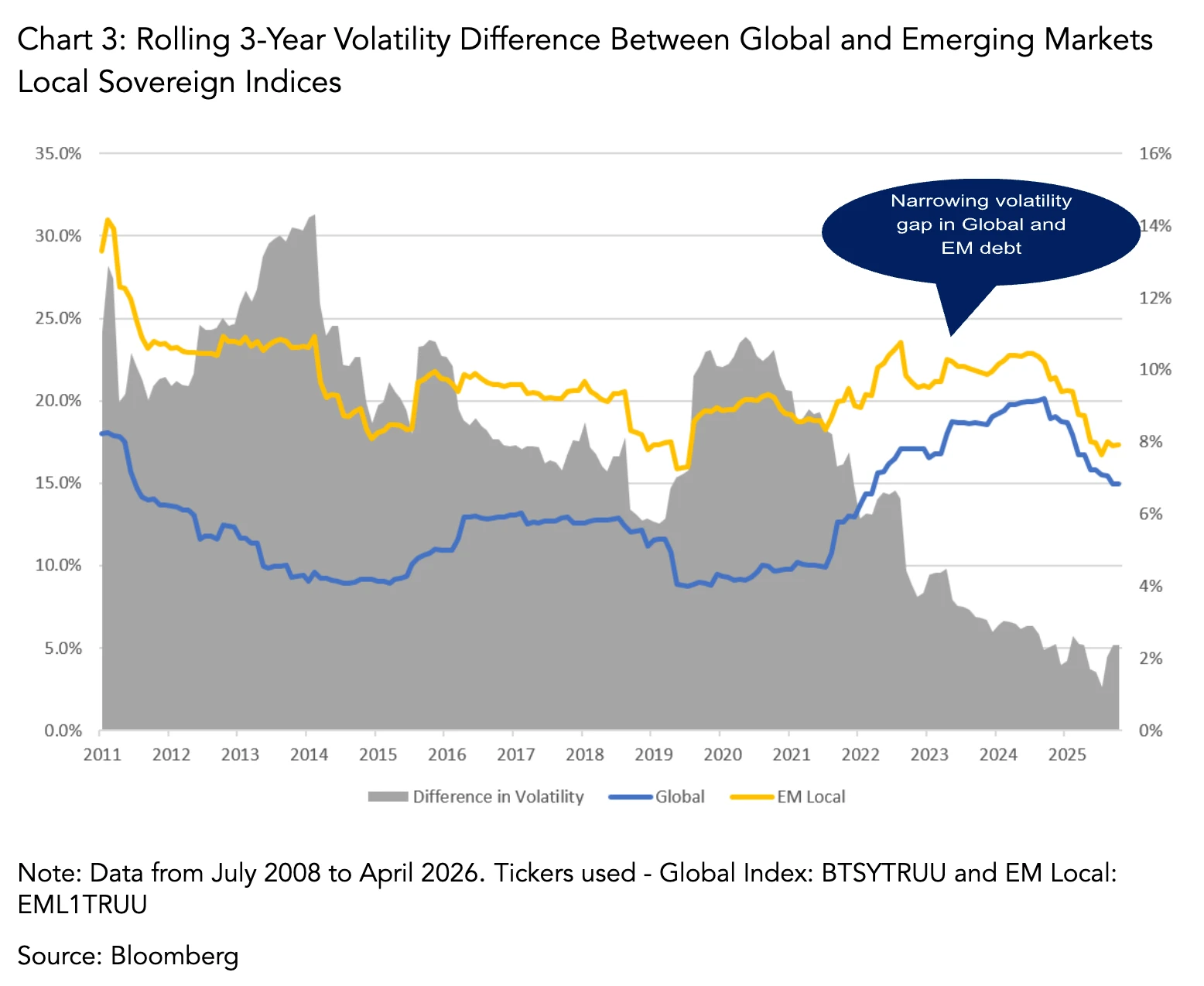
The distinction between developed and emerging markets increasingly resembles a continuum rather than a binary classification. Some emerging market sovereigns compare favourably with parts of the developed world across selected fiscal metrics, although broader sovereign assessments need to account for differences in market depth, institutional frameworks and political structure considerations.
Should sovereign benchmarks be debt-weighted?
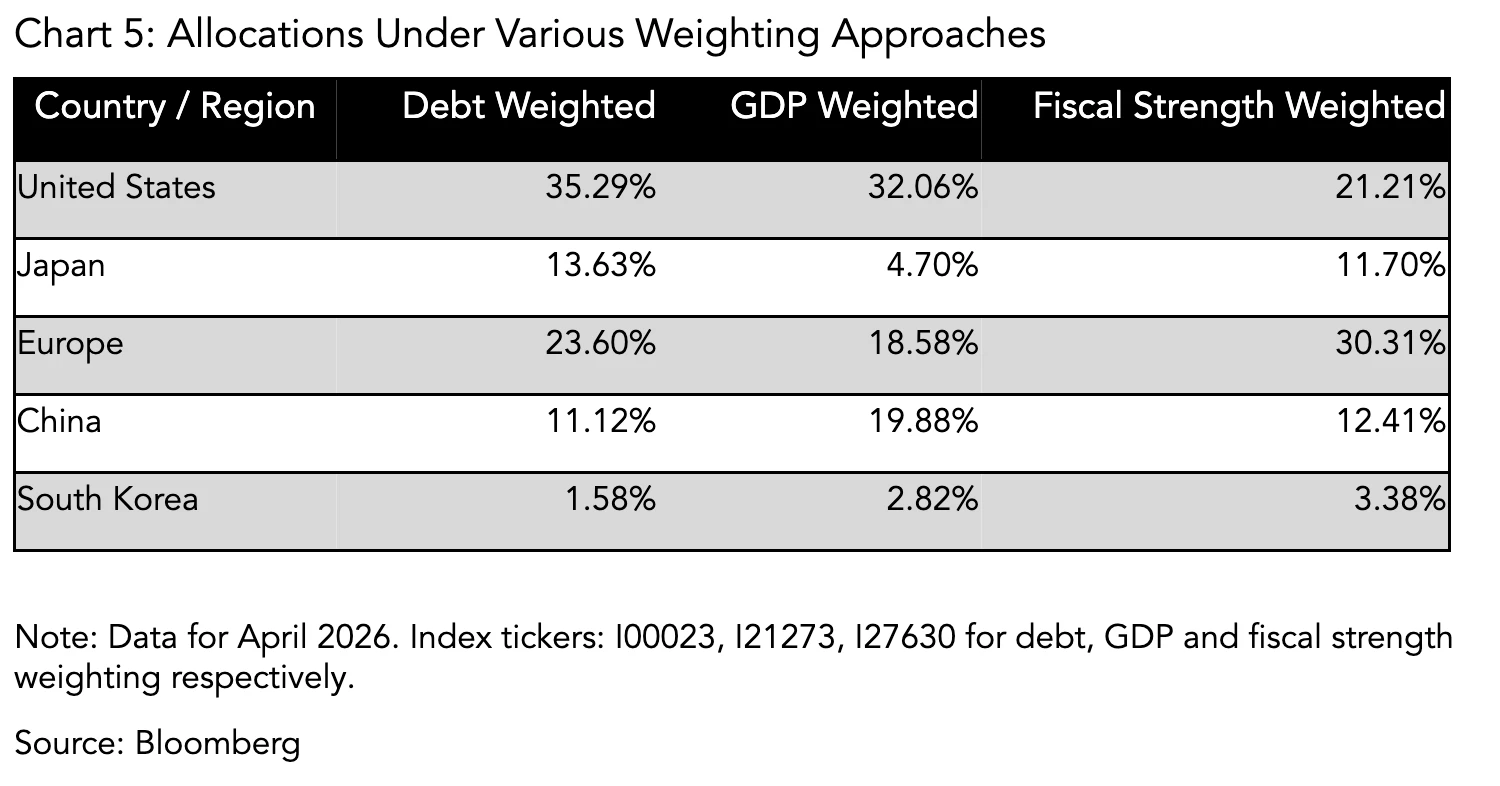
Traditional sovereign bond benchmarks are largely weighted by debt outstanding, meaning the largest borrowers receive the largest representation within benchmark portfolios. This approach made sense when developed market sovereigns were perceived as relatively homogeneous. However, in a world characterized by widening fiscal dispersion and increasingly differentiated sovereign fundamentals, debt outstanding may no longer be the most effective measure of sovereign importance or resilience.
Investors have responded to this concentration risk in several ways, including country caps and alternative weighting approaches based on economic size or fiscal characteristics.
GDP-weighted sovereign indices allocate capital according to economic size rather than borrowing levels, providing a more intuitive representation of a country’s contribution to the global economy. Note, detailed methodology for Bloomberg’s GDP-weighted indices is available here
Fiscal Strength-weighted approaches go a step further by incorporating measures of debt sustainability, fiscal balances and interest burden dynamics, helping investors differentiate between sovereign issuers based on underlying fundamentals rather than issuance volume alone. Note: Detailed methodology for Bloomberg’s fiscal strength weighted indices available here
These differences can lead to meaningfully different index outcomes over time.
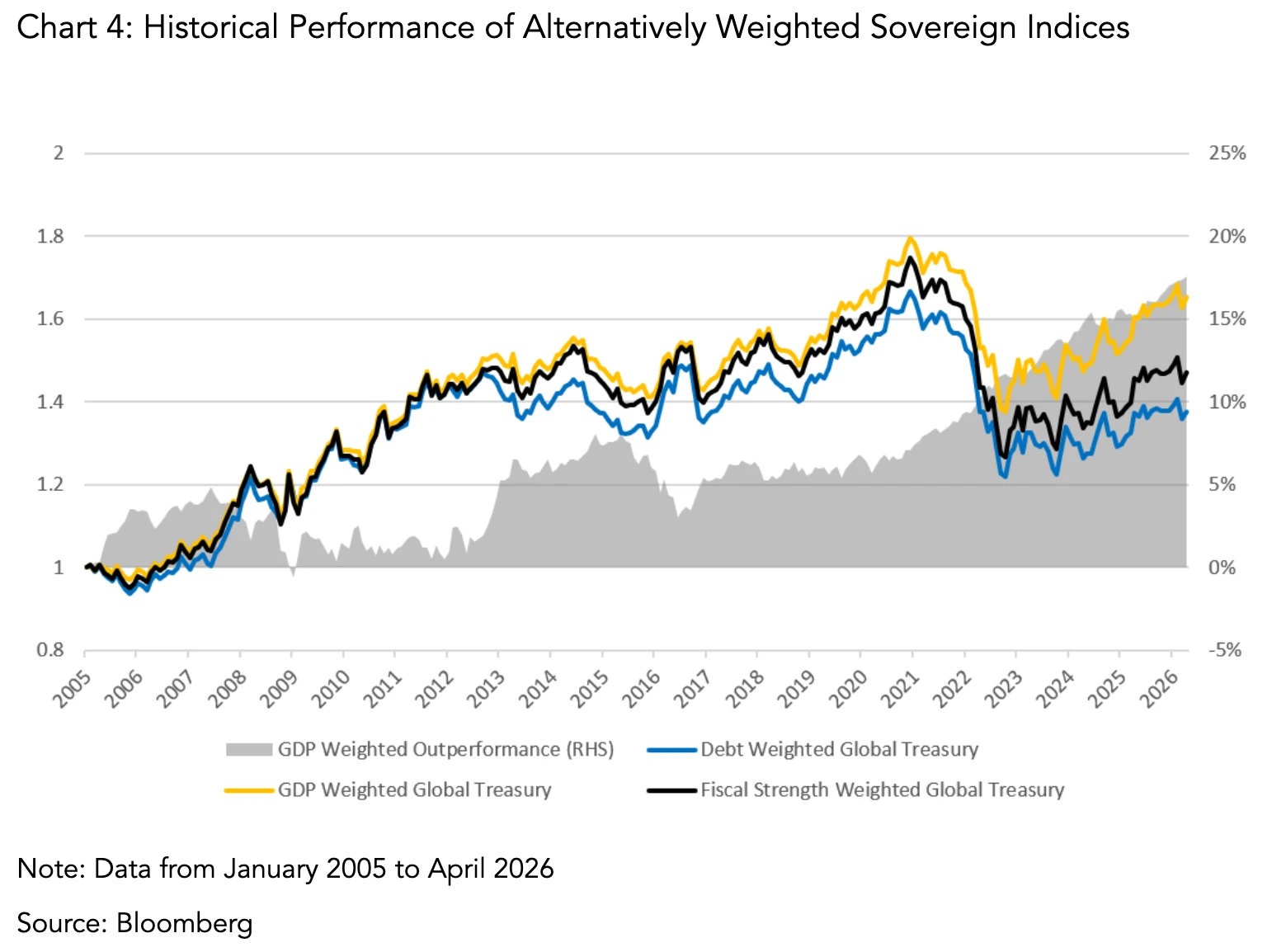
Much of the performance difference reflects the allocation shift from Japan toward China, as sovereign bond returns in the two markets have diverged significantly over the period.
These approaches are not intended to eliminate sovereign risk. Rather, they seek to reduce structural borrower bias and create portfolios that better reflect the evolving drivers of sovereign creditworthiness and macroeconomic resilience.
A new framework for sovereign debt allocation
Perhaps the most important shift is conceptual. Market participants may increasingly look beyond the assumption that sovereign bonds are homogeneous safe assets, as markets appear to reflect differences in fiscal strength, inflation dynamics, policy credibility, currency stability and institutional quality.
In this environment, diversification can extend beyond geography. It can also involve exposure to different fiscal trajectories, monetary policy frameworks and sovereign balance sheets.
Rather than asking whether a country is developed or emerging, market participants may also consider whether its fiscal trajectory, institutional credibility and policy framework support its role within a sovereign portfolio. As sovereign risks become more differentiated, benchmark construction and country allocation may become useful complements to duration management.
Precision and customization in fixed income indexing
Precision in benchmark construction can help sovereign investors reassessing debt-weighted benchmarks align exposures with evolving fiscal, policy and diversification considerations.
As portfolio construction becomes more targeted, defining benchmark exposures with precision is becoming essential.
Bloomberg Fixed Income Indices give investors the tools to tailor exposures quickly and accurately. Powered by integrated data and analytics on the Bloomberg Terminal, users can combine asset classes, apply constraints and refine methodologies in line with specific investment objectives.
Interested to learn more? Explore Bloomberg Fixed Income Indices
The data and other information included in this publication is for illustrative purposes only, available “as is”, non-binding and constitutes the provision of factual information, rather than financial product advice. BLOOMBERG and BLOOMBERG INDICES (the “Indices”) are trademarks or service marks of Bloomberg Finance L.P. (“BFLP”). BFLP and its affiliates, including BISL, the administrator of the Indices, or their licensors own all proprietary rights in the Indices. Bloomberg L.P. (“BLP”) or one of its subsidiaries provides BFLP, BISL and its subsidiaries with global marketing and operational support and service. Certain features, functions, products and services are available only to sophisticated investors and only where permitted. Bloomberg (as defined below) does not approve or endorse these materials or guarantee the accuracy or completeness of any information herein, nor does Bloomberg make any warranty, express or implied, as to the results to be obtained therefrom, and, to the maximum extent allowed by law, Bloomberg shall not have any liability or responsibility for injury or damages arising in connection therewith. Nothing in the Services or Indices shall constitute or be construed as an offering of financial instruments by Bloomberg, or as investment advice or investment recommendations (i.e., recommendations as to whether or not to “buy”, “sell”, “hold”, or to enter or not to enter into any other transaction involving any specific interest or interests) by Bloomberg. Information available via the Index should not be considered as information sufficient upon which to base an investment decision. All information provided by the Index or in this publication is impersonal and not tailored to the needs of any person, entity or group of persons. Absence of any trademark or service mark from this list does not waive Bloomberg’s intellectual property rights in that name, mark or logo. For the purposes of this publication, Bloomberg includes BLP, BFLP, BISL and/or their affiliates.
BISL is registered in England and Wales under registered number 08934023 and has its registered office at 3 Queen Victoria Street, London, England, EC4N 4TQ. BISL is authorised and regulated by the Financial Conduct Authority as a benchmark administrator.
© 2026 Bloomberg. All rights reserved.