ARTICLE
The role of inflation-sensitive diversifiers in investment portfolios

Bloomberg Professional Services
- Market participants have been returning to commodities over the last two years as demand for portfolio diversification and inflation hedging has become top of mind.
- Commodity futures exposure can be affected by the shape of the futures curve, making roll yield an important consideration for investors seeking to hold commodities over time. By incorporating a structured approach to enhancing roll yield, market participants can maintain a long only commodities exposure over time.
- Compared to more established broad commodity benchmarks, the Bloomberg Enhanced Roll Yield Index (BERY) is demonstrating its relevance during a supportive commodity environment in the 2020s.
This article was written by Jim Wiederhold, Commodity Indices Product Manager at Bloomberg.
Global commodity markets are drawing renewed attention as investors reassess how to build diversified portfolios in a higher inflation and geopolitically complex environment. After a decade in which commodities faced persistent headwinds, the 2020s have created a more supportive backdrop for real assets, with market participants increasingly looking for exposure that can behave differently from equities and fixed income.
PRODUCT MENTIONS
That shift has made the construction of commodity exposure more important. As investors revisit the role of commodities in portfolios, the question is not only whether to allocate to the asset class, but how that exposure is structured over time.
The Bloomberg Enhanced Roll Yield Index (BERY) is marking five years since its launch, creating a timely opportunity to assess how commodity exposure has evolved during a more inflation-sensitive decade. Launched June 4, 2021 with backtested history from 2001, the broad commodity index was built to be a benchmark for market participants seeking diversification and an inflation hedge. Assets benchmarked to the index increased meaningfully beginning in 2025 as demand for a long-commodities exposure picked up (Exhibit 1).

Why do commodities matter for portfolio diversification?
BERY is a benchmark used by many market participants for their investment and hedging needs. Commodities, like infrastructure and real estate, are considered real assets, offering exposure that can behave differently from other asset classes such as equities and fixed income.
The role of commodities in traditional asset portfolios has been documented by academics and investors across the world for decades. Commodities tend to have low correlations to other major asset classes as can be seen in Exhibit 2. This persistent low correlation over time can support portfolio diversification, which is why the commodity asset class represented by BERY tends to be used for that purpose.


Commodities can behave differently from other asset classes, and commodity prices have historically tended to move more sharply to the upside than the downside during supportive market environments. This pattern differs from equities, where downside moves can often be more pronounced during periods of stress.
While the 2010s were a decade with headwinds for the commodity asset class, the 2020s have proved to be a conducive environment for a commodities allocation. Even a small 5% allocation within a portfolio might help mitigate portfolio volatility, decrease drawdowns, and provide upside participation when conditions support a bull market in commodities. Exhibit 3 shows that, over the period we analyzed, how adding BERY exposure to a traditional 60/40 portfolio allowed a portfolio to perform better than a portfolio without commodities exposure.

Why does roll yield matter in commodity futures exposure?
With five years of live history for BERY, the index is meeting its objective of allowing market participants to hold a long only exposure in the commodities asset class overtime. It has outperformed the Bloomberg Commodity Index (BCOM) by 2.5% annualized since the launch in 2021.
BERY’s historical outperformance has been influenced in part by features embedded in its index methodology, which incorporate alternative risk premia in the index construction. Specifically, curve and carry premiums are introduced into a broad commodity index exposure.
It achieves the curve premium via holding exposure not just in the near-dated or front-month futures contract for each commodity, but across four futures contracts. This allows for exposure to be spread out across each commodity’s futures curve, which can help lower volatility over time.
The curve premium tends to generate more than half of BERY’s outperformance while the carry premium generates the rest. The carry premium is generated by looking at the shapes of all the BERY commodities future curves and scoring the constituents based on the slopes of the curves.
Commodities futures curves in contango see their weights tilted lowered while commodities in backwardation are tilted higher. This step was included because going long commodities in contango tends to produce a negative roll yield so reducing exposure to these futures can assist in holding a long commodities exposure over time.
Exhibit 4 shows the outperformance of BERY over BCOM and how much the curve and carry premiums contributed each year going back to the start of the backtested history. BERY also has a slightly larger universe than BCOM which has contributed to performance.

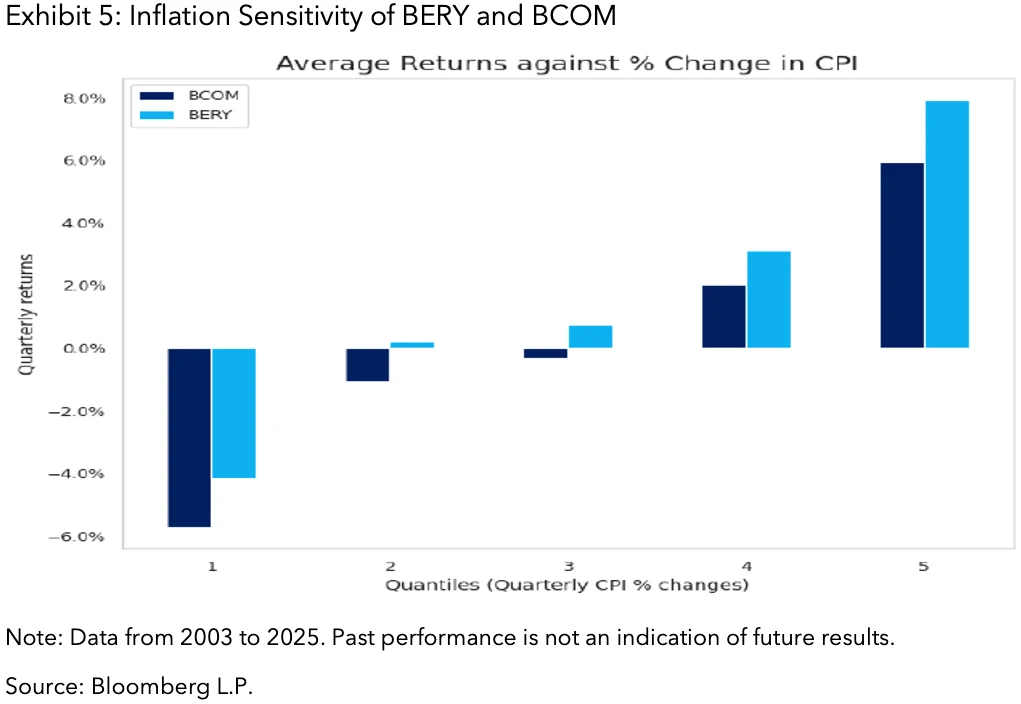
While BERY has historically outperformed BCOM due to the curve and carry premiums, it also served a more effective hedge than BCOM. It not only performs better to the upside during periods of very high inflation, BERY has provided a positive performance during low and no inflation environments. Exhibit 5 shows how both BERY and BCOM performed during each type of inflation environment, including deflation going back to 2003.
Commodity benchmarks adapting to changing market conditions
BERY is a commodities benchmark designed for a changing investment environment. Inflows back into the commodities asset class have picked up pace as tailwinds abound. The 2020s are proving to be a decade where diversified exposure to liquid alternatives is becoming a crucial piece of an investment portfolio.
After five years of live history, BERY’s live performance has been broadly consistent with the historical characteristics observed in its backtested history due to structural, idiosyncratic dynamics of commodities futures markets. Whether investors are looking for diversification, an inflation hedge, or an instrument which reacts to this new highly geopolitically sensitive macro environment; BERY can provide access to broad commodity exposure within a portfolio.
Learn more about BERY and other Bloomberg Commodity Indices here.
The data and other information included in this publication is for illustrative purposes only, available “as is”, non-binding and constitutes the provision of factual information, rather than financial product advice. BLOOMBERG and BLOOMBERG INDICES (the “Indices”) are trademarks or service marks of Bloomberg Finance L.P. (“BFLP”). BFLP and its affiliates, including BISL, the administrator of the Indices, or their licensors own all proprietary rights in the Indices. Bloomberg L.P. (“BLP”) or one of its subsidiaries provides BFLP, BISL and its subsidiaries with global marketing and operational support and service. Certain features, functions, products and services are available only to sophisticated investors and only where permitted. Bloomberg (as defined below) does not approve or endorse these materials or guarantee the accuracy or completeness of any information herein, nor does Bloomberg make any warranty, express or implied, as to the results to be obtained therefrom, and, to the maximum extent allowed by law, Bloomberg shall not have any liability or responsibility for injury or damages arising in connection therewith. Nothing in the Services or Indices shall constitute or be construed as an offering of financial instruments by Bloomberg, or as investment advice or investment recommendations (i.e., recommendations as to whether or not to “buy”, “sell”, “hold”, or to enter or not to enter into any other transaction involving any specific interest or interests) by Bloomberg. Information available via the Index should not be considered as information sufficient upon which to base an investment decision. All information provided by the Index or in this publication is impersonal and not tailored to the needs of any person, entity or group of persons. Absence of any trademark or service mark from this list does not waive Bloomberg’s intellectual property rights in that name, mark or logo. For the purposes of this publication, Bloomberg includes BLP, BFLP, BISL and/or their affiliates.
BISL is registered in England and Wales under registered number 08934023 and has its registered office at 3 Queen Victoria Street, London, England, EC4N 4TQ. BISL is authorised and regulated by the Financial Conduct Authority as a benchmark administrator.
© 2026 Bloomberg. All rights reserved.