ARTICLE
Tracking biopharma innovation through AI, licensing and index performance

Bloomberg Professional Services
- As AI shifts value creation earlier in the drug development cycle, investors are paying closer attention to signals that may help identify emerging biopharma innovation.
- Since launch, the Bloomberg Global Innovative Biopharma Index has outperformed broader healthcare and biopharma benchmarks, driven mainly by security selection.
- The index methodology uses drug licensing activity to identify companies whose innovation is being validated through partnerships, co-development and milestone-based deals.
Biopharmaceutical innovation has traditionally been difficult to capture through traditional market exposures. Drug development is capital-intensive, time-consuming and uncertain by nature, with value often created years before a therapy reaches commercialization.
PRODUCT MENTIONS
At the same time, advances in AI are transforming how drugs are discovered, shifting the industry toward faster, more data-driven and high-throughput innovation models. That shift adds a new layer to an already difficult challenge for investors: identifying companies that can consistently generate high-quality innovation and convert it into value.
This article looks at how an index-based approach, using the Bloomberg Global Innovative Biopharma Index (BGIBT) as an example, can help track value creation in the modern biopharma ecosystem. Designed with this objective in mind, BGIBT focuses on drug licensing activity as a proxy for innovation and combining biotech innovators with large pharmaceutical partners. This approach has become increasingly relevant as the industry shifts from a model dominated by late-stage asset purchases toward one characterized by high-throughput, early-stage innovation, where value is validated through licensing, co-development and milestone-based partnerships.
Since launch in March 2024, the index has provided a practical test of whether this framework can capture that evolving dynamic in practice.
Validation of biopharma innovation signals
In the research leading up to the index launch, a prior attribution analysis using Bloomberg’s PORT function, a portfolio and risk analytics tool that helps assess the drivers of performance, showed that, in the five years through March 2024, the strategy outperformed broad healthcare by approximately 13.6% cumulatively, driven largely by stock selection within biotech.
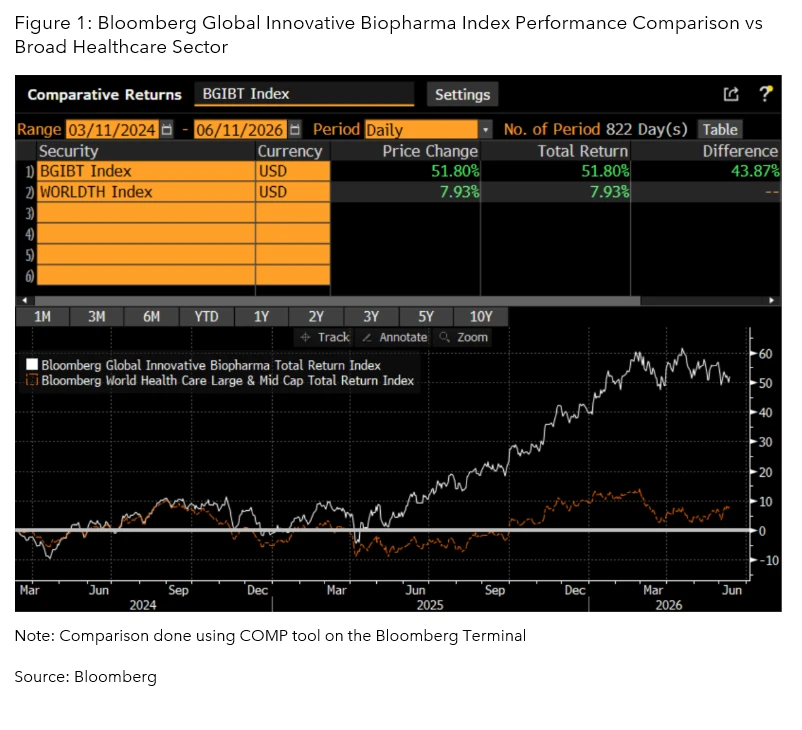
What has happened since the index launch is, in many ways, a stronger version of that story. Based on COMP, a Bloomberg Terminal tool used to compare relative performance, for the live period from March 11, 2024 to June 11, 2026, the index returned 51.80%, compared with 7.93% for the Bloomberg World Health Care Large & Mid Cap Index (WORLDTH Index), generating 43.87% of outperformance.
Note, WORLDTH is used as a broad healthcare market benchmark for contextual performance comparison. It is designed to represent broad healthcare sector exposure and serves a different investment objective from the Bloomberg Global Innovative Biopharma Index.
Importantly, this is materially larger than the historical 13.6% outperformance observed before launch. The implication is that the signal visible in historical analysis has strengthened in the live period, rather than faded.
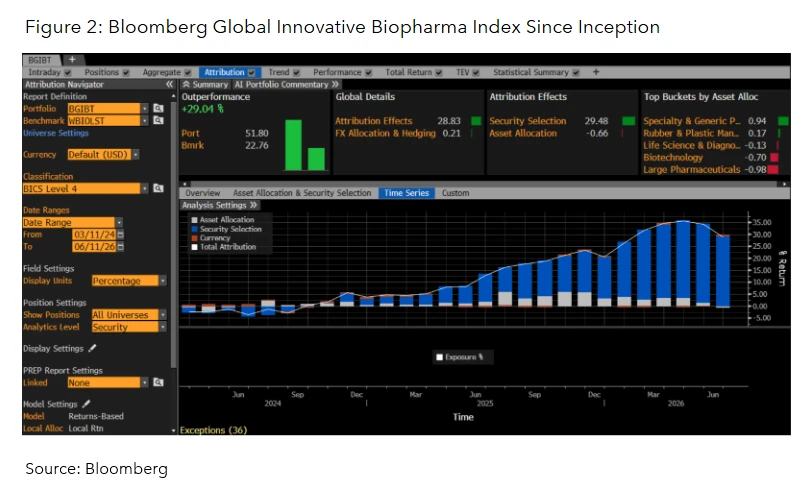
Narrowing the comparison to the Bloomberg World Biotech & Pharma Large, Mid & Small Cap Index (WBIOLST Index), representing the same investable universe—leads to a similar conclusion. Based on PORT analysis, the index still generated 29.04% of outperformance, indicating that results cannot simply be attributed to sector allocation.
Looking more closely at the underlying performance mechanics, Bloomberg’s PORT attribution analysis shows that most of the outperformance was generated by security selection (approximately 29%), while asset allocation contributed negatively.
This suggests that performance was not simply driven by overweighting biotech or other innovation-heavy segments of healthcare. Instead, the index appears to have exposures to specific companies within those segments that deliver stronger performance.
That outcome aligns closely with how the index is constructed. By ranking biotech companies based on recent licensing activity, the methodology prioritizes companies whose innovation has already been externally validated, rather than relying on broad sector exposure.
How AI is changing the biopharma innovation cycle
One possible reason the live period may have been especially favorable is that the market itself might have changed. More of the industry’s economic value is now being recognized earlier in the life cycle, before a product reaches commercialization, trends that might have been reinforced by advances in AI.
Bloomberg reporting highlights early evidence that AI is already changing the pace of drug discovery, with a consulting estimate suggesting that AI-driven R&D could reduce the time and cost of bringing drug candidates to human testing by 25% to 50%. More broadly, industry analysis points to improving success rates for AI-enabled programs at early clinical stages.
The implication is not simply faster timelines. It is a shift in where value is created. The greatest efficiencies are concentrated in early-stage R&D, precisely where licensing often becomes the first signal of validation.
The index methodology is designed to capture this shift directly and remains robust as the underlying R&D model evolves.
First, it uses drug licensing as a proxy for value creation, applying a rolling Drug Licensing Activity Score (DLAS) to identify companies already demonstrating external validation through partnerships. Active drug licensing activity is increasingly viewed as a signal of deeper investment, stronger financial commitment and robust pipeline development for the licensee. These are the same transactions that increasingly underpin sector returns.
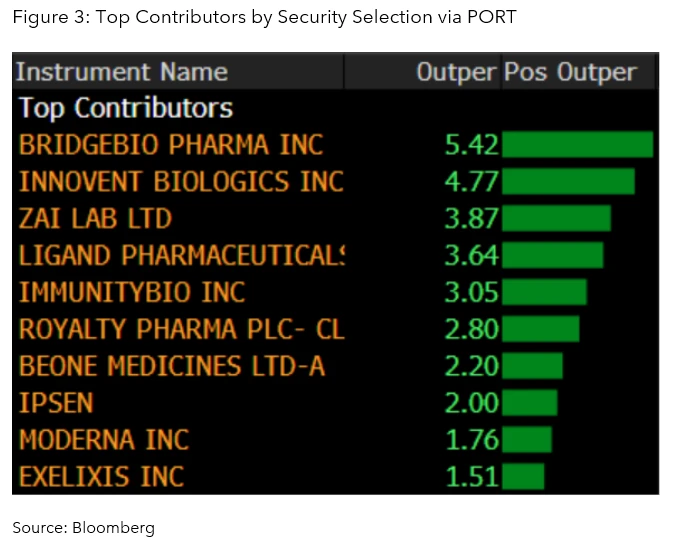
This is evident at the constituent level. Innovent Biologics, for example, partnered with WeComput to build an AI-driven drug discovery platform integrating NVIDIA BioNeMo, aiming to improve R&D efficiency and success rates. Such platform-oriented collaborations are precisely the type of early validation signal that the DLAS framework is designed to capture.
The methodology also explicitly rewards early-stage innovation, where AI’s impact is most concentrated. By incorporating preclinical and Phase I activity, in addition to later-stage trials, it captures forward-looking pipeline expansion well before assets reach commercialization.
This dynamic is also evident in BridgeBio Pharma, one of the top contributors to performance. The company has applied AI and high-performance computing in collaboration with research institutions to accelerate molecule discovery and reduce development iterations, illustrating how computational approaches are increasingly embedded across the innovation process.
The timing of performance provides additional context. Attribution shows relatively modest and uneven contributions through much of 2024, followed by more consistent gains through 2025 and a clear acceleration into late 2025 and early 2026. This coincides with a broader shift in how investors assess the sector, with increasing emphasis on early-stage innovation, licensing validation and differentiated pipelines.
Tracking biopharma value creation through licensing and partnerships
In modern biopharma, value creation is increasingly tied to early-stage innovation, external validation and the ability to turn scientific progress into commercial opportunity. Rather than capturing innovation broadly, an index-based approach can focus on signals that indicate when innovation is being validated and translated into market value.
BGIBT applies that framework by identifying companies actively engaged in innovation, and capable of validating that innovation through licensing and partnerships, can outperform broader healthcare peers.
The evidence since launch reinforces that premise. The index has delivered significant outperformance versus the benchmark, and attribution analysis shows that this was driven primarily by stock selection within innovation-focused segments. The comparison with the pre-launch period suggests that this effect has strengthened in the live period.
Notably, AI appears to have reinforced the relevance of a methodology already designed to capture early-stage innovation, licensing dynamics and the evolving division of labor between biotechs and large pharmaceutical companies.
In that sense, the BGIBT Index provides a systematic framework for tracking how biopharma value creation is evolving as the industry changes.