
Bloomberg Intelligence
This article was written by Bloomberg Intelligence Senior Analyst Jennifer Bartashus. It appeared first on the Bloomberg Terminal.
FIFA’s nearly $9 billion expected revenue take from this year’s World Cup may understate the tournament’s broader economic impact, with US legal betting alone set to top $2 billion, based on Bloomberg Intelligence’s analysis. Apparel, gear, travel, lodging, food and beverage companies will also capture incremental demand as tourism, transportation, services and commerce accelerate and total global sales approach $80 billion, based on an OpenEconomics study.
World Cup exposure favors Arca, Mexico; Chile not so much
Arca Continental is a likely World Cup beneficiary, supported by its host-city footprint and Coca-Cola sponsorship links. Mexican retailers Gruma, Bimbo and Cuervo may benefit from Mexico/US revenue exposure. CCU and Coca-Cola Andina look less favorably positioned due to their Chile skew, as that nation failed to qualify. Key drivers are host-market traffic, qualifying-country demand and sponsor visibility.
Host cities to drive first consumption wave
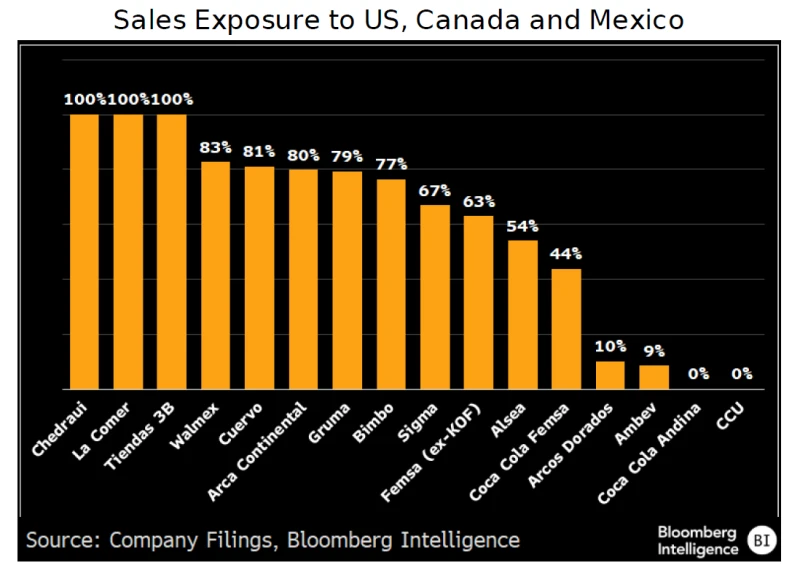
For in-person World Cup demand, host-market exposure is the most direct screening metric. Chedraui, La Comer and Tiendas 3B rank highest, with all sales in Mexico, the US and Canada, followed by Walmex (83%), Cuervo (81%), Arca (80%), Gruma (79%) and Bimbo (77%). Retailers are better placed to capture store traffic, larger baskets and impulse purchases, while beverage and food companies should benefit more from out-of-home consumption occasions.
Despite not being fully host-market exposed, Arca is positioned well. Its territories include Monterrey, Guadalajara, Dallas and Houston, a broader, denser venue footprint than Coca-Cola Femsa’s 44% exposure concentrated in Mexico City. This gives Arca a combination of local execution, cold-drink availability and sponsor-led activation around stadiums, fan zones and at-home viewing.
Team participation spurs a broader LatAm tailwind
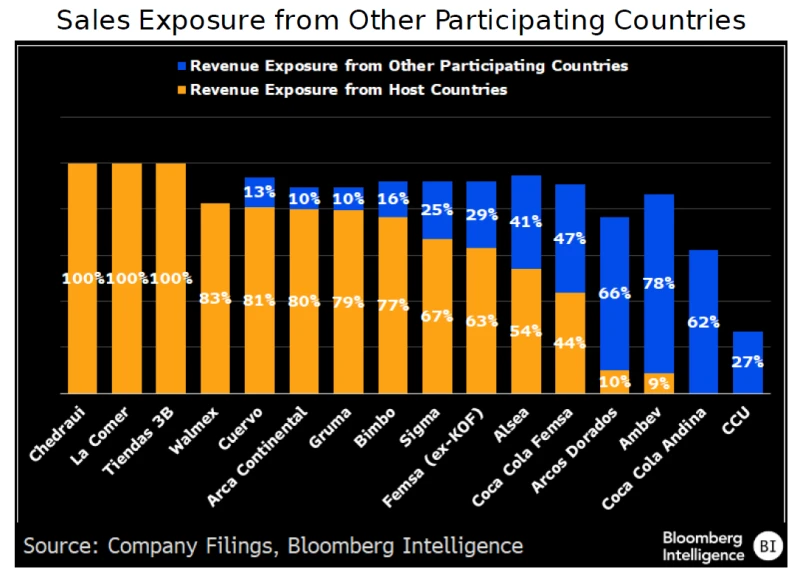
Looking at qualified-country exposure excluding host markets, Ambev is the clear winner, with 78% of sales in World Cup-playing nations, along with its 9% exposure in Canada. The primary driver is Brazil at 59%, followed by Argentina (13%) and smaller contributions from Uruguay, Panama, and Paraguay. Companies such as Femsa, Coca-Cola Femsa and Alsea already have relevant exposure to host countries, but the tailwind should grow as countries in the tournament account for 29%, 47%, and 41% of sales.
Arcos Dorados also benefits, with 66% of sales led by Brazil and Argentina, making McDonald’s regional-traffic exposure tournament-relevant. This can favor companies whose core markets have team participation, not just host-city traffic, as national-team success can extend promotions, watch parties, and consumption.
Sponsor platforms add brand-equity upside
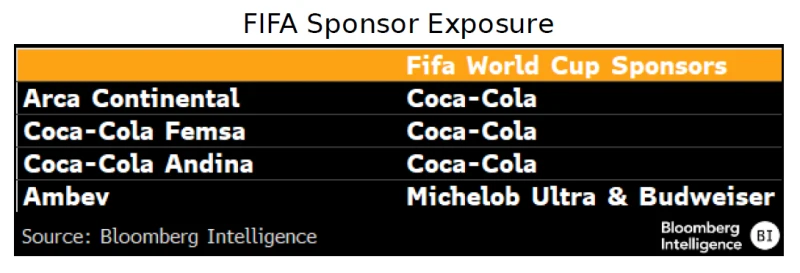
Among sponsor-linked entities, Coca-Cola bottlers, Ambev and Arcos Dorados stand to benefit most directly. Arca, Coca-Cola Femsa and Andina can leverage Coca-Cola’s official soft-drink status through strategic packaging, cold-door execution, pricing and zero-sugar recruitment. The Panini sticker promotion is on 20-ounce Coke and Coke Zero Sugar bottles, while the global campaign uses video, anthem content, a trophy tour and digital and on-site activations.
Ambev leverages its beer portfolio through Budweiser and Michelob Ultra, with the latter using the Player of the Match platform and fan-access giveaways. Arcos Dorados benefits from McDonald’s as the official restaurant sponsor, complemented by local limited-time menus like “Mundialistas.” These campaigns aim to deepen brand equity leading up to and during the tournament.
Nonqualified markets dilute the tailwind
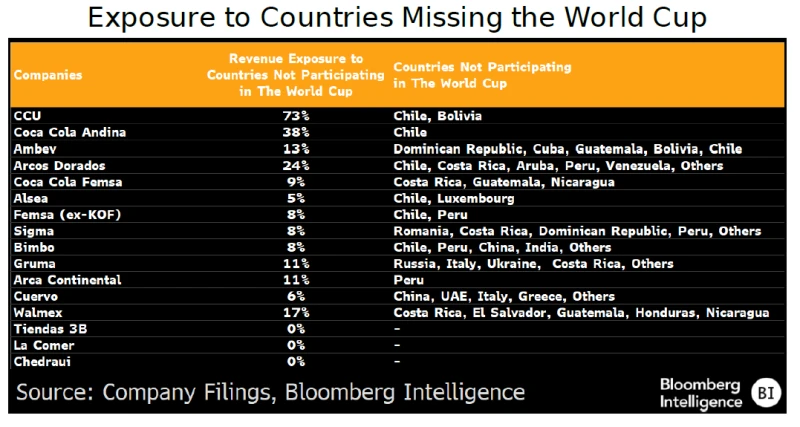
Companies with the biggest exposure to markets not represented at the World Cup appear least likely to benefit. CCU is the clearest example, given 73% of its sales are linked to Chile and Bolivia, neither of which qualified, leaving limited tournament-related support beyond normal consumption. Coca-Cola Andina follows, with 38% of sales in Chile, reducing the benefit from its Brazil, Argentina and Paraguay exposure.
Arcos Dorados has 24% of sales in nonqualified markets, including Chile, Costa Rica, Aruba, Peru and Venezuela, though its Brazil and Argentina presence, plus sponsor links, should partly off set this. Walmex has 17% exposure to Central America outside Mexico, while Ambev’s 13% is spread across the Dominican Republic, Cuba, Guatemala, Bolivia and Chile.
The biggest World Cup to date
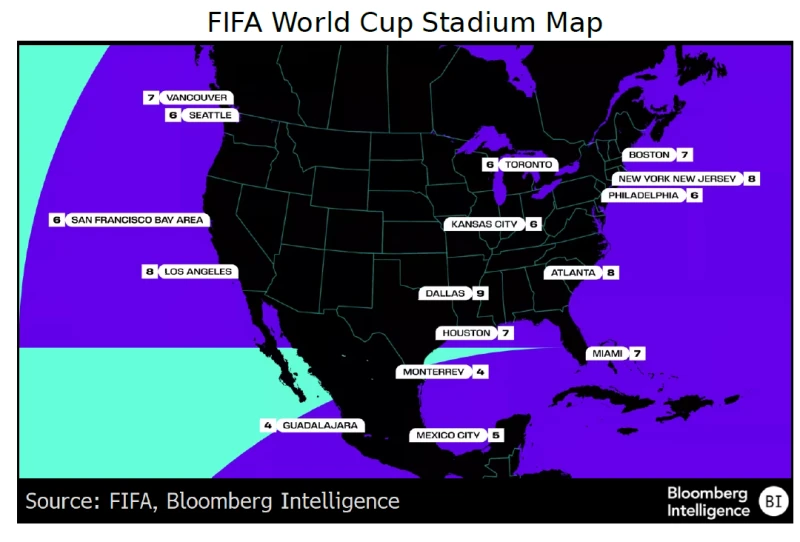
The 2026 FIFA World Cup started June 11 in Mexico City and ends July 19 with the final in New Jersey just outside of New York City. Hosted jointly by Canada, Mexico and the US, it features 48 teams playing 104 matches in 16 North American cities. Games in the US will be played in Atlanta, Boston, Dallas, Houston, Kansas City, Los Angeles, Miami, New York/New Jersey, Philadelphia, the San Francisco Bay area and Seattle. Mexico will see games in Guadalajara, Mexico City and Monterrey, while Toronto and Vancouver are the two sites in Canada.
The format has 12 groups of four, adding a round of 32, for more match days than the previous 64-game format. Within key LatAm consumer footprints, Dallas has nine contests, Houston seven, Mexico City five and Guadalajara and Monterrey four each.
The data included in these materials are for illustrative purposes only. The BLOOMBERG TERMINAL service and Bloomberg data products (the “Services”) are owned and distributed by Bloomberg Finance L.P. (“BFLP”) except (i) in Argentina, Australia and certain jurisdictions in the Pacific Islands, Bermuda, China, India, Japan, Korea and New Zealand, where Bloomberg L.P. and its subsidiaries (“BLP”) distribute these products, and (ii) in Singapore and the jurisdictions serviced by Bloomberg’s Singapore office, where a subsidiary of BFLP distributes these products. BLP provides BFLP and its subsidiaries with global marketing and operational support and service. Certain features, functions, products and services are available only to sophisticated investors and only where permitted. BFLP, BLP and their affiliates do not guarantee the accuracy of prices or other information in the Services. Nothing in the Services shall constitute or be construed as an offering of financial instruments by BFLP, BLP or their affiliates, or as investment advice or recommendations by BFLP, BLP or their affiliates of an investment strategy or whether or not to “buy”, “sell” or “hold” an investment. Information available via the Services should not be considered as information sufficient upon which to base an investment decision. The following are trademarks and service marks of BFLP, a Delaware limited partnership, or its subsidiaries: BLOOMBERG, BLOOMBERG ANYWHERE, BLOOMBERG MARKETS, BLOOMBERG NEWS, BLOOMBERG PROFESSIONAL, BLOOMBERG TERMINAL and BLOOMBERG.COM. Absence of any trademark or service mark from this list does not waive Bloomberg’s intellectual property rights in that name, mark or logo.
All rights reserved. © 2025 Bloomberg.