ARTICLE
Five charts on the energy transition: Who is spending, who is earning, who is delivering?

Bloomberg Professional Services
This article was written by Rohit Seksaria, Product Manager, Climate Transition Solutions at Bloomberg.
The global energy system is being reshaped by a combination of geopolitical shocks, volatile commodity markets, rising electricity demand and accelerating investment in energy infrastructure. For investors, policy makers and companies, the key question is no longer whether the transition matters, but whether data-driven signals can help distinguish durable trends from short-term noise.
That question is becoming more urgent as hesitation builds across parts of the market. Companies are weighing transition investments against high capital costs and uncertain policy signals. Investors are looking for evidence that clean investment is translating into revenues, profitability and valuation support. Policymakers are trying to balance energy security, affordability and decarbonization without creating new bottlenecks.
This blog takes stock of recent company-level data through the lens of the energy trilemma: security, affordability and sustainability.
The transition landscape remains uneven across sectors, technologies and geographies, and many signals are still early. But viewed together, these datasets can help investors identify where companies are allocating capital, where execution is becoming visible, where constraints are emerging and where transition positioning may be starting to matter financially.
Capital allocation and economic signals
The first test of the transition is capital allocation. Where companies continue to invest, where spending is becoming more selective and where clean energy revenues are emerging can help investors assess whether the transition is moving from ambition to commercial activity.
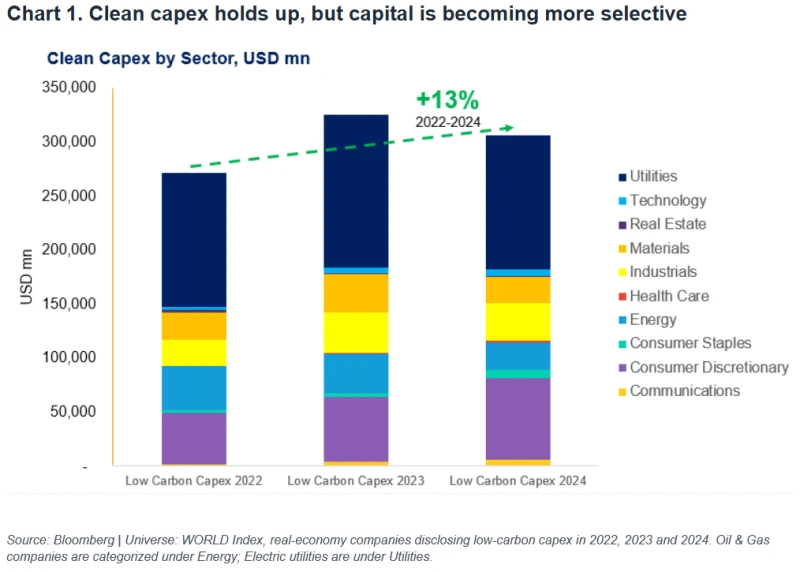
Despite macro uncertainty, clean capital expenditure in the disclosed company universe grew by 13% between 2022 and 2024. Utilities continue to dominate investment, reflecting their central role in electrification and grid infrastructure, while Consumer Discretionary, largely automobiles, and Industrials also show sustained commitment.
The sector pattern also points to more selective deployment. In Energy, spending moderated after a period of elevated investment, suggesting that returns, capital discipline and project economics are becoming more important as the transition scales.
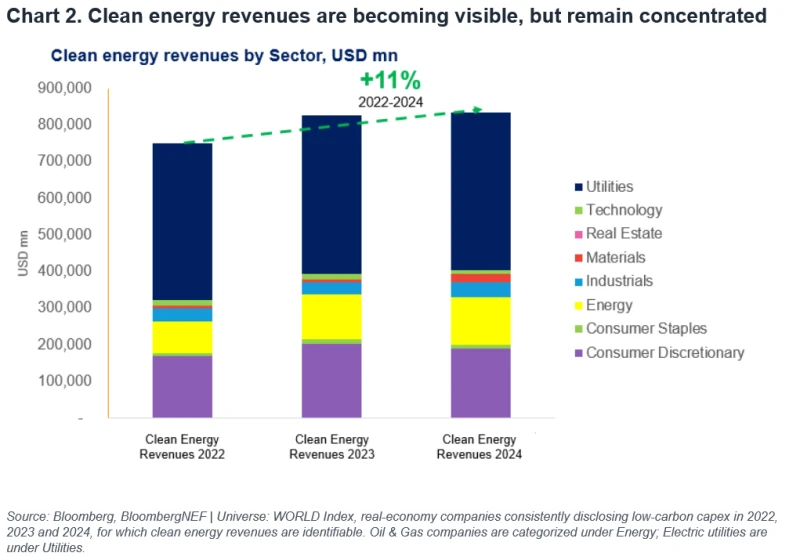
The next question is whether clean investment is translating into revenue. Clean energy revenues increased across several sectors for companies consistently disclosing low-carbon capex, but revenue remains concentrated, indicating that commercial maturity varies significantly by sector and business model.
Clean energy revenues appear to be scaling where capex is tied to clearer demand and monetization pathways, including power generation and electric vehicles. That does not imply a simple one-for-one link between capex and revenue: deployment lags, regulation, technology maturity and accounting treatment all affect when revenue becomes visible.
Infrastructure, operations and bottlenecks
Capital and revenue signals are only part of the picture. The transition also depends on whether infrastructure and operations can keep pace. This is where the energy security dimension of the trilemma becomes more visible: generation, grids, storage and corporate power sourcing all need to evolve together.
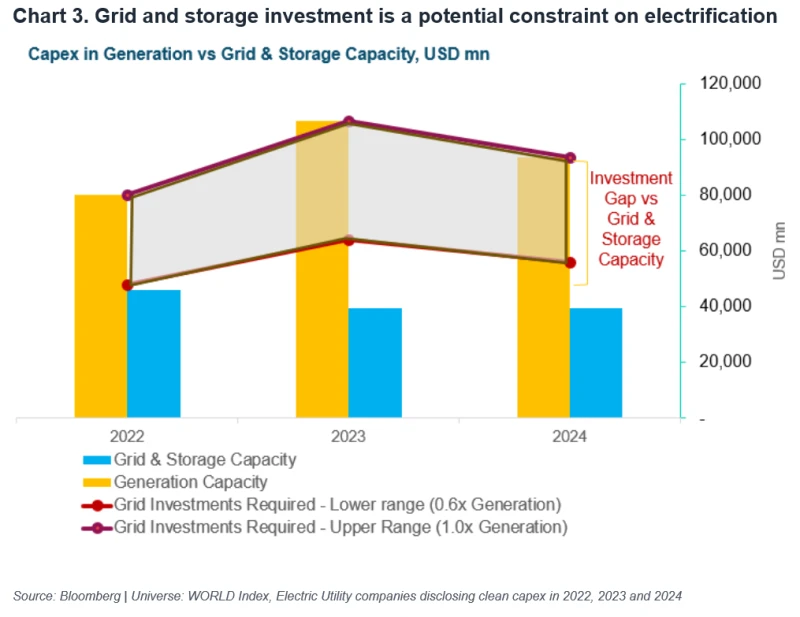
As generation capacity expands, transmission and grid infrastructure become increasingly important to maintaining reliability and system resilience. This is one of the clearest bottleneck signals in the chart set.
Grid and storage investment remains below benchmark ranges implied by generation capacity expansion. The gap widened in 2023 before improving modestly in 2024, suggesting that grid infrastructure may become a constraint on deployment if it does not keep pace with generation growth.
Credibility, execution and market differentiation
The final part of the analysis moves from activity to credibility. Targets can signal ambition, but investors are increasingly assessing whether companies have the capital allocation, governance and operational progress needed to support those commitments.
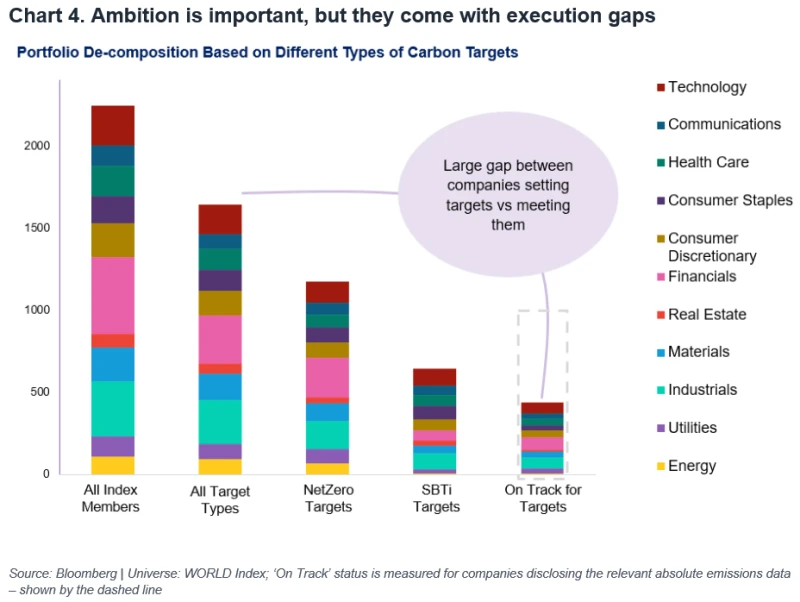
Companies are setting a broad range of emissions and carbon targets. That is an important starting point, but target type, scope and credibility vary significantly across sectors.
A target alone does not demonstrate implementation capability. For investors, the more useful question is whether ambition is supported by evidence of execution, including capital allocation, operational change and measurable progress.
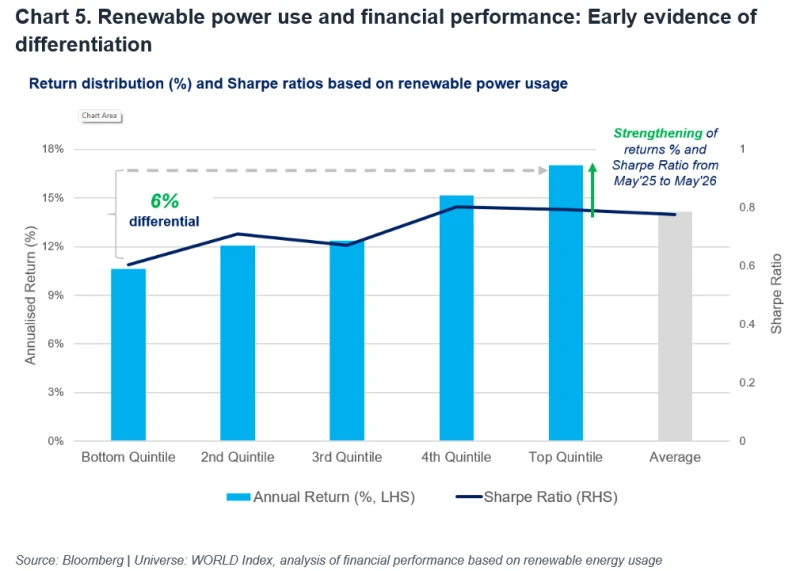
A final test is whether operational transition signals are associated with market performance. Bloomberg research indicates that companies with greater renewable energy use outperformed laggards by about 6% in the analysis, with higher returns and stronger Sharpe ratios.
The result appears to persist across both equal-weighted and market value-weighted methodologies, suggesting it is not driven purely by company size. A significant portion of the returns of this long-short portfolio could not be explained by conventional factors such as industry, country, currency or equity style. This is a useful signal for further research, but it should be framed as evidence of possible financial materiality rather than proof that renewable power usage caused outperformance.
The top-bottom return spread widened from ~4.5% (May 2025) to ~6% (May 2026); the Sharpe ratio also improved during this time. The Iran conflict and disruption around the Strait of Hormuz have kept energy security, input costs and inflation risks in focus; in that context, renewable power usage may become a more relevant operational signal for investors assessing resilience across the energy trilemma.
The methodology behind this analysis, which was first conducted in 2025, is available here.
Conclusion
The energy transition is increasingly shaped by the interaction between security, affordability and sustainability rather thansustainability objectives alone. Across sectors, the data shows continued capital deployment, expanding clean energy revenues, rising renewable power usage and improving operational positioning in some parts of the economy. At the same time, fossil fuel revenues remain material, infrastructure constraints are emerging and financial outcomes remain uneven across sectors and technologies.
Several cross-cutting themes stand out. First, clean investment remains resilient, but capital allocation appears to be becoming more selective. Second, the economics of the transition are uneven: clean energy revenues are becoming visible in some areas, while profitability and valuation signals remain sector-specific. Third, infrastructure, particularly grids and storage, may be a key constraint on both electrification and energy security. Finally, execution is becoming a more important differentiator than ambition alone.
For investors, the implication is that navigating the energy trilemma requires granular, company-level analysis. The most useful signals are likely to come from combining financial data, operational metrics and forward-looking transition indicators, rather than relying on any single target or disclosure. These remain early indicators, and further research is needed to determine which signals are durable, financially material and consistently reflected in valuations or cost of capital.
Bloomberg Terminal users can explore company-level capital allocation, revenues, emissions pathways and transition credibility through ESG TRANSITION <GO>.
The data included in these materials are for illustrative purposes only. The BLOOMBERG TERMINAL service and data products (the “Services”) are owned and distributed by Bloomberg Finance L.P. (“BFLP”) except (i) in Argentina, Australia and certain jurisdictions in the Pacific islands, Bermuda, China, India, Japan, Korea and New Zealand, where Bloomberg L.P. (“BLP”, together with its affiliates, including BFLP, “Bloomberg”) and its subsidiaries distribute these products, and (ii) in Singapore and the jurisdictions serviced by Bloomberg’s Singapore office, where a subsidiary of BFLP distributes these products. BLP or one of its subsidiaries provides BFLP and its subsidiaries with global marketing and operational support and service.
Certain features, functions, products and services are available only to sophisticated investors and only where permitted. The Services are standard services offered by Bloomberg. Users are responsible for their use of the Services and for assessing whether the Services help meet any regulatory obligations that apply to them. Bloomberg does not guarantee the accuracy of data or other information in the Services. Nothing in the Services shall constitute or be construed as an offering of financial instruments by Bloomberg, or as investment advice or recommendations by Bloomberg of an investment strategy or whether or not to “buy”, “sell” or “hold” an investment. Information available via the Services should not be considered as information sufficient upon which to base an investment decision. Bloomberg makes no claims or representations, or provides any assurances, about the sustainability characteristics, profile or data points of any underlying issuers, products or services, and users should make their own determination on such issues. The following are trademarks and service marks of BFLP, a Delaware limited partnership, or its subsidiaries: BLOOMBERG, BLOOMBERG ANYWHERE, BLOOMBERG MARKETS, BLOOMBERG NEWS, BLOOMBERG PROFESSIONAL, BLOOMBERG TERMINAL and BLOOMBERG.COM. Absence of any trademark or service mark from this list does not waive Bloomberg’s intellectual property rights in that name, mark or logo. All rights reserved. © 2026 Bloomberg.