ARTICLE
What €1 trillion in EU Taxonomy data reveals about Europe’s transition
Bloomberg Professional Services
- EU Taxonomy data now shows more than €1 trillion in taxonomy-aligned capital expenditure, reflecting growing investment in renewable energy, low-carbon infrastructure and industrial transition activities.
- Bloomberg analysis of EU Taxonomy disclosures highlights how energy, manufacturing and transport sectors are driving sustainable finance investment across Europe.
- Standardized sustainability reporting under the EU Taxonomy is improving comparability across markets and helping investors assess climate-related capital allocation and identify transition risks and opportunities.
This article was written by Nadia Humphreys, Head of Sustainable Finance Data at Bloomberg.
The EU Taxonomy was designed to help address the long-standing challenge in sustainable finance: the absence of a shared definition of what “green” means in economic terms. At its core, the framework links corporate activity directly to environmental objectives by requiring companies to quantify how much of their revenue, capital expenditure and operating expenditure aligns with a science-based classification system for environmental sustainability.
PRODUCT MENTIONS
In many international reporting regimes, companies retain a degree of discretion in defining and labelling “green” activities, which can lead to inconsistencies in methodology and interpretation across markets and sectors. The EU Taxonomy takes a different approach. It sets out detailed technical screening criteria and disclosure requirements that apply uniformly across the 27 EU Member States, helping create a level of comparability that has historically been missing from sustainable finance data.
How EU Taxonomy reporting reveals the progress of the transition
The rollout of taxonomy reporting has been gradual. Initial disclosures began in 2021 with limited scope, focusing primarily on eligibility. Over subsequent years, the framework expanded to include alignment metrics and broader coverage across environmental objectives. By 2024, companies were reporting a full set of financial and non-financial key performance indicators under Article 8, marking the first complete year of taxonomy-aligned disclosure.
Now, in 2026, the data is reaching a stage where it can provide additional insight about capital allocation across the European economy. One recent milestone is worth highlighting: taxonomy-aligned capital expenditure has surpassed €1 trillion.
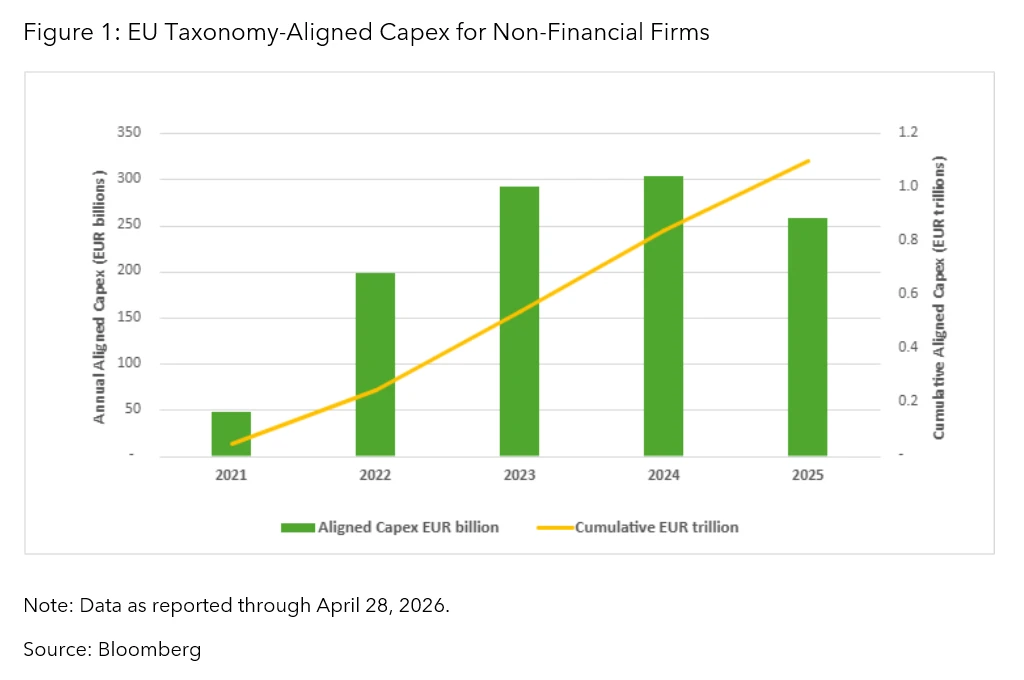
This is not a forward-looking estimate, it is the reported capital deployment associated with activities described as supporting companies’ efforts to operate more sustainably. Under the EU Taxonomy Regulation, aligned CapEx should correspond directly to capital expenditure recognised in a company’s financial statements for the reporting year.
If a company reports €100 million of aligned CapEx for 2025, that amount is expected to be reflected as spent in its 2025 accounts, in accordance with the applicable reporting framework. It cannot represent planned investment or multi-year commitments. This requirement, set out in the detailed rules under Article 8 of the Taxonomy, helps ensure that the data captures real, contemporaneous investment decisions rather than projections.
Even more notable is that the €1 trillion threshold has been reached before the full set of 2025 disclosures has been reported. Current disclosure for 2025 sits at approximately ~1,100 non-financial reporting firms, representing ~60% of a typical reporting cycle. This suggests that the final reported figures for 2025 may exceed this milestone as additional disclosures are made.
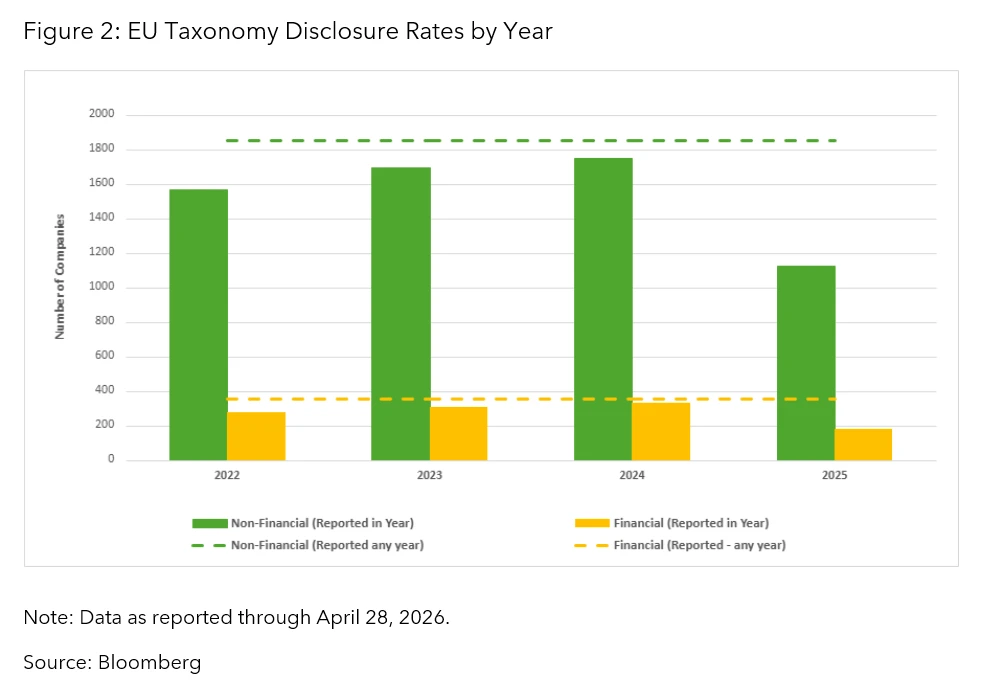
This capital is being deployed into activities that meet the criteria set out in the EU Taxonomy framework, including renewable energy generation, low-carbon infrastructure, energy efficiency improvements and industrial transformation. Importantly, the taxonomy also includes investment in sectors with higher emissions intensity, such as activities associated with transition efforts, rather than excluding high-emitting industries.
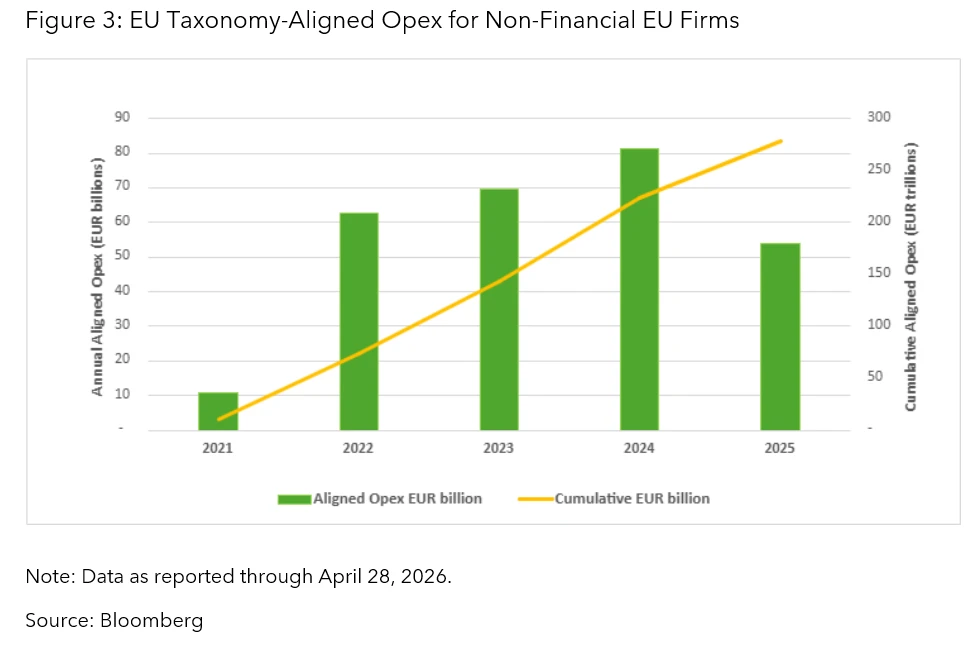
Operating expenditure, while smaller at approximately €250 billion, provides additional insight into ongoing costs associated with maintaining and improving aligned activities.
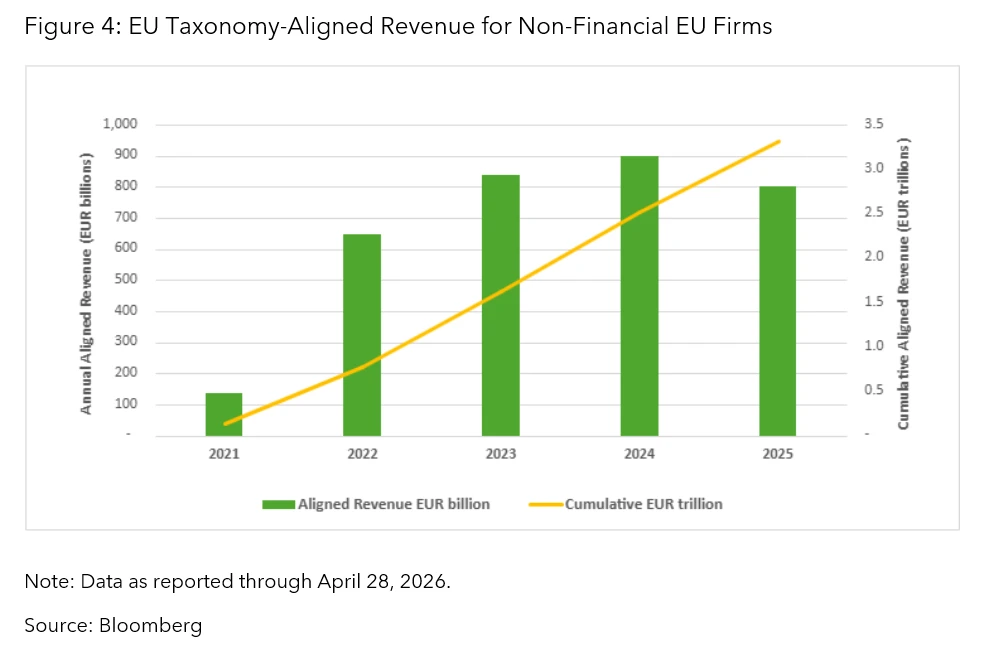
Beyond expenditure, the broader dataset reinforces the same trend. Companies are reporting more than €3 trillion in taxonomy-aligned revenue, indicating that a growing share of economic activity is already consistent with the framework’s environmental objectives.
Which sectors are leading EU Taxonomy-aligned investment?
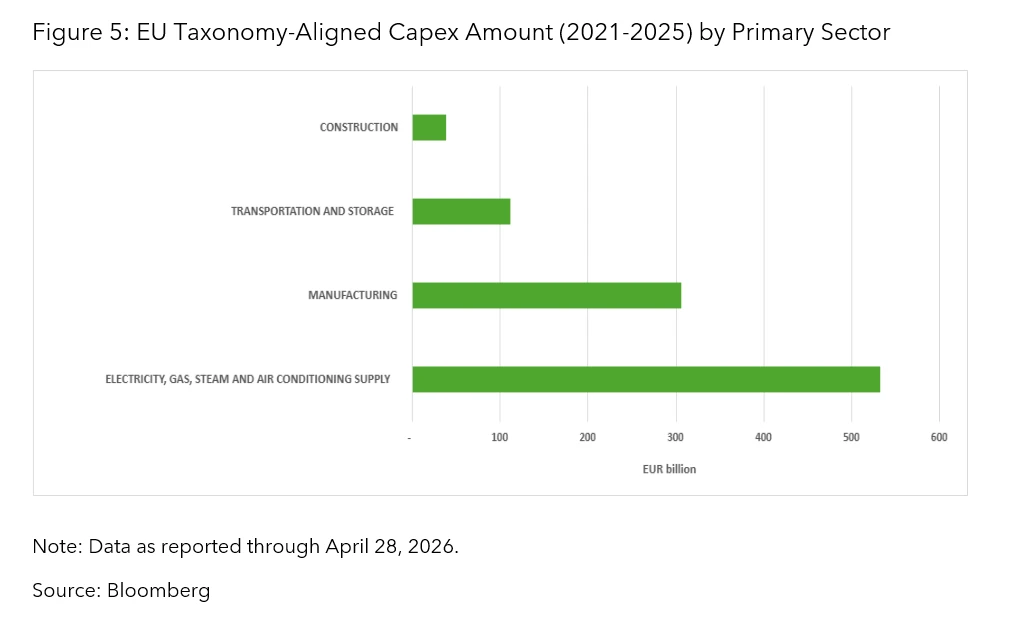
Looking at the sectoral distribution, the concentration of aligned investment is not evenly spread. Energy, manufacturing and transport emerge as the leading sectors by absolute capital expenditure, each contributing significant volumes of aligned CapEx. It is important to note that this classification is based on the primary NACE code of the reporting entity, reflecting its main revenue-generating activity rather than segment-level reporting.
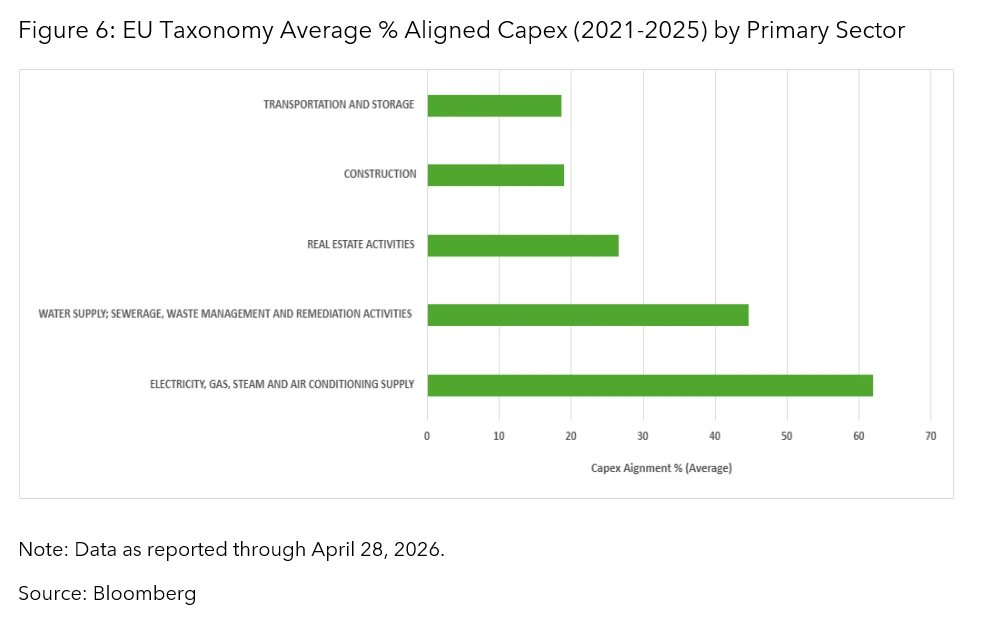
When alignment is assessed on a relative basis, a slightly different picture emerges. Sectors such as energy, water, real estate, construction and transport show the highest average alignment ratios, with many approaching or exceeding 20% of total capital expenditure. This suggests that while some industries dominate in terms of scale, others report higher alignment ratios relative to their capital expenditure.
Taken together, the data highlights changes in capital allocation associated with the EU’s environmental objectives. Based on these observations, the taxonomy has been operating as both a disclosure framework and a tool to support capital allocation decisions. By anchoring sustainability claims to measurable, standardized criteria, the taxonomy can help reduce ambiguity and increase credibility in reported figures.
Policy frameworks help shift corporate strategy
There are still limitations to consider. Coverage remains incomplete, methodologies continue to evolve and the framework itself is refining testing criteria for environmental objectives and sectors. However, the data demonstrates that the combination of policy, clarity, and financial materiality can shift behavior at scale.
Crossing the €1 trillion threshold in aligned capital expenditure is less about the headline number and more about what sits behind it. It suggests a growing alignment between the EU’s policy framework, corporate strategy and reported financial flows. In practical terms, it indicates that an increasing portion of EU investment is associated with activities that meet the EU’s common definition for environmental sustainability.
For more insights on the transition and other climate risks, Bloomberg provides a comprehensive suite of data and analytics in addition to research from BloombergNEF and Bloomberg Intelligence. To learn more, please visit Bloomberg Sustainable Finance Data website or request a demo.
The data included in these materials are for illustrative purposes only. The BLOOMBERG TERMINAL service and data products (the “Services”) are owned and distributed by Bloomberg Finance L.P. (“BFLP”) except (i) in Argentina, Australia and certain jurisdictions in the Pacific islands, Bermuda, China, India, Japan, Korea and New Zealand, where Bloomberg L.P. (“BLP”, together with its affiliates, including BFLP, “Bloomberg”) and its subsidiaries distribute these products, and (ii) in Singapore and the jurisdictions serviced by Bloomberg’s Singapore office, where a subsidiary of BFLP distributes these products. BLP or one of its subsidiaries provides BFLP and its subsidiaries with global marketing and operational support and service.
Certain features, functions, products and services are available only to sophisticated investors and only where permitted. The Services are standard services offered by Bloomberg. Users are responsible for their use of the Services and for assessing whether the Services help meet any regulatory obligations that apply to them. Bloomberg does not guarantee the accuracy of data or other information in the Services. Nothing in the Services shall constitute or be construed as an offering of financial instruments by Bloomberg, or as investment advice or recommendations by Bloomberg of an investment strategy or whether or not to “buy”, “sell” or “hold” an investment. Information available via the Services should not be considered as information sufficient upon which to base an investment decision. Bloomberg makes no claims or representations, or provides any assurances, about the sustainability characteristics, profile or data points of any underlying issuers, products or services, and users should make their own determination on such issues. The following are trademarks and service marks of BFLP, a Delaware limited partnership, or its subsidiaries: BLOOMBERG, BLOOMBERG ANYWHERE, BLOOMBERG MARKETS, BLOOMBERG NEWS, BLOOMBERG PROFESSIONAL, BLOOMBERG TERMINAL and BLOOMBERG.COM. Absence of any trademark or service mark from this list does not waive Bloomberg’s intellectual property rights in that name, mark or logo.
© 2026 Bloomberg. All rights reserved.