ARTICLE
How to use pre-trade data to better target automation on Rule Builder

Functions for the Market
This article was written by Harry Street, Global Head of Credit Electronic Trading, and Christopher Clodius, Global Head of Trade Automation, at Bloomberg. It appeared first on the Bloomberg Terminal.
As bond markets continue their rapid evolution toward electronic trading, automation is no longer considered optional—it’s becoming a strategic necessity.
Automation is known to boost trading desk productivity, but it can also improve performance through better execution, reducing the implicit costs that affect overall fund performance. A Bloomberg study of anonymized trades in sovereign and credit markets found automation outperformed manual traders in both the US and Europe.
PRODUCT MENTIONS
Increasingly, traders recognize that the effectiveness of rules-based execution is determined not only by the sophistication of the rules themselves but also by the market signals feeding them. Automation is most successful when it’s powered by high-quality, timely, and interpretable pre-trade data.
One key tool for buy-side companies automating trading workflows is Bloomberg’s Rule Builder (RBLD). RBLD lets you create rules that automate alerting and routing actions on orders in the Fixed Income Execution Management (TSOX) system. By turning pre-trade intelligence into systematic and repeatable decision frameworks, RBLD enables traders to automate confidently while maintaining control over execution outcomes.
Across asset managers, hedge funds, private banks and wealth managers, the objectives driving automation are consistent. Traders want to adhere to best-execution policies without expanding their manual workload, to minimize slippage versus a benchmark and to obtain price-back certainty—that is, confidence that a contributed price will be honored at execution.
They want to balance market impact against certainty of execution, ensuring a trade gets done. They want to get access to reliable quotes and sufficient size without overexposing trading intent. They want to maintain low execution costs and consistent trading quality. Traders at private banks also want to achieve or beat limit levels, which are predefined caps on exposure to certain risks.
Meeting such objectives with automation, however, requires credible, structured pre-trade signals.
Why? For one thing, the ecosystem that provides liquidity for fixed-income trading has become more diverse and fragmented in recent years.
Liquidity today appears in axes, dealer inventories, algorithmic liquidity providers, streaming markets, request-for-quote protocols and nontraditional participants. Each layer has its own impact profile and behavioral characteristics. To help traders navigate such disparate sources of liquidity, pre-trade data can provide a map.
Consider axes, indications from a dealer of special interest in buying or selling particular bonds. Axes are a strong signal of the availability of liquidity for both line traders—those who handle a particular slice of the market—and algo desks. They provide directional insight and urgency and can help reduce market impact. In effect, such pre-trade information can act as a proxy for dealer engagement. A dealer providing timely prices, axes and executable quotes is demonstrating real liquidity—making them more suitable for automated routing.
Dealer algos increasingly serve as real-time liquidity providers. Their pricing adapts instantly to client activity, market volatility and inventory. It’s important to note that algos often provide higher price-back ratios compared with traditional line traders, making them valuable partners for automated workflows.
How Rule Builder uses pre-trade intelligence
Bloomberg delivers a pre-trade feed that includes pricing, axes, dealer performance metrics and executable price qualifications. You can then use RBLD to translate this data into a structured decision hierarchy. Here’s a quick overview of how.
To start, Bloomberg Terminal subscribers can access this via {RBLD <GO>}. Although we’re focusing here on fixed income, Rule Builder is a multiasset tool that can also be used for equities, futures, options and foreign exchange. Once you’ve created autorouting rules to convert an order into a trade, you can display them by clicking on the Automation tab.
Figure 1: Rule Builder enables alerting and routing automation for TSOX orders
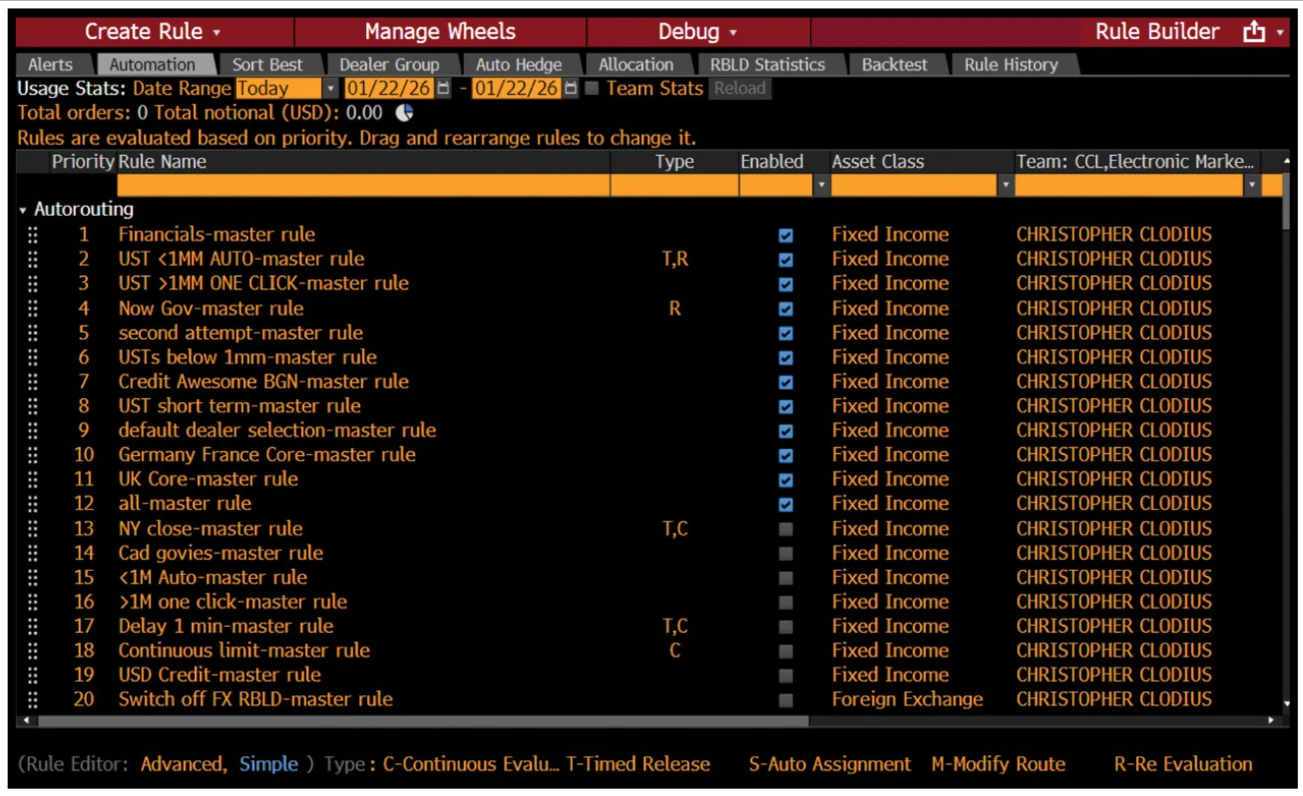
To set up a rule, click the “Create Rule” button on the red toolbar and select “Sort Best” or “Autorouting” for example. Use the “Asset Class” drop-down to select “Fixed Income.” Then use the “Dealer Selection” drop-down to select “Create New Rule.”
Figure 2: Rule Builder enables users to define a sequence of criteria used to prioritize dealers
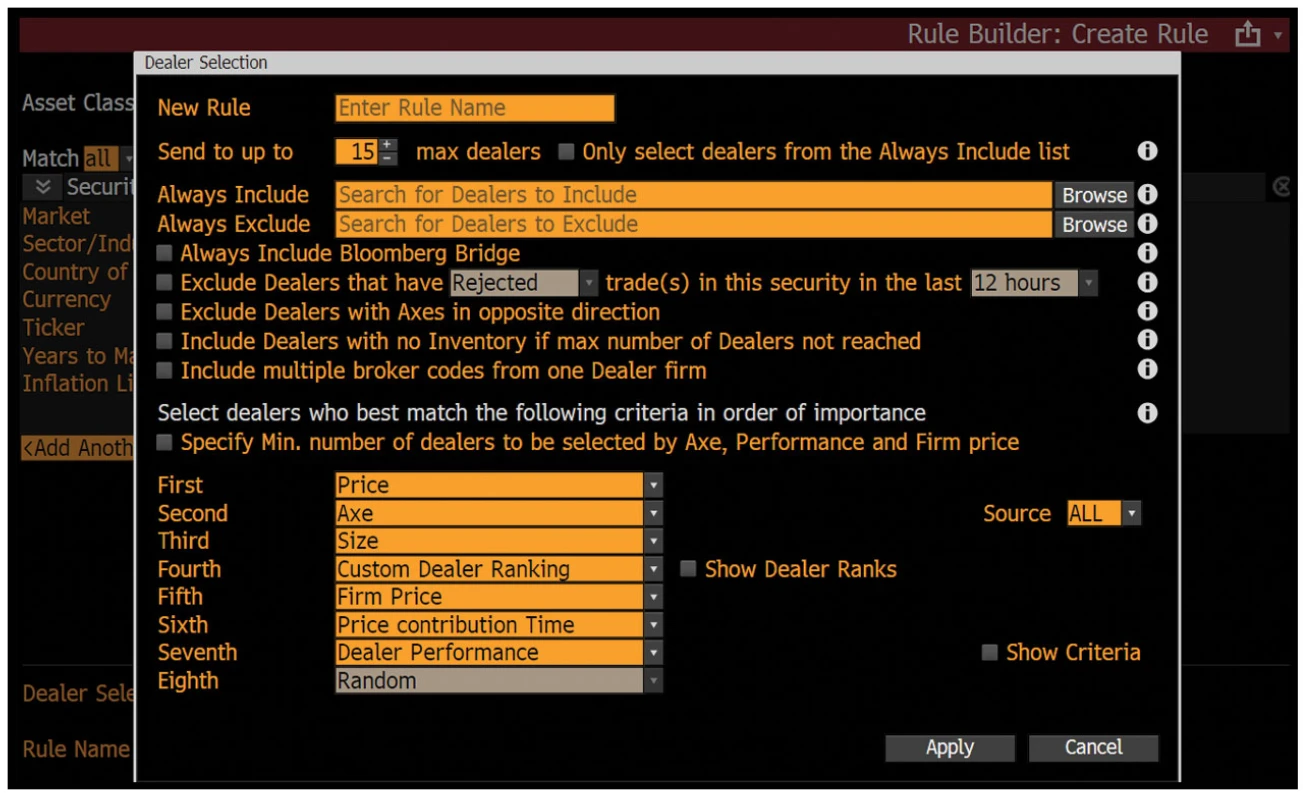
Here, users can define a sequence of criteria, and RBLD will fill dealer slots according to that order or priority. If a criterion can’t fill all slots, the engine moves to the next. Once slots are full, remaining criteria act as tiebreakers.
In addition, Bloomberg subscribers can incorporate Bloomberg Bridge, an anonymous intermediated all-to-all trading service for corporate and emerging-market bonds, as another liquidity source and mix criteria to select dealers from different pre-trade buckets.
Pre-trade signals for Rule Builder automation include:
Price
Dealers providing the most competitive pricing relative to market or a reference are prioritized.
Axe
Dealers axed in the direction of the trade receive preference. Specifying All as the source of your axes will include quotes from your Runs Manager (RUNZ) worksheet and from ERUN, which are real-time FIX-based axes.
Size
Dealers quoting size at or above the order amount, including axe size, receive preference.
Custom Dealer Ranking
Rank as many as five dealers based on relationships, liquidity tendencies or strategic alignment.
Firm Price
Dealers with a firm-price honor rate greater than or equal to 95% (measured over two weeks) move higher in selection.
Price Contribution Time
Staleness matters; dealers with the most up-to-date contributions win tie situations.
Dealer Performance
This suite of past-execution key performance indicators can help you target the dealers most likely to execute efficiently. Among these metrics are responsiveness, hit ratio and slippage.
Random
This criterion allows you to select a subset of dealers from a list so you can rotate among them.
The underlying assumption here is that the majority of workflows will include the most active dealers in the market. RBLD simply allows those dealers to be ordered statistically, based on their likelihood of providing high-quality execution.
Systematic dealer selection creates consistency, reduces noise and improves execution outcomes. It reduces human bias and variability. Clear pre-trade signals ensure automation doesn’t compromise execution quality.
Pre- and post-trade analytics let you build a continuous improvement loop. Combining pricing with axes has been shown to increase price-back ratios. RBLD enables desks to scale execution without adding head count, preserving performance.
In fixed income, automation is no longer about simplifying workflows; it’s about amplifying intelligence. Pre-trade data can give you a detailed picture of liquidity, intent and execution potential. RBLD then converts that picture into an actionable, repeatable strategy. Treating pre-trade data as the engine of an automation strategy will only become more crucial as markets become more electronic.