ARTICLE
How tradable products and modern market infrastructure are reshaping credit markets

Functions for the Market
This article was written by Fateen Sharaby, Head of Index Derivatives at Bloomberg. It appeared first on the Bloomberg Terminal.
Fixed income markets have undergone multiple waves of transformation. When the Bloomberg Terminal was introduced in the early 1980s, it helped bring electronic data, transparency and analytics to markets that had long relied on fragmented information.
More recently, fixed income has entered a new phase of evolution driven by advances in technology, real-time data and market infrastructure. Bond trading, once largely bilateral and conducted by phone, has become an increasingly electronic, data-rich ecosystem. Today’s credit markets operate through interconnected layers: cash bonds, exchange-traded funds, indexes and derivatives. Together these layers enable more continuous pricing, more efficient hedging and broader access to credit exposure.
PRODUCT MENTIONS
Credit futures on bond indexes trade on Cboe Global Markets Inc., CME Group’s Chicago Board of Trade and Eurex. These futures sit at the intersection of three structural trends: electronification of trading; the proliferation of index-linked vehicles such as bond ETFs; and advances in data and analytics infrastructure that enable intraday pricing, automation and systematic strategies.
From opaque to transparent
The adoption of electronic trading in credit markets has accelerated. Roughly 44% of US corporate bond volume trades electronically, and almost one-third of dealer workflows involve no human intervention, according to a recent report by Crisil Coalition Greenwich. Portfolio trading—buying or selling a basket of bonds, which barely existed a decade ago—now routinely accounts for 10% or more of daily activity. Credit ETFs represent 15% to 20% of the notional volume traded.
Electronification has enabled the rise of systematic and quantitative credit strategies, particularly among hedge funds, principal trading firms and multi-asset managers. These approaches rely on fast, consistent analytics, deep data and efficient execution across both cash and derivative instruments.
The rise of bond ETFs has been especially influential. With global assets under management exceeding $3 trillion, fixed income ETFs introduced intraday price signals and scalable liquidity mechanisms—particularly the creation/redemption process, in which a basket of bonds is traded for shares of the fund—that make it easier to get and measure exposure. The US Securities and Exchange Commission’s Rule 6c-11, by permitting more-flexible basket substitutions, further integrated ETFs into the workflow of credit market makers.
Collectively these shifts enable credit instruments to behave more like equity or rates products. Global fixed income markets are bigger than equities (about $145 trillion, according to the Securities Industry & Financial Markets Association’s 2025 Capital Markets Fact Book, versus roughly $130 trillion for stocks). Yet bond ETFs still account for only about 16% of the almost $19 trillion ETF market, which remains equity dominated. In other words, the evolution underway in fixed income is still in early stages.
Derivatives market structure has similarly transformed. Exchanges have taken the familiar architecture of equity index futures and applied it to corporate credit, launching listed contracts tied to transparent bond indexes rather than bespoke credit-default-swap baskets. Credit index futures sit naturally alongside ETFs within modern credit market structure. Liquidity providers use ETF markets to dynamically hedge futures exposures, translating deep ETF liquidity into tight, resilient pricing for the futures contracts.
Data and benchmarks
High-frequency pricing lets investors monitor credit risk in ways that used to require bespoke analytics or dealer quotes. Trade reference pricing, which generates intraday bond price predictions based on available real-time data, now supports everything from market-making automation to pre-trade analytics and intraday net asset value calculations.
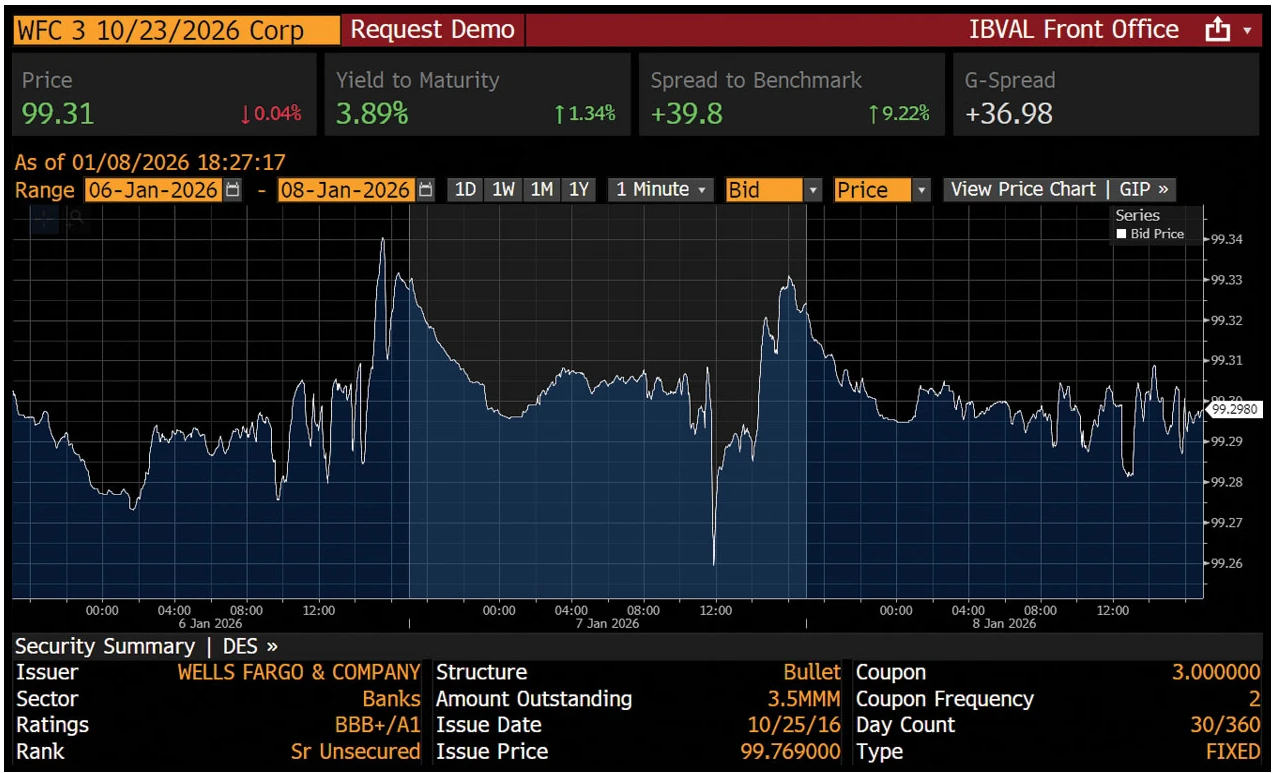
Bloomberg’s IBVAL Front Office intraday pricing service uses an artificial intelligence model that ingests trade and quote data to produce reference prices as fast as every 15 seconds for corporates and every second for liquid government bonds. IBVAL, available for more than 90,000 bonds globally, is now the default pricing source on the Bloomberg Terminal. For example, Bloomberg Terminal subscribers can chart intraday prices for a bond issued by Wells Fargo & Co. by running WFC 3 10/23/2026 Corp IBVL <GO>
Figure 1: Intraday Prices for a Bond Issued by Wells Fargo & Co.
Real-time reference pricing data, in turn, enabled the development of tradable indexes. Bloomberg’s Tradable Trackers—built from a subset of the most liquid bonds in flagship indexes to replicate their performance—produce intraday indicative levels reflecting executable market prices. Performance of the Bloomberg US Corporate Bond Index, the investment-grade benchmark, can be compared with its Tradable Tracker via the Bloomberg Terminal by running LUACTRUU Index GP <GO>.
Figure 2: Performance comparison of the Bloomberg US Corporate Bond Index Compared with its Tradable Tracker
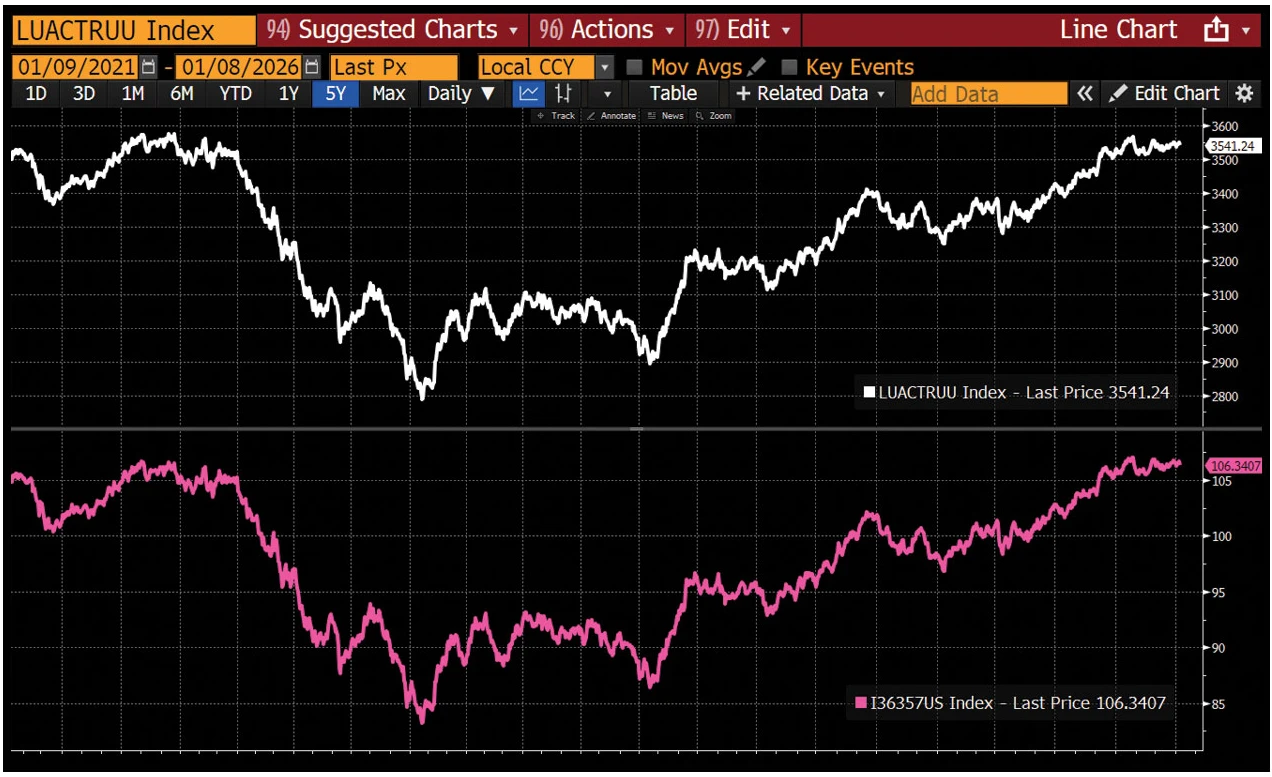
These trackers can be used to follow index movements throughout the day, compute the fair value of credit index futures, support portfolio trading workflows and compare pricing across cash bonds, ETFs and futures.
Credit index futures
The most recent step in the market’s evolution has been the adoption of credit index futures. Futures referencing Bloomberg Indices’ corporate bond benchmarks are listed on CME and Eurex, in both total-return and spread-return (or duration-hedged) formats, which aim to isolate changes in the credit spread above a risk-free rate. A chart shows notional open interest for the 10 contracts available as of late December.
Figure 3: Notional Open Interest for the 10 Futures Contracts on Bloomberg Indices as of December 2025
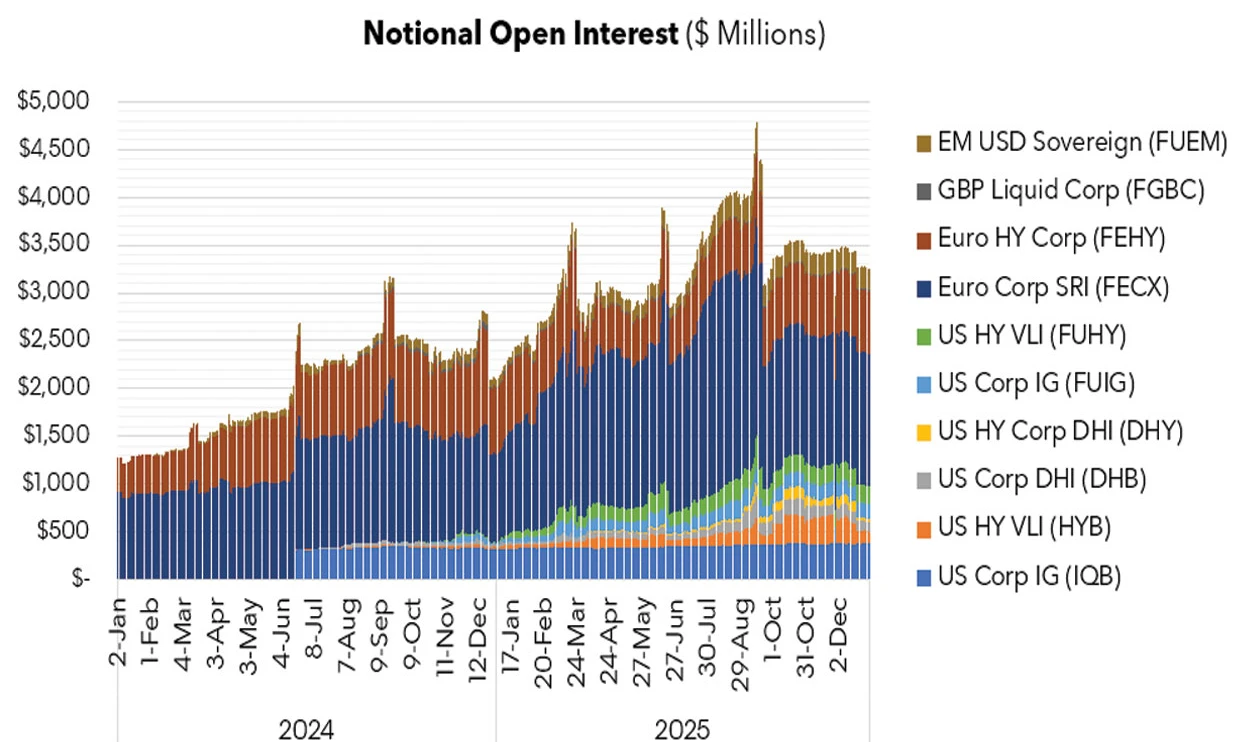
Adoption accelerated in 2025, with trading volumes reaching record highs early last year. Aggregate open interest climbed steadily—an important indicator of sustained institutional use. Amid a bout of market volatility in September, total notional open interest on these futures soared above $4.5 billion. As of December more than 3 million contracts have traded, or almost $300 billion in notional terms. In addition to that activity, block trading has also grown, with individual block trades reaching several hundred million dollars in notional size in some contracts.
Several factors explain this momentum. First, credit futures offer leveraged, capital-efficient exposure. Margin requirements typically range from about 1% to 4%, a materially lower cost than holding physical bonds or shorting ETFs. Second, futures simplify hedging and relative-value positioning by allowing investors to adjust credit beta, or exposure, or isolate spread risk without sourcing individual securities. Third, they trade nearly around the clock, enabling more continuous intraday risk management than most over-the-counter credit instruments.
Market participants deploy the futures in different ways depending on their role, constraints and objectives. Asset managers use investment-grade and high-yield corporate bond futures as overlays to quickly adjust betas and to manage inflows and outflows without disturbing underlying bond portfolios. Insurance companies deploy them to hedge solvency-capital sensitivities.
Global macro managers, CTAs, or commodity trading advisers, and relative-value traders use them to express views on credit spreads versus rates across regions. And ETF market makers increasingly incorporate credit futures into their hedging toolkits, particularly around roll periods and large primary market flows.
Market infrastructure
The rise of tradable credit products is intertwined with advances in analytics and computational infrastructure. Systematic credit strategies increasingly rely on cloud-based repricing, curve analytics and real-time signal generation—often running at subsecond frequencies. Traders routinely recalculate prices of entire portfolios against Treasury and spread curves, overlay historical time-series analytics and evaluate default-probability models to identify mispricings.
Bloomberg’s Fixed Income Trading provides comprehensive electronic execution across cash and derivative products in the credit markets. That includes support for multiple trading styles, ranging from low-touch automated workflows to single-security RFQs, or requests for quotes, list RFQs and portfolio trading.
For credit futures, trading is currently available via Bloomberg Execution Management System (EMSX) and RFQ Trader Ticket (RFQe), allowing participants to integrate futures execution alongside cash bonds and ETFs within existing workflows.
Tools such as the Portfolio Trading Basket Builder (PTBB), Rule Builder (RBLD) and execution management workflows—enable clients to design, automate and monitor credit strategies across instruments.
Figure 4: Portfolio Trading Basket Builder
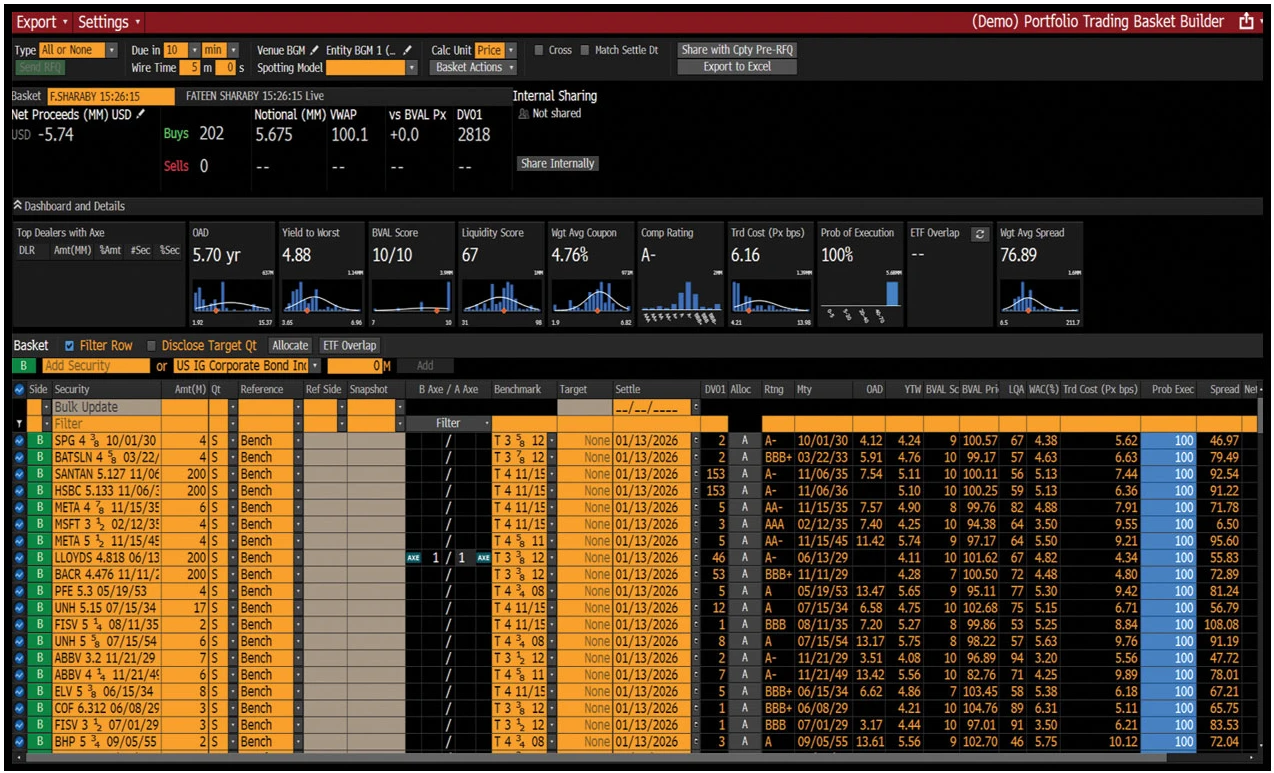
Research and transaction-cost analysis indicate that automation can improve execution quality, particularly during periods of heightened volatility, by reacting more quickly to price dislocations between cash bonds, ETFs and futures.
Fair-value analytics allow traders to monitor deviations between live futures prices, tradable index levels and ETF pricing, supporting basis trades, roll management and relative-value strategies. For example, Bloomberg Terminal subscribers can dig into the contract on the Bloomberg MSCI Euro Corporate SRI Index that trades on Eurex by running LXYA Index FAIR <GO>.
Figure 5: Example of the Contract on the Bloomberg MSCI Euro Corporate SRI Index that Trades on Eurex
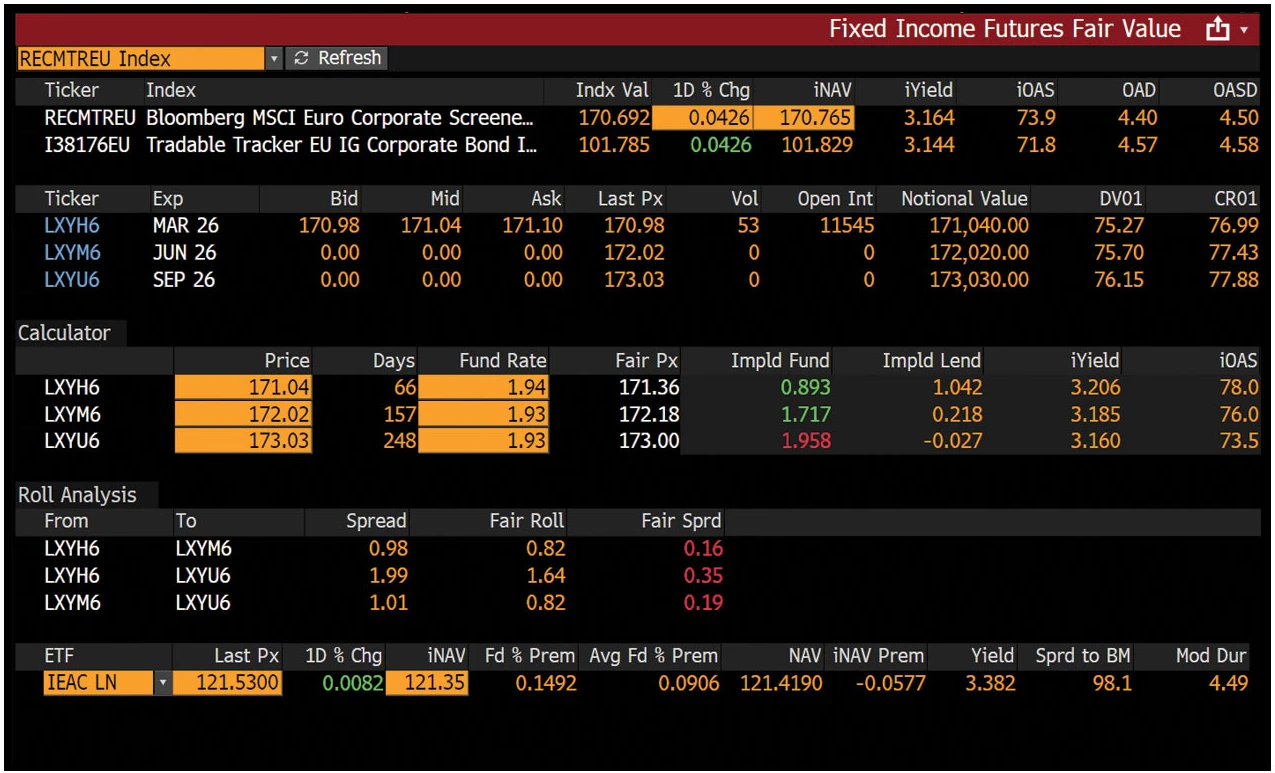
Harmonized analytics mean that an ETF, an index and a futures contract can now be evaluated on an apples-to-apples basis in real time.
Derivatives-linked design
Index design itself is evolving to reflect the growing role of derivatives. Duration-hedged credit indexes, rolling futures-based trackers and other investability-oriented index structures allow investors to isolate specific credit factors or implement systematic strategies more easily. These design principles underpin CME’s duration-hedged credit futures, which reference Bloomberg spread-return indexes and strip out rate exposure, leaving a “purer” credit-beta instrument.
For systematic and multi-asset strategies, these instruments behave more like traditional derivatives and fit more naturally into existing risk frameworks. The same concepts are increasingly applied across Bloomberg’s multi-asset and volatility-controlled index families. Applied to credit, these structures can support spread-only or rate-neutral exposures, credit overlays on top of physical portfolios and the incorporation into CTA-style momentum strategies.
Looking ahead
For fixed income investors, the implication is clear: Credit exposure is no longer defined solely by the cash bonds held on balance sheet. It increasingly resides in a continuum of data, indexes, ETFs and futures, all of which can be combined and reconfigured in near real time. The next phase of growth will come from investors who embrace this integrated toolkit—using bond ETFs for strategic asset allocation, tradable indexes and IBVAL pricing for real-time risk measurement, and credit index futures for tactical implementation, liquidity management and systematic strategies.
Looking ahead, more-granular index exposures—by rating, sector or duration bucket—may support future tradable products. Continued automation and tighter linkages between execution and analytics will further compress the distance between idea generation and implementation, reinforcing credit futures as a core component of modern fixed income market structure rather than a niche overlay.