ARTICLE
Portfolio trading is reshaping fixed income. Is your desk ready?
Bloomberg Professional Services
- As credit markets become more electronic and portfolio trading grows, firms need an integrated end-to-end workflow that can enable fast, efficient and reliable portfolio trading.
- Solutions need to offer connectivity, reliable pricing, smart automation, the capacity to handle increasingly complex baskets, and post-trade integration and reporting.
- As portfolio trading scales, competitive advantage will come from combining automation with trader judgement, supported by tools that help desks orchestrate a more complex workflow.
This article is by Angela Cai, Head of D2C Trading, TEMS at Bloomberg and Dan Tsou, Global Head of Sell-Side EMS at Bloomberg.
Portfolio trading is changing the shape of fixed income execution. Increasingly, clients want to transfer risk at the portfolio trading level, which raises the bar for workflow control, data quality and execution oversight.
PRODUCT MENTIONS
Sell-side dealers are looking for speed, transparency and efficiency. Clients are increasingly using portfolio-level strategies for allocation, rebalancing and risk management. Portfolio trading gives a way to implement those decisions without having to work every bond independently. What now matters to firms is whether the entire workflow can support portfolio trading as the market evolves.
Bloomberg analysis found that in March 2025, 26.4% of institutionally-sized US investment-grade (IG) dealer risk trades were executed via portfolio trading, up from 21.1% in January. The figures reflect the fact that portfolio trading is now a significant aspect of dealer workflow rather than an emerging trend.
Portfolio trading as a workflow challenge
The complexity of portfolio trading places greater demands on the fixed income desk. For example, a 250-line-item IG portfolio trade may contain bonds that offset existing exposures, bonds that can be hedged electronically and bonds that require input from a specialist line trader.
The challenge is therefore not simply producing hundreds of prices quickly, it is understanding the economics of the basket as a whole and determining how individual risks should be warehoused, hedged, automated or routed to specialist traders.
To ensure this works smoothly, liquidity discovery, pricing judgement, automation, trader oversight and post-trade control need to operate as part of the same process. What’s needed is a single execution solution that can support the complexity, without forcing traders to stitch the process together manually.
Dealers are trading across multiple venues, so need to be able to inject portfolios quickly from different venues and protocols. The need is for an end-to-end system that can connect all these venues and support multiple different trading protocols. The information also needs to enter downstream workflows to enable the necessary reporting.
What portfolio trading demands from the modern trading desk
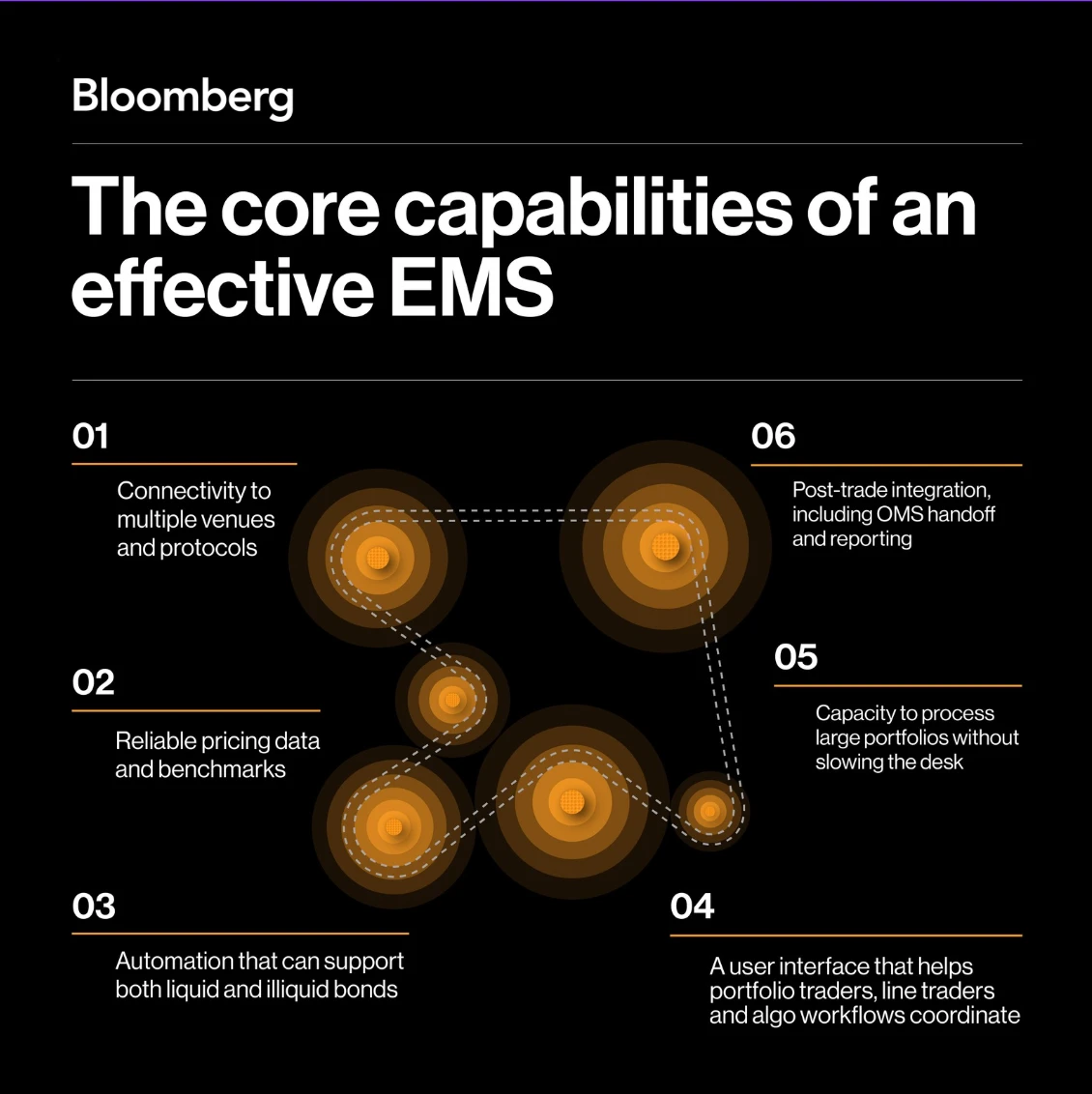
As heads of trading and technology assess whether their current environments can support portfolio trading at scale, they should consider several core capabilities:
- Connectivity to multiple venues and protocols
The ability to connect to fragmented pools of liquidity and support different execution workflows across venues.
- Reliable pricing data and benchmarks
Access to reliable pricing and analytics to help traders assess the basket, understand how the risk fits with inventory and market conditions, and evaluate both liquid and illiquid bonds.
- Smart automation
The ability to automate pricing and execution where appropriate, while allowing traders to retain control over more complex or less liquid securities.
- UI that coordinates traders, algorithms and workflows
A user interface that supports portfolio traders, line traders and algo workflows operating together.
- Capacity to process large portfolios efficiently
Systems that can handle increasingly complex baskets without introducing operational friction.
- Post-trade integration and reporting
The ability for information to flow seamlessly into order management and reporting systems, while supporting the requirements of portfolio trades.
Effective portfolio trading depends on having these capabilities and ensuring that the components can work together. Weakness in any part of the workflow can slow execution, reduce transparency or introduce risk. For traders, that means being able to automate where it makes sense and focus attention where judgement matters most.
A unified workflow
As portfolio trading grows, execution environments are expected to do more than connect traders to venues. Increasingly, firms are looking for connectivity, pricing data, analytics, communication tools and downstream integration to operate as part of a connected trading solution.
This idea of a unified workflow underpins Bloomberg Trade EMS (TEMS).
Bloomberg offers a suite of solutions. It brings trading workflows, market data, evaluated pricing, analytics, TOMS integration and communication tools together in a connected solution that is designed to support portfolio trading at scale.
Bloomberg connects to multiple venues and protocols, helping firms ingest portfolio trades efficiently. Intraday BVAL (IBVAL) provides near-real-time intraday pricing designed for front-office trading workflows, while BVAL provides evaluated prices at designated market snapshots across a broad range of instruments and liquidity profiles. Together, they support pricing needs across front, middle and back-office workflows.
The goal isn’t just to make portfolio trading faster. It’s also to make it more efficient and transparent by reducing friction across the entire workflow.
The next phase of portfolio trading
The increase in portfolio trading is likely to continue, especially in regions where uptake has so far been behind the US. Portfolio trading is now being used by a significant proportion of US investment-grade dealers, and it’s been increasing year-on-year. Adoption has been slower in Europe, but this year there has been an uptick as more venues introduce portfolio-trading protocols and workflows.
As portfolio trading continues to expand and evolve, the next stage is likely to be less about workflow efficiency alone and more about decision support. Portfolio trades generate large volumes of information, including pricing, historical execution data, client activity and analytics. Traditionally, traders have had to gather this information from multiple systems to help them make decisions.
AI has the potential to help reduce the information gathering burden around integrated pricing, trader judgement and orchestration.
ASKB, Bloomberg’s agentic AI interface for the Bloomberg Terminal, lets users retrieve, analyze and contextualize Bloomberg information using natural language. For information intensive workflows such as portfolio trading, this can help traders access and synthesize relevant information more efficiently.
Keeping pace with the market
Portfolio trading is ultimately a test of whether fixed income execution workflows can keep pace with the market. As it grows, it is changing more than the speed and efficiency of trading. It is changing how risk is transferred, and therefore how dealer desks need to price, coordinate and manage that risk across the full workflow.
Firms that can bring those capabilities together, supported by infrastructure such as TEMS, will be well positioned to handle greater complexity and compete as portfolio trading continues to scale.