ARTICLE
From prediction to precision: The evolution of pre-trade intelligence
Bloomberg Professional Services
- Liquidity is increasingly fragmented across asset classes, reducing market transparency and making the true conditions harder to observe.
- TCA is evolving from backward-looking reporting to real-time decision support, helping traders act on incomplete, delayed or fragmented information across markets.
- Across equities, fixed income and FX, the core challenge remains consistent: assessing liquidity and choosing the best execution path.
As capital markets industry leaders convene in Europe, one theme continues to dominate conversations across desks, asset classes, and regions: liquidity is no longer where – or what – it used to be. Over the past seven years, financial markets have evolved in distinct ways across markets, creating a fragmented landscape that rewards those who can navigate its changing terrain.
In equities, liquidity has spread across lit venues, dark pools and off-exchange channels, making the full trading picture harder to infer from displayed markets alone. This has become increasingly evident in the U.S., where off-exchange volumes now exceed 50% of trading (CBOE U.S. Equities Market Structure Review, 2025; SEC market structure data).
PRODUCT MENTIONS
In fixed income, protocols have become increasingly specialized with click-to-trade, RFQ, all-to-all, portfolio trading and voice operating side-by-side, each revealing liquidity differently.
In FX, liquidity remains deep, but highly concentrated, among a small set of currencies, financial centers, and major dealers/non-bank liquidity providers, despite a proliferation of execution venues and workflows (BIS Triennial Survey 2025; BIS FX market structure work).
At the same time, portfolio and ETF trading, including creation/redemption workflows, are introducing new links between instruments and, increasingly, across asset classes.
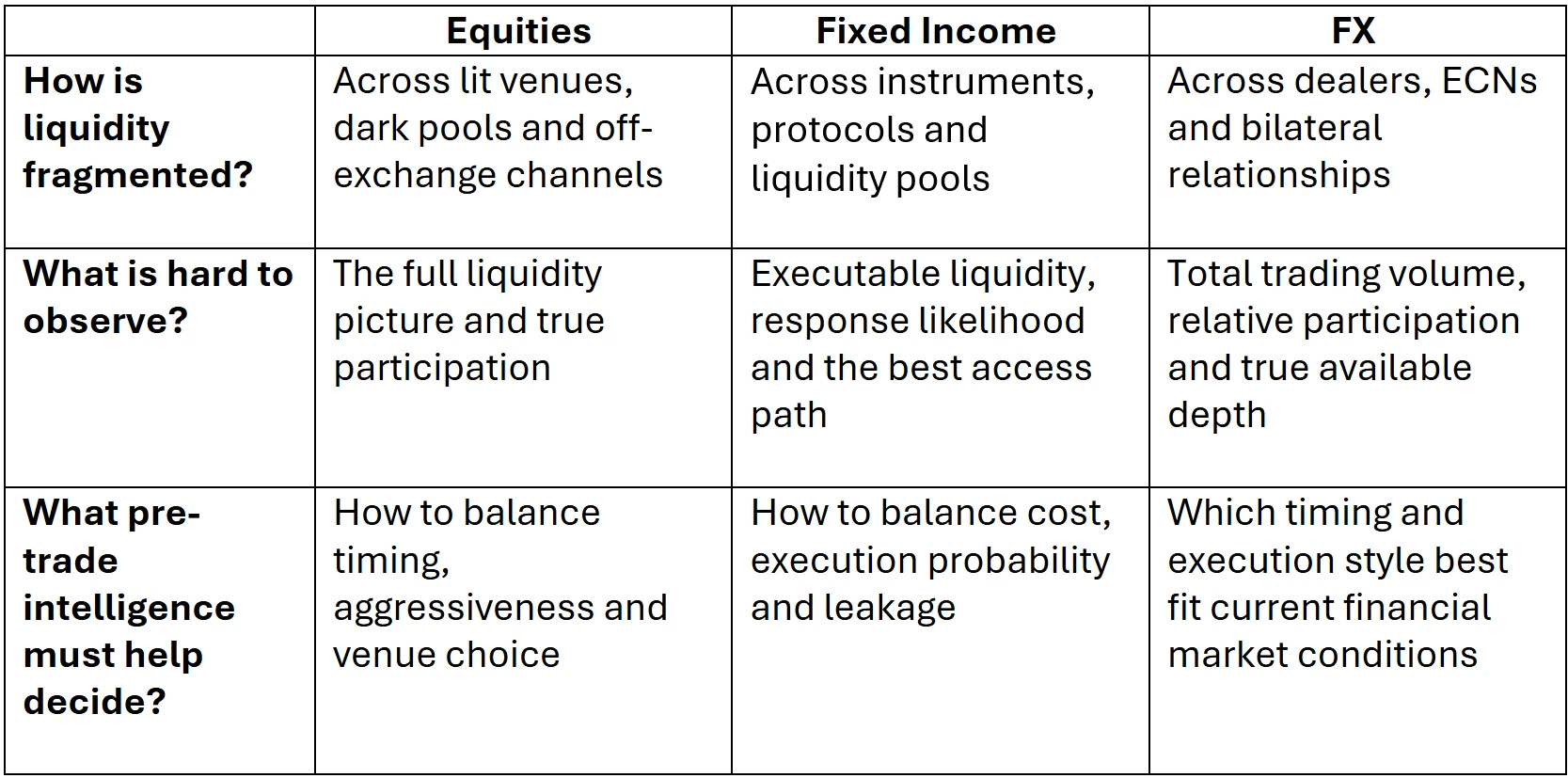
For all their differences, these financial markets present the same pre-trade challenge: assess relative liquidity, whether by observation or inference, and identify the execution path most likely to deliver the best result.
From static prediction to precision intelligence
TCA is moving beyond historical reporting and static prediction toward trading choice assistance: helping market participants make a multitude of micro-decisions when information is incomplete, delayed or conflicting.
In fixed income, for example, relying solely on executed trades overlooks a wealth of information embedded in participant attempted interactions – such as RFQs that receive quotes but do not result in trades, or those that receive no response at all. Similarly, in equities, off-exchange activity makes it harder to infer the full liquidity landscape from lit market data alone. In FX, fragmentation makes it difficult to even estimate total trading volume. Across all three asset classes, better pre-trade intelligence depends on helping traders act on incomplete information, not just analyzing the past.
Similar challenges, distinct market expressions
Equities, fixed income and FX are distinct asset classes, and pre-trade analytics should not pretend otherwise. Yet they increasingly pose similar questions:
- How large is the order relative to available liquidity?
- How much of that liquidity is directly visible?
- What can be inferred from financial market activity, conditions and historical patterns?
- How does the execution path change the likely outcome?
In some cases, the question is no longer what it will cost to trade a single instrument, but what the most effective liquidity pathway is for the desired exposure. What differs by asset class is not the discipline, but the observable signals.
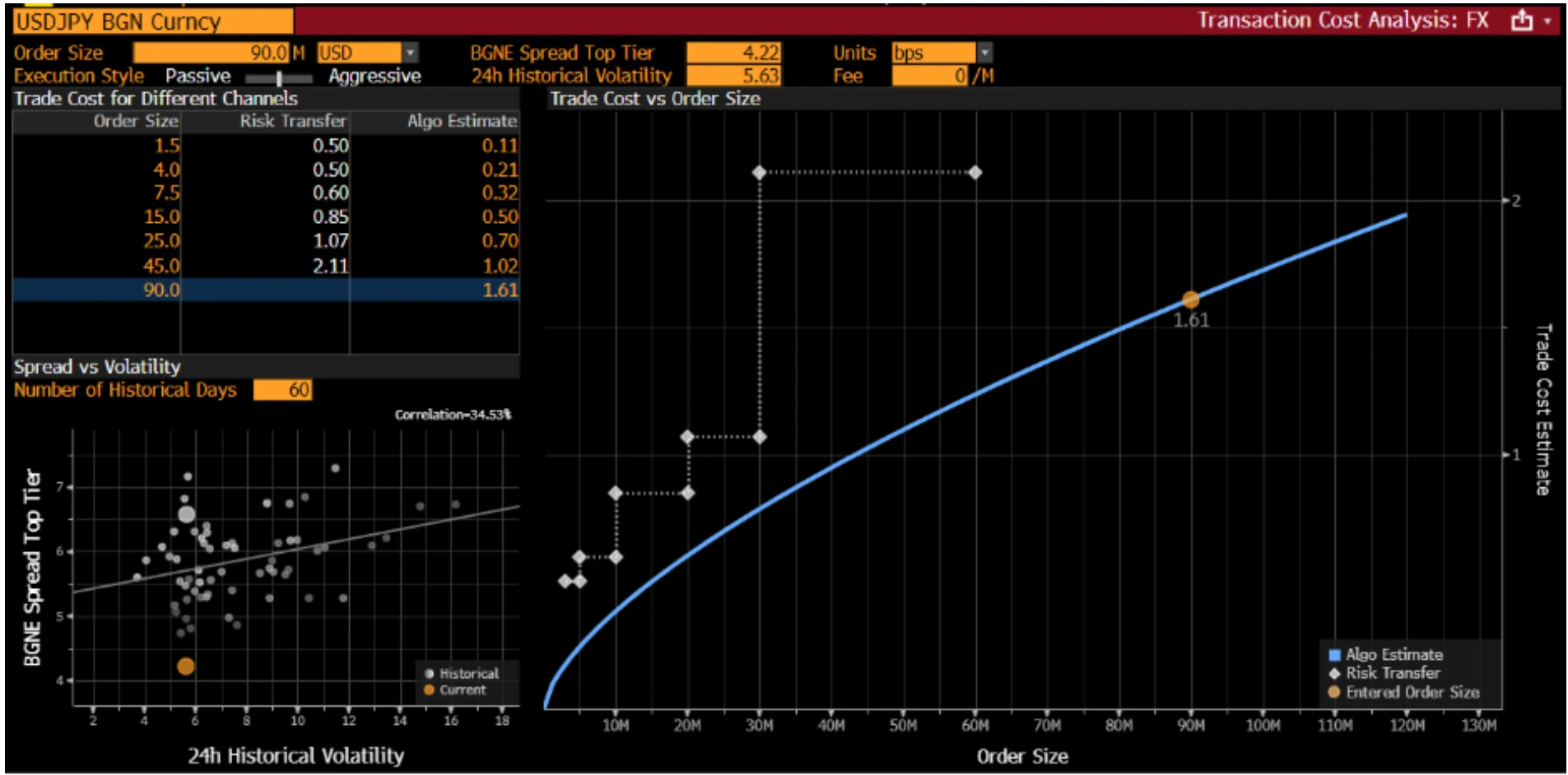
In FX, for instance, the execution cost of a large order is shaped largely by spread, volatility, order size and aggressiveness. Trading volume is also a key factor, but it is not immediately observable, making it necessary to model relative participation. Similarly, as more equity activity moves away from lit markets, estimating participation accurately becomes more difficult. In fixed income, fragmentation across protocols, regulatory regimes and market structure creates a different kind of visibility challenge.
Models that fail to account for these dynamics risk oversimplifying the problem. The value of a multi-asset approach lies in transferring insight across markets while respecting the differences that matter.
From cost estimation to trading choice
Across markets, traders are increasingly faced with a paradox: more data than ever before, but less clarity on how to use it. New tools should provide market context and real-time insight by helping traders compare:
- Execution strategies against one another
- Current market conditions against historical norms
- Individual instruments against peer groups or portfolios
Bloomberg’s suite of pre-trade analytics continues to evolve to address many of these challenges while integrating new solutions into existing workflows. These analytics are increasingly available outside the Bloomberg Terminal itself. Bloomberg’s TCA data is now available via REST API, allowing clients to embed real-time pre-trade analytics directly into OMS, EMS, compliance, automation and portfolio optimization workflows, bringing the same contextual decision support into the places where execution choices are actually made. Increasingly, TCA is taking on a broader meaning: not just transaction cost analysis, but Trading Choices Assistant.
This approach is already embedded in Bloomberg’s solutions across asset classes. In equities, pre-trade analytics extend to portfolios and ETF baskets, where accounting for correlation across constituents helps estimate the cost of trading the portfolio as a whole, not just the sum of its parts.
Figure 1: FX screen allows analysis of execution scenarios and spread-volatility regimes
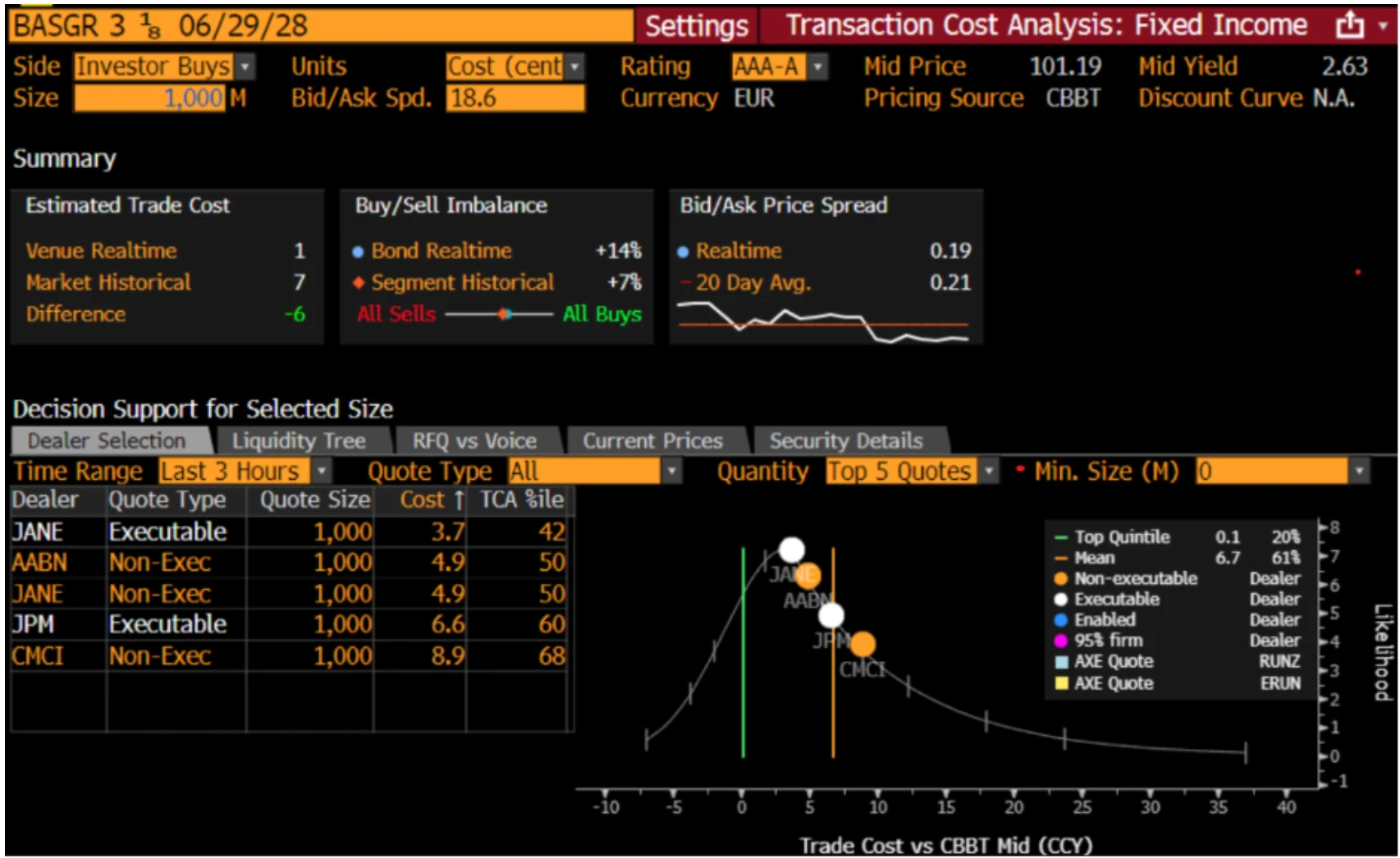
In fixed income, historical cost estimates are being complemented by financial market-aware models, voice-versus-electronic decision support and portfolio trading premium/discount analytics.
Figure 2: The Fixed Income TCA screen is reorganized into tiles, allowing trading decisions to be made at a glance
In equities, pre-trade analytics also extend to portfolios and ETF baskets, where accounting for correlation across constituents helps estimate the cost of trading the portfolio as a whole, not just the sum of its parts.
Looking ahead
The shift from prediction to precision can reflect a broader change in how trading decisions are made. As liquidity continues to evolve, pre-trade intelligence is becoming less about fixed answers and more about guiding choices—helping traders interpret incomplete signals and adapt to changing conditions. How this develops will likely depend on both market structure and how these insights are embedded into workflows.